Sunday, July 31, 2005

What Should We Be Teaching In HS Chemistry?

I doubt that there's a teacher for any subject that hasn't asked a question similar to the one addressed in the title to today's blog. They may not have been pondering chemistry but rather history, geography, math, etc., with specific regard to what it was that they should be focusing on to make for the best learning experience for their students, with the idea being to best prepare them for whatever future lies before them. This becomes a problem for many teachers, many of whom are convinced that what they know from their own past experience is what meets the need, though in the case of chemistry specifically there seems to be a disconnect between what high school instructors feel is important and what college instructors are looking for.

In chemistry there are two widely held perspectives regarding what the goal should be for a chemistry curriculum:

1. Preparing students for college chemistry.

2. Helping to mold a more scientifically aware and comfortable citizen.

Goal #2 is not divorced from goal #1, though when the curriculum focus is largely on prepping students for college chemistry (as opposed to just college) the emphasis that might otherwise be given to nurturing a more scientifically literate or aware citizen is very often subsumed, if not all together lost, in the quest for some ill-defined goal of college chemistry preparation. Deters (1) found that high school chemistry teachers were split about 50/50 on which of the two goals were most important.

Specifically it is found (1 - 4) that while the goal may be to create students who are best prepared for college chemistry, what this requires is not determined in concert with college instructors but otherwise based on the assumptions and beliefs of high school teachers, various levels of state education administrators, parents, and school committees/districts. Efforts have been made to identify and better understand this problem (3 - 4) in the past, and most recently by Kelly Deters (1 - 2). The following chart is an amalgam of information provided by Deters (1 & 2) based on the results of surveys of college instructors and high school teachers presented similar lists of topics. The college instructors represent 96 of 300 attendees at the Biennial Conference on Chemical Education in August 2002 at The University of Michigan (2). The instructors were asked to choose the top 5 topics from a list provided (shown in the table to the left.) The high school teachers represent 571 teachers located throughout the country who were in contact with Deters from her first article (1) and were asked what topics within chemistry that they were teaching.

InstructorEmphasisHighSchoolChemist.jpg

What's most striking is the divergence in topics considered to be important by both groups. A comparison of the two shows that there's clearly a disconnect between what college instructors desire and what high school teachers feel that they should be providing to their students. Deters shares with us: "These surveys showed that while the high school teachers focused on content and knowledge, the college professors tended to focus on personality traits, higher order thinking skills, study skills, and interest" (1).

Mitchell (3 - 4) approached the topic differently from Deters but came to many similar conclusions (it should be noted that Mitchell's survey population of college instructors was larger than Deters, about 280.) Mitchell found that college instructors were more concerned that high school students come into the college environment with good study habits, reading skills, basic math skills, and some measure of interest in and understanding of science: "Higher level instructors prefer that lower level instructors concentrate on teaching students how to study and think in general, leaving the development of a specific knowledge base about the subject to the "experts""(3). The following points come through in the references cited:

1. College instructors do not feel that high school chemistry should be a mini-version of a college chemistry course (3).

2. There's little value in emphasizing more intricate/difficult chemistry topics, i.e. content, inasmuch as students lose much (up to 70% within a year) of what they learn after leaving the course (1, 3). Deters (1) quotes Marvin Gold (5) on this subject: "My plea is that we (all of us, high school and college teachers alike) attempt to create a better balance between the teaching of content and the development of cognitive skills. The students who do not take college chemistry will forget almost all of the content. Those who take some college chemistry will begin to forget it unless it is applied to their own careers. Who needs to know a lot of content? Practicing chemists, that's who, and they will learn the content as they continue on in upper level courses and in the day to day practice of their profession."

3. The ability of students in high school (research indicates that one half or more students fall into this category) to successfully grapple with and grasp the more abstract aspects of chemistry is limited by their mental development at the age they normally encounter a course such as chemistry (1). While much of the basic material can be dealt with easily enough by the vast majority of students, the more abstruse topic areas can be problematic and result in frustration for the student concerned.

4. Teachers are trying to teach more than they're able to given the time constraints placed on them - Deters' results showed that 75% of teachers (a total of 571 found throughout the nation) participating in her survey are not able to cover all the topics they would like to in their courses. Given that a significant amount of what they are teaching is not considered by collegiate educators as important preparation for college level courses, the question arises as to whether teachers might find themselves more productively using their time focusing more on the basics, real-life applications of chemistry, and inquiry-based learning which in the long-term may well encourage students into science related fields professionally (1).

What we teach in high school is heavily influenced by what we've always done and an apparently mistaken belief, reflected in the content heavy curriculums of the science teachers surveyed, that heavily content laden courses are the best route for college prep of students. Deters (1) makes the following point:

"As many surveys of college professors indicate that content is less important than process skills, study skills, interest, and lack of fear in the subject, then high school teachers would better prepare their students by setting these as their goals and using content as the avenue through which to meet these goals."

Where the line should be drawn in content, how much emphasis should be placed on process skills, where inquiry-based teaching and learning should fit into the overall plan (Deters found that while most chemistry teachers believe this is an important tool in the teaching toolbox, about 45% of the teaching population is not using it (1)), how we should convince those in charge that, as Deters puts it, "... that less can be more ...", and how we can work to increase interest and reduce fear in chemistry in particular and science in general, all stand as some of the more pressing challenges for chemistry teachers today.

1. Deters, K. Accepted for and pending publication J. Chem. Educ. as of Aug 2005. What Are We Teaching in High School Chemistry?
2. Deters, K. J. Chem. Educ. 2003, 80,1153. What Should We Teach in High School hemistry?
3. Mitchell, T. J. Chem. Educ. 1989, 66, 563. What Do Instructors Expect from Beginning Chemistry Students? Part I
4. Mitchell, I. J. Chem. Educ. 1991, 68, 116. What Do Instructors Expect from Beginning Chemistry Students? Part II
5. Gold, M. J. Chem. Educ. 1988, 65, 781. Chemical Education: An Obsession with Content.
Note: Blogger is willing to send the articles (collectively about 1 megabyte) to anyone interested who sends an email request (not a request through the comment section of the blog) to science_teach(at)cox(dot)net.

Friday, July 29, 2005

What's in a Name?

BabyJamesII.bmp
This once was Jimmy, then Jim, and now he's James

This has been on my mind lately, the name thing. My name, as many others, runs naturally to a diminutive and, again like many others, a childish one at that (put "ie" or "y" after a given name and you have a child's name, which I've come to find happens in Farsi, the language of Iranians, too, so my guess is that this is likely a cultural rule of thumb of some sort.) In the days when I was a young boy growing up James was invariably turned into Jimmy. I don't recall having a problem with that, and inasmuch as my father was "Jim" it didn't seem out of place to me. Eventually I, too, became Jim, and somehow James was relegated to signatures and roll calls, but otherwise never spoken as a personal identifier. That said, my mother still calls me "Jimmy", a luxury conferred only upon her at this point in my life.

Believe it or not it took my getting out of the Navy to change that. I don't recall when, it was a few years before I actually got out, but I started to see myself more as a James than a Jim. I
can't say what specifically drove me to that, though part of it was a correspondence with a wonderful friend in Saudi Arabia who flat out said, "I can't begin to think of calling you Jim; you're James to me." That declaration got me thinking. Somayya, my Saudi friend, never explained why this was so, i.e. why to her I was a James vice a Jim, but there was no mistaking the fact that the more I thought about it the more I realized that I preferred James over Jim.
So James I became.

Transitioning out of the Navy made this a bit easier as it made for a huge change in many aspects of my life. People I was involved with professionally, who heretofore knew me as Jim, I no longer saw every day and with my traveling and their eventual transfer to other commands
(we military people are a decidedly nomadic lot) I found that I was interacting with fewer and fewer people who knew me as Jim, and new people were introduced to me as James. There are many in my past who know me as Jim and that's how they'll always know me, though my wife and our friends here all know me as James. It sort of creates a split social existence, but that's ok especially since I find that many friends and relatives who once called me Jim (I do not force the Jim to James thing with them, with my seeing it as not their problem given that this is how they knew me for many, many years) begin to call me James when they see that this is what my wife calls me.

You don't run into many James', though today it's more common than 20 or 30 years ago. I'm not sure why. Maybe it's too much a name of King's - the King James Bible. Or too otherwise pretentious in some odd British way; saying you were Sir Jim somehow doesn't have the same verve as Sir James. Whatever the reason it's not common to hear "James" and then from there not take it to Jim; my life is now studded with, "I'm sorry, but I go by James, not Jim." Jim, or better yet Jimmy, is perceived to be more common, more a "people's" name. It's not that I don't see myself as common, or a people, but rather that I more prefer James to Jim and according to my birth certificate I'm entitled to be called what I prefer.

What I find interesting are the number of people who automatically call you Jim. If you write to them and sign off your email/letter as James, they'll respond to you with "Dear Jim". You'll be introduced to someone as James, and immediately they'll respond to you with, "It's nice to meet you Jim." Now the latter I can more easily understand, people do what they naturally do and most take James and turn it into Jim. But when someone signs off their name as James you'd think that the person who's responding would take the hint, take notice of how someone identifies themselves in their sign off --- frequently no, they don't.

I suppose in one respect it's odd for me to decide that I wish to be called something other than what I've normally been called most of my life, especially when given the choice the average person will take James and turn it into Jim - so what if James is your name, the "rules" say we can call you something else. Well, yes, I suppose it's odd, but then it's sort of nice, it's not often you get to re-discover your name, and then find that you prefer it to the one you've been living by for the past 45 some years, and moreover make it the name you go by. I suppose it's never too late to find some part of yourself.

Thursday, July 28, 2005

What Kind of War is it When We All Don't Feel the Pain?

All Quiet on the Home Front, and Some Soldiers Are Asking Why by Thom Shanker ran on Sunday. From the article:

From bases in Iraq and across the United States to the Pentagon and the military's war colleges, officers and enlisted personnel quietly raise a question for political leaders: if America is truly on a war footing, why is so little sacrifice asked of the nation at large?

There is no serious talk of a draft to share the burden of fighting across the broad citizenry, and neither Republicans nor Democrats are pressing for a tax increase to force Americans to cover the $5 billion a month in costs from Iraq, Afghanistan and new counterterrorism missions.

There are not even concerted efforts like the savings-bond drives or gasoline rationing that helped to unite the country behind its fighting forces in wars past.

"Nobody in America is asked to sacrifice, except us," said one officer just back from a yearlong tour in Iraq, voicing a frustration now drawing the attention of academic specialists in military sociology.

You'd think that with a war on that's up to this point sucked up over $200 billion dollars at a point in our fiscal history when we've actually cut taxes (we're spending more at a rate we didn't anticipate and still can't anticipate, but cutting back on the taxes that we use to finance that spending --- I'll never figure this out), that something would be asked of us, to help us share the pain in this endeavor. But that's the point, there's no pain to be felt, there's not much being asked of you and me, and for those with family members who've been killed or maimed in the war they're small potatoes and they don't count, at least not to the extent that the rest of us come close to feeling whatever they've had to go through and they sure as heck don't make enough of a political constituency to make any sort of blip on a congressperson's or senator's radar screen.

I read or hear people talking about a possible draft --- it's not going to happen, I'd bet money on it. The reason for that is first the military doesn't want it (it takes far too much to train new recruits that you only get to keep for four years vice the minimum of four you get with volunteers), and lastly, and more importantly, it would indeed force ALL Americans to look at what they have to sacrifice in support of misguided endeavors such as the one we're in now. Frankly that's likely a good thing, but politicians like Bush aren't about to go there; he doesn't want you to feel any pain at all.

Bush's answer to this sense of disproportionate sacrifice is to build a volunteer corps, to wit:

In an interview, Douglas J. Feith, the under secretary of defense for policy, said that discussions had begun on a program to seek commitments from bankers, lawyers, doctors, engineers, electricians, plumbers and solid-waste disposal experts to deploy to conflict zones for months at a time on reconstruction assignments, to relieve pressure on the military.

When President Bush last addressed the issue of nationwide support for the war effort in a formal speech, he asked Americans to use the Fourth of July as a time to "find a way to thank the men and women defending our freedom by flying the flag, sending a letter to our troops in the field or helping the military family down the street."

In the speech, at Fort Bragg, N.C., on June 28, Mr. Bush mentioned a Defense Department Web site, Americasupportsyou.mil, where people can learn about private-sector efforts to bolster the morale of the troops. He also urged those considering a career in the military to enlist because "there is no higher calling than service in our armed forces."

Well, gee, let's just roll out the volunteer wagon and scoop us up some lawyers, electricians, and solid-waste disposal experts (correct me if I'm wrong, but aren't most of those guys in the mob, or have I been watching too many episodes of the Sopranos?), ship them over to Iraq where they, too, can get pissed off about working elbow to elbow with contractors doing the same thing but who are being paid megabucks, on our collective tax dollar, for being there. I'd guess that they're just beating all those volunteers with sticks there's so many of them.

We're building up an extraordinary debt due to this "war", a debt that will more likely than not be passed down to our children, and the men and women actually fighting the war or in other ways making significant sacrifices (a supply clerk, who may never "see action", in Iraq is still in a dangerous environment and if they're a reservist they're away from home and their job, not an insignificant sacrifice) are legitimately starting to ask why in the world are they the only ones expected to give up something, and mind you in their cases it's very possibly their lives we're talking about here, to support this war on terror?

On some level you have to give people like Bush credit when they manage to take on huge endeavors that they don't ask the average Jane or John to worry about, in particular with having to pay for it. As I said, Bush doesn't want you to feel pain, he doesn't want to inconvenience your day-to-day life, he'd rather you make your pain and inconvenience an inheritance, something you can pass along to the next generation. That's Bush gets away with this is nothing shy of amazing, but that we let him, in all the ways that he's managing to do it, says a lot about us that's not very good to consider and sure and heck will be hard to explain to our kids and grandkids.

Wednesday, July 27, 2005

The Carnival of Education

I was just reading Hedwig's Blog, who's a wonderful and very prolific writer, and she reminded me that I didn't give a plug to the The Carnival of Education - Week 24, where I managed to actually have something accepted. There's a new Carnival coming up this week, likely tomorrow. Good stuff, and worth checking into if you want to have some clue about what's going on in the world of education.

Whoooooa

I took a trip into school yesterday to get a feel for what awaits me in the classroom --- that didn't exactly make me happy, but hey, I keep telling myself that it can only go up from here. I have no clue what I have with regards to glassware, what of it I should keep since a lot of it has chemicals etched into the glass, things are put away in no particular order, and I have no sense of what this guy was up to, though he didn't lack for stuff to do it with, some of it over 40 years old.

But that's not what I'm here to report, no, it's another incident of road rage. That makes two in the last two months, the last time was in early June, and I'm beginning to wonder if I should be really concerned about living, or at least driving here in Rhode Island. The problem with this incident is that for the life of me I have zero clue as to what brought it on. I hadn't done anything as near as I could tell. Of course that doesn't exclude the possibility that I did something very reckless or potentially dangerous and wasn't mindful of it, but that's not my normal modus operandi and as a rule of thumb if I've done something dumb I'm pretty much aware of it.

I'm driving on route 1 north, heading home, and I hear someone beeping their horn as we all come to a stop light. I look to my right and there's a black pick up truck, driven by a redneck-looking guy who's very agitated and sticking his head out his window to yell somewhat apoplectically at me, "You better learn how to drive!" I'm a bit stunned, I have no clue what has
brought this on. I suppose my next response wasn't especially helpful as, noticing the light changing, I nod my head yes, and raise my right hand and flutter my fingers at him as if to say, "Toodles!", and then pull away. He wasn't going to have any of this, no siree, so the next thing I hear is a mild thud against the back of my car --- he threw his chicken salad sandwich at the
back of my car! I can see pieces of lettuce and streaks of mayo, and some particulate matter that I was later able to make out to be something akin to chicken, splayed across my back window.

Fortunately I had a good lead on him, at least three cars, because it was pretty clear that he was looking to get up behind me. At one point he went so far as to almost drive around the car behind me by passing it on the left hand side --- mind you, we were all in the left lane at that point so there wasn't any "road" to pass on. I made my way over to the right hand lane where I could wedge myself into other cars to avoid this Neanderthal, and as it turned out the traffic flow was such that he wasn't able to get over to where I was, instead finding himself passing me by, which I'd guess was what I had somehow stopped him from doing earlier without being aware of it.

As I watch this cretin turn off the road to get to wherever his presence was so urgently required, I'm sitting there thinking to myself "What in the world did I do that merited someone throwing their lunch at me? And "I'm" the bad driver? This butthead is dining and driving, throwing leftovers at whomever pisses him off, and making a general road nuisance of himself all in one fell swoop."

There's no accounting for someone like this, they just happen to you like the dog turd you step in when you're not watching. This time I kept my presence of mind, though the finger fluttering (I never showed a curse finger at anytime) likely didn't help --- he probably considered this my being disrespectful after he so kindly attempted to correct my driving skills. I was mindful of the ever ready cell phone, and made a point of taking his license plate down as he was forced to move ahead of me, so I was prepared to deal with this more sensibly and likely with a more satisfactory resolution than the first time should it have come down to that. But really, what in the world is it that causes people to act like this? It's ridiculous, you can't control your rage, you let yourself get angry over something that on the whole you should assume happened without the least bit deliberateness to you, i.e. the other person may have done something stupid but there's no reason to think it was done solely for your benefit and therefore there's zero reason to take it personally. Or maybe finger flutters are more derogatory and nasty than I ever thought --- I better learn to control those fingers. Let me tell you, mayonnaise cooked onto your back window in the summer sun is a pain in the butt to clean off.

Tuesday, July 26, 2005

Capitalism Ain't User-Friendly.

[graph]

Taken from http://oregonstate.edu/instruct/anth484/minwage.html:Multiplying the minimum wage by a work year of 50, 40-hour weeks gives the annual earnings that can be expected from a minimum wage job. The red line is the poverty level annual income for a family of four. Minimum wages have never been sufficient to raise a family out of poverty, if only one member of the family works [Blogger's note: the red and blue values have been adjusted for inflation to allow for a comparison of annual wages and the poverty level over a span of the years since the poverty level was introduced as a government income measure in 1959.]

Today's subject came to me as I was skimming through the Times a few days ago and saw the following article in the top 25 emailed articles list that the online version of the paper runs:
How Costco Became the Anti-Wal-Mart
; in fact it was running in the number 1 position as the most emailed article and continued to do so until sometime on Sunday - it's still in the top 10 as of this blog posting. This reminded me of a piece I listened to about a year ago on NPR, and I went looking for it and, lo and behold found it: NPR : Costco's Business Philosophy Questioned on Wall Street.

How an oxymoron like "Working Poor" can exist in the one superpower on the planet is a bit hard for me to understand, but I guess I'm just that kinda guy. What's the working poor, you may ask? People who are out there working, trying to stay off welfare and any sort of public subsistence, but find themselves in jobs that pay the U.S. minimum wage, which for those not
familiar with it is $5.15/hr (for a 40 hour week that's $206/week, $10,712/year, before taxes), can't make it on that wage (wow, really?). Of course this requires them to get an additional job, and if they have kids they now incur the cost of childcare, and ...well, you get the idea. To put a finer point on it, in 2003 if you made an income equal to or greater than $18,400 you were above the poverty level for a family of four --- of course you can't make that on a minimum wage income, and it also bears knowing that the common belief is that you would need a minimum income of about $35,000/year to adequately support a family of four.

There are many working poor in this country, especially without any healthcare. The healthcare issue is important - if the working poor get sick and they can't afford healthcare the fact is that it can't be refused to them, something has to be done for help them get well. Guess who gets to pay for that? Yep, you and I, the taxpayer. When Wal-Mart/Sam's [for those not in the know, Sam's owns Wal-Mart] makes it too expensive for their employees to buy into healthcare in reality the company's pushing the cost for that employee's ill-health, and their kid's ill-health, on us; it does make it easier for you to buy things more cheaply, though.

What amazes me is that it's not that by and large the working poor are willing to work hard, they just can't find a job that will pay them a decent wage and benefits for their efforts. Why is that? Well in this country we're more interested in pleasing Wall St. and corporate investors than we are in making sure people have a decent wage and coverage for things like health and dental care. But, alas, not all corporations seem to live by this rule of business. Here's how the introduction to the NPR report reads:

"The membership discount store Costco is doing incredibly well in terms of sales. Customers seem pleased with low prices and employees like the fact that they're paid more than the industry average. But some Wall Street observers say shareholders should be receiving more benefits from the company."

One Costco worker interviewed said that he'd been working at the drug chain CVS for ten years and left with an hourly wage of $7/hr after that time. After 7 years at Costco he was making $17. A starting cashier makes $10.50/hr, and after three years with promotions and bonuses could be making close to $45,000/yr. Moreover employees receive reasonable and affordable dental and medical coverage, with affordable family benefits; needless to say these are livable wages. If you read "Nickel and Dimed: On (Not) Getting By in America" by Barbara Ehrenreich, you learn how she had a terrible time trying to get by on what she was being paid at Wal-Mart and medical benefits for herself, much less for a family if she had one to worry about, were simply not affordable.

The NPR reporter talks to a couple of financial analysts about Costco and why Wall Street has a problem with it. One tells us that if you work or shop at Costco there's absolutely nothing not to love about the company. But if you were a shareholder there's a lot not to love in that the company doesn't wring the most it can out of salaries, benefits and health care costs, unlike
Wal-Mart/Sam's. The analyst goes onto say that the company's stock would be more attractive if the company wasn't so eager to please its employees and customers. A specific bone of contention was that the health care provisions for employees were far too generous, and the costs that were going to this could otherwise be diverted to investors. I sat there listening to this woman talk about healthcare benefits that were too expensive and thought to myself that her healthcare package likely well exceeds that of a Costco employee, but I'm sure in her mind she's entitled to this because she has an MBA.

A similar point is made in the Times article:

But not everyone is happy with Costco's business strategy. Some Wall Street analysts assert that Mr. Sinegal [Blogger's note: the company CEO] is overly generous not only to Costco's customers but to its workers as well.

Costco's average pay, for example, is $17 an hour, 42 percent higher than its fiercest rival, Sam's Club. And Costco's health plan makes those at many other retailers look Scroogish. One analyst, Bill Dreher of Deutsche Bank, complained last year that at Costco "it's better to be an employee or a customer than a shareholder."

Mr. Sinegal begs to differ. He rejects Wall Street's assumption that to succeed in discount retailing, companies must pay poorly and skimp on benefits, or must ratchet up prices to meet Wall Street's profit demands.

Good wages and benefits are why Costco has extremely low rates of turnover and theft by employees, he said. And Costco's customers, who are more affluent than other warehouse store shoppers, stay loyal because they like that low prices do not come at the workers' expense. "This is not altruistic," he said. "This is good business."

Is it good for business? Well the article tells us this:

IF shareholders mind Mr. Sinegal's philosophy, it is not obvious: Costco's stock price has risen more than 10 percent in the last 12 months, while Wal-Mart's has slipped 5 percent. Costco shares sell for almost 23 times expected earnings; at Wal-Mart the multiple is about 19. Mr. Dreher said Costco's share price was so high because so many people love the company. "It's a cult stock," he said.

So the stock is doing better than Wal-Mart/Sam's, the stockholders seem to love it, and this guy at Deutsche bank, who I'm sure is a bright person who's very capable and all that, poo poos all this by labeling Costco as a "cult stock". Wow. It's not that Costco uses a business model that
validates and rewards its human capital and that, therefore, is one that's worthy of emulation, uh uh, nope - according to this clever analyst you have to be a lover of scientology or a moonie before you can make a logical case for buying the stock and otherwise Costco's success has nothing to teach business in general.

The credo for Costco is "Take care of your customers and your employees and your success will take care of your investors." I like that thinking, and I didn't until now appreciate how radical that is. Wall St. doesn't care about customers, and it sure and heck doesn't give a rat's butt about employees; it wants the highest return on its investment that it can find, which means miserly wages and miniscule healthcare coverage, a la Sam's/Wal-Mart, and taking the customer as far in price as you can possibly get away with. What does Costco have to show for its credo? Going to this snippet from an article written by John Helyar and Ann Harrington that originally appeared in Fortune Magazine on November 24, 2003:

"Consider some figures. Sam's Club has 71% more U.S. stores than Costco (532 to 312), yet for the year ended Aug. 31, Costco had 5% more sales ($34.4 billion vs. an estimated $32.9 billion). The average Costco store generates nearly double the revenue of a Sam's Club ($112 million vs. $63 million). Costco is the U.S.'s biggest seller of fine wines ($600 million a year) and baster of poultry (55,000 rotisserie chickens a day). Last year it sold 45 million hot dogs at $1.50 each and 60,000 carats of diamonds at up to $100,000. Chef Julia Child buys meat at Costco. Yuppies seek the latest gadgets there. Even people who don't have to pinch pennies shop at Costco. "I like bargain securities," says Berkshire Hathaway vice chairman Charlie Munger, a Costco shopper, investor, and director. "Why shouldn't I like bargain golf balls?"

Costco is beating out Sam's/Wal-Mart, but at the same time making the analysts on Wall St. unhappy because the investor isn't getting as much out of the store as they possibly could. Well, that's a problem I suppose, inasmuch as the investor is a capitalist and is investing to make money, and, therefore, should be expecting to get the most back on their investment. The fact that there's millions of happy customers and some tens of thousands of happy employees seems all a bit besides the point. Yep, that's how the system works, and it hits me that somehow there's something fundamentally not right with this. I suppose making money is important, but at what point does this outweigh whatever social responsibility there may be for providing people jobs with decent wages and the sort of healthcare that someone living in a country like the U.S. should come to expect? I don't know, I'm not sure, but I do know this bothers me. I also know something else:

Costco now has all my business when it comes to this kind of shopping - I now need to go and buy some of its stock and become a cult member.

Monday, July 25, 2005

Things You Think About in an Ob/Gyn Clinic

First, the good news: I have the job definitively, contractually, and any other way one could have a job. Heck, I even have keys to the classroom at this point. That's good, but then figuring out what insurance plan I want, whether I want my paycheck in 21 installments or 26, and the list goes on, that's bending my brain a little bit. I'll get over it.

Thursday I got to go with my darling wife to her first obstetrician's appointment. Given that this was the first one I wasn't invited in and sat out in the waiting room; that was interesting. Being the first visit it was longer than a regular visit might otherwise be so I got to spend a lot of time in the waiting area. That is not a problem for me as I always come with some sort of reading material to keep myself occupied and this was no exception, having arrived with a magazine and something I printed out before I left the house. But this is a waiting room in a clinic where by and large the patients are women who are pregnant or often with child in tow. The pregnant women didn't give me much to think about; the kids, though, did.

One pregnant woman came in with her sister and her young daughter. The little girl was about 3 and adorable. She's clearly going to turn into a very lovely young woman. She wanted out of the stroller as soon as her mother parked herself in a seat. Given her freedom she began to wonder around the waiting area, while her aunt took up tracking duty, making sure the little girl didn't get into anything she shouldn't. The girl was clearly very accustomed to getting her way as her responsiveness to both her mother and her aunt wasn't what you'd call very prompt or attentive. She basically ignored what was said until she was pulled away from what she was told not to do, and at that point she'd make her displeasure known in anything but a cute way, in fact she was decidedly irritating to anyone who had to listen to her.

Now this was balanced by a family that had come in, which included mom, dad, and three children. Mom was called in for her appointment and dad took charge, but not in anything like an obvious way inasmuch as his kids seemed to be very well-behaved. He, too, had a daughter, though she was closer to about 8 years old. She will also be a pretty young woman, and a person with a good heart it seems. The younger girl came in and immediately wanted to play with a toy that was near the older girl, which her brother, closer to her age than the 3 year old, had been playing with. The older girl, unasked by anyone, picked up the game and brought it closer to the new arrival so she could play with it.

There was nothing about any of this that especially caught my attention. It's not really fair to compare an 8 year old to a 3 year old, they're both in two different worlds of development and self and "other" awareness. What tripped me over into thinking about what I would do were I the parent of the little girl was something that occurred just as the she was leaving with her mom. Another woman was sitting down a few seats away from me. The little girl was waiting to leave as her mother and aunt were in the process of getting their things together. I could hear the woman rustling some cellophane paper, apparently taking out a candy and unwrapping it to eat. The little girl made a bee line to the woman, having heard what I had and making the association with candy. Her mother saw this and immediately told her daughter, "No, come back here, we're leaving." The little girl didn't listen, and brazenly (for as much as a three year old can be legitimately brazen) stood in front of the candy un-wrapper, looking straight at her, while mom in the background is saying "No." The little girl stayed in place for a good 15 seconds or so and the woman, being like most of us, gave in, handing over whatever it was that she had unwrapped. The mother and the aunt both thanked the women profusely, with what I would imagine was some measure of embarrassment, and scooped up the little girl and headed out the door.

I remember thinking to myself: The mother is going to have a bad life with this kid. The child's behavior to begin with was not in keeping with an example of a well-disciplined child, but then often times something like that can be chalked up to crankiness of whatever. The candy incident though, that to me was telling. If it were my mother the second she said "No" that would have been it, and had I continued to stand there I'd have gotten a bottom slap for doing so, and if indeed the woman had made the effort to pass me a piece of candy it would have been returned immediately, regardless of any protestations from the candy-giver.

In my day, and in all honesty I think it's still an excellent rule of thumb, I was taught that no is no, you listen to what you're told and you do what you're told when you hear it, and you certainly never expect to get away with being selective about what you, and your mother, darn well know you heard. The lesson this mother taught to her daughter was that no doesn't always mean no, that you don't have to necessarily pay attention to your mother when she tells you something you don't want to hear, and if you're brazen enough you'll often get what you want. The last lesson isn't necessarily a bad one, but in combination with the first two it will make for a far more difficult older child and I don't want to even think what sort of teenager and adult can come out of this.

Now in all fairness I've not seen this mother and daughter interact but this one time. But then maybe that's as much as you need to see sometimes. If nothing else it sure and heck got me to thinking --- my guess is that I'll have plenty of opportunity for reflections on child rearing as I sit in the Ob-Gyn waiting room; who'd have thought? I'm feeling enlightened --- actually, between the new job, figuring out where the money's going to go, what needs to be bought, life insurance, saving for college, and on and on, I think I'm feeling something a bit more heavy than enlightenment. Hey, that Navy training will carry me through, but let me tell you, this is some crazy times and I'm paying attention to kids far more than I ever did before.

Friday, July 22, 2005

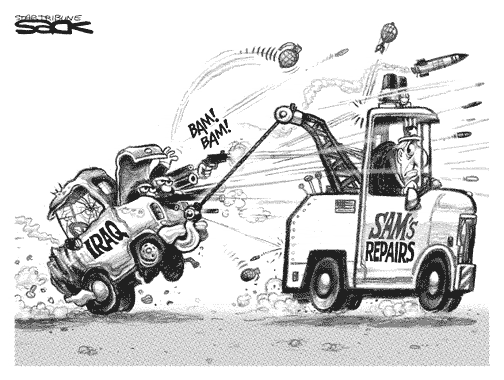
Iraq: What You're Likely to Get for Your Blood And Tax DollarsIraq.gif

Two very good articles out this week. The first by Seymour Hersh, Get Out the Vote: Did Washington Try to Manipulate Iraq's Election? Hersh takes us back to the much vaunted election back in January of this year and lays out how it would seem to appear that we managed to spill a lot of money into the election process specifically to sway an outcome that we wanted. Well, really, it would indeed be embarrassing to find that we didn't get what we wanted after all that effort, but what's really ironic is even after all that money was spent we still didn't get a result that was favorable to us --- a Kurdish prime minister elect was not in the cards. Hersh's main point is that we went in to bring freedom and democracy, but we really didn't want true democracy as that wouldn't work out in our favor, which is why we were trying to sway the vote. Hersh touches on the fact that more and more of Iraq is moving in the direction of Iran; now who would have thought THAT could occur? Well, I suppose any political science undergraduate with a smattering of Middle Eastern history under his/her belt would, but I digress ...

Then there's Peter W. Galbraith's article in the New York Review of Books, Iraq: Bush's Islamic Republic. Galbraith deals much more specifically with where things are going in Iraq vis-a-vis the Iranians. Basically it would seem it's all a matter of time before the Iranians have a new little brother to the west. Already the Iraqi government has apologized for the Iran-Iraq war, which, as Galbraith points out, on the whole may well be historically correct --- though the Iranians have the war years '82 through '88 to take the blame for --- but the Sunni minority were infuriated that an apology was made; the Iraqi government recently established a defense agreement with the Iranians; and there's recently been an agreement to run an Iraqi oil pipeline through Iranian territory into the Persian Gulf, something inconceivable during Sadaam's time. Lastly, but no less significantly, there's now talk about the new Iraqi constitution curbing women's rights and restricting certain freedoms (NY Times - Iraqi Constitution May Curb Women's Rights.)

In addition two Sunnis involved in writing the new Iraqi Constitution were recently gunned down (NY Times - 2 Sunnis at Work on Constitution Are Shot Dead in Car in Baghdad). The Sunnis were the more secular of the participants in Constitution building, with a greater inclination to sustain the secularism that dominanted Iraqi life during the time of Sadaam. The Shiites, on the opposite hand, are inclined to build a Constitution that is based on Sharia, or Islamic law, which would make Iraq's government very similar to Iran's.

So what's our blood and money, not to mention Iraqi blood and money, likely to buy when the final bill of goods is laid out for all to see? Here's what I prognosticate:

1. A country that at best will be divided three ways, with Shiites (about 55% of the population) in the south with 80% of the Iraqi oil reserves. The Shiites have no love for the U.S. - as far as they're concerned out invasion this time made up for the one we didn't do back during Gulf War I, and for which they were killed in large numbers when they believed that Bush I was going to support them when they rose up against Sadaam. Iran, though, has consistently been their friend and supported them when it was possible to do so; who do you think they'll be getting cozy with in the coming years?

The Kurds (about 20% of the population) will take over the north of Iraq, with 20% of the countries oil reserves going to them. Ultimately they will likely try to form their own country, but for the short term they'll be happy with semi-autonomy. They, too, have no great love for the U.S., for reasons similar to the Shiites, but they've been pissed on by so many in the world for so long they don't hold as much of a grudge as the Shiites do.The Sunnis (about 20% of the population) will continue to occupy the middle of the country, and continue fueling the insurgency against the U.S. and the Shiites. In the end it's not clear what they'll be left with, but their fortunes will likely be dramatically different from when they had it good under Sadaam.

2. Iran will be in a much stronger position in the world with a friend to its west that is largely populated by co-religionists who have some measure of gratitude in their hearts for the support the Iranians provided them. They, along with a good part of the Iraqis, will wait until the indigenous Iraqi government is strong enough to survive the insurgents, and a new node of power in the Middle East will arise as the Americans will be asked to leave.

3. If the Bush administration and the Pentagon strenuously take exception with the inclinations of the Iraqi government, or more aptly the majority of the Iraqi people, and Iran, we might well see another war in Iraq. This time, though, the insurgents we'd be fighting would not be solely Sunnis, but well-armed and trained Shiites, and quite possibly equally well-armed and even better trained Kurds as well. If you think we're having a hard time of it up to now, what's going on now would be a side show to what could potentially happen later.

The reason we're at this point? The hubris of the Bush administration, specifically with regard to a complete lack of understanding regarding what it was getting itself into and what it was going to need to do to extricate itself and actually leave something behind that was functional
and friendly to this country (note: I'm not in the least bit sure we could have gone in and left something functional and friendly to this country.) This is additionally exacerbated by a policy of deliberate belligerence to Iran --- indeed, Iran has its problems, as do we, and making nice nice after all these years would have taken some effort, but it's an effort that hasn't extended past our giving the Europeans a nod to use an invitation to the Iranians to join the WTO if they curtailed their nuclear efforts. This is unacceptable, and so shortsighted and fundamentally
idiotic it begs one to question what sort of ding-a-lings are running this show. Hold it, hold it,
maybe the same ones that went into Iraq thinking that they'd dump some democracy on the country and we'd all live happily ever after --- major "duh" epiphany here! To think that we'd take a major incursion next door to Iran, into a country where 60% of the people are co-religionists to the Iranians (you see, that's the other part of the problem here, in this country we don't seem to get the fact that religion drives things in this part of the world), and not expect the Iranians to actively working in their own interests, and then not try to make peace with Iran so maybe we could all meet somewhere in the middle, is totally mind blowing. But here's the hubris part in spades: We're more clever than the Iranians, we're more powerful, of course we'll have our way; who cares that the Iranians have been playing games in this part of the world for over 2,000 years.

The Iranians tried for 8 years to get to Sadaam --- we did it for them. The Iranians wanted an apology from Iraq (badly, I mean they REALLY wanted an apology, you'd be surprised to what degree Iranians and their seeing themselves wronged in the war with Iraq is such a factor in relations here) --- thanks to us and a newly elected Kurdish prime minister, they have one. The
Iranians wanted to feel safe along their border with Iraq --- when we're gone, and thanks to us, they will be. The Iranians want to spread the Islamic Revolution begun with Khomeini throughout the region --- thanks to us they now have their foot in the door in Iraq. The Iranians wanted unfettered access to their holy cities in Najaf and Karballa --- thanks to us they do. The Irony of it all is that they have G.W. Bush, the man who held them up as member number 2 in the axis of evil, to thank for all of this, as well as you and me, the American taxpayer, and our sons, daughters, husbands, and wives who are spilling their blood in the effort for "Iraqi Freedom and Democracy".

Thursday, July 21, 2005

LISTEN CAREFULLY

Listeningwoman.jpg

My sister rises from our bed hours before dawn.
I smell her first cigarette and fall back asleep
until she sits on the foot of the bed to pull
on her boots. I shouldn't look, but I do,
knowing she's still naked from the waist up.
She sees me looking and smiles, musses my hair,
whispers something secret into my ear, something
I can't tell anyone because it makes no sense.
Hours later I waken in an empty room
smelling of no yesterdays. The sunlight streams
across the foot of the bed, and for a moment
I actually think it's Saturday, and I'm free.
Let me be frank about this: my older sister
is not smart. I answer all her mail for her,
and on Sundays I even make dinner because
the one cookbook confuses her, although
it claims to be the way to a man's heart.
She wants to learn the way, she wants
a husband, she tells me, but at twenty-six she's
beginning to wonder. She makes good money
doing piece work, assembling the cups that cap
the four ends of a cross of a universal joint.
I've seen her at work, her face cut with slashes
of grease while with tweezers she positions
the tiny rods faster than you or I could ever,
her eyes fixed behind tiny goggles, her mind God
knows where, roaming over all the errors
she thinks make her life. She doesn't know why
her men aren't good to her. I've rubbed
hand cream into the bruises on her shoulders,
I've seen what they've done, I've even cried
along with her. By now I believe I know
exactly what you're thinking. Although I don't
get home until after one, we sleep
in the same bed every night, unless she's
not home. If you're thinking there's no way
we wouldn't be driven to each other, no way
we could resist, no way someone as wronged
as my beautiful sister could have a choice
about something so basic, then you're
the one who's wrong. You haven't heard a word.

Philip Levine

Wednesday, July 20, 2005

Ya Gotta Have a Plan, or a Good Back Up Story.

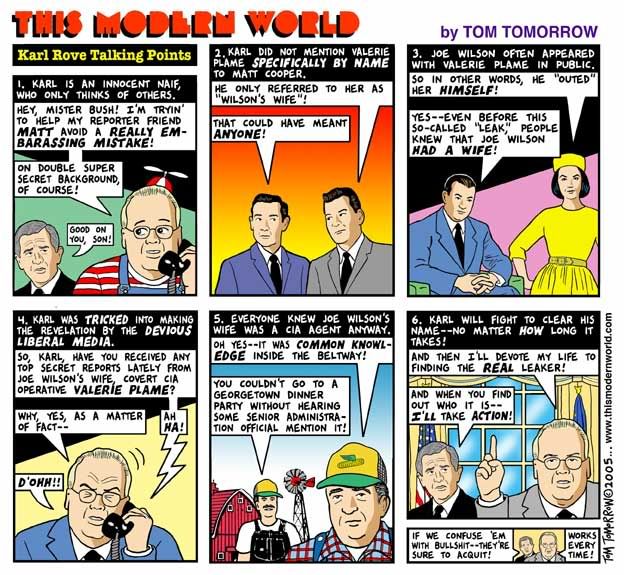
TomTomorrow-Rove.jpg

I myself think talking point #4 carries the day --- those tricky liberals from the media will get those innocent Republicans every time!

Tuesday, July 19, 2005

I'm Gonna Be a Daddy!

Baby.jpg

The very first picture of Chaneeca! I made up that name, if it's a boy he becomes Chaneeco; when he/she is born they'll get an appropriate Farsi first name.

I'm still a bit in awe about this ... way cool.

Which Way to Go --- III


Thank God, the pay and benefits got better by 1980.

We last left our blogger being told by his recruiter, as they walked out of the ASVAB test center, that he was eligible for the Navy's officer program and, moreover, someone would be waiting at the recruiting station to talk to him about this option. Our blogger, being ignorant of officer candidate school, was intrigued and excited as he headed back to the recruiting station, located at the junction of Fordham Road and the Grand Concourse, in a not-so-beautiful section of the Bronx.

I was genuinely surprised that I was a potential candidate for the Navy's officer program. It didn't take me long to figure out that given the two options in front of me, which were: 1. going into the Navy as an enlisted man, or 2. going in as an officer, that the latter would likely be far more challenging, interesting, and far more likely lead to something interesting after I completed my four year obligation. So I was primed for this officer thing, though not at all
familiar with what was going to be required of me. I was also somewhat surprised that the system kicked over the way it did, i.e. the recruiter I had been dealing with had a sure thing in taking me into the nuclear power program as an enlisted recruit so it didn't seem to me that he gained anything by pushing me up to the officer program. In fact he didn't gain anything, unless he officer recruiter in question slipped him something for his time and trouble (later, after having to go through being an officer recruiter for a year, I found that this was a common practice --- it was often the only way the enlisted recruiter got anything out pushing someone over to the officer side of the house.) There are two possibilities here:

1. The recruiter himself felt it was the right thing to do and called an officer recruiter with the particulars on me. That's not outside the realm of possibility as I later did see recruiters do that. That said, for some recruiters making their monthly goal was what concerned them, as far as the potential recruit was concerned Caveat Emptor.

2. Talking to the chief at "oh dark thirty" on the day of the ASVAB may have swayed the decision to get in touch with the officer recruiters. He did show surprise at my background and he may have told the recruiter to get in touch with the officer recruiters as this would likely happen at some point along the way anyway.

Whatever the reason, the fickle finger of fate had turned in my direction and at this point there was no reason to question why. We arrived at the recruiting station and sure enough, there are
two guys waiting to talk to me. Both of them were in dress whites, one of them an officer, a Lieutenant (LT), the other a relatively senior (a yeoman first class, or E-6 --- the military's enlisted system goes from E-1, the lowest rank, to E-9) enlisted man who was a number of years older than the LT. It was close to noon so the LT offers to buy me a hot dog for lunch and recommends we go for a walk to discuss my options.

LT basically worked on selling me on the idea that the officer program was the better option for me to take. At this point selling me on the officer program didn't take much selling; I had made my mind up about a minute after I realized that these guys wanted me. Next I'm told that I should come down to the officer recruiting office at 26 Federal Plaza in Manhattan to take the officer test, which wasn't a problem as far as I was concerned given how many tests I had taken to this point. So I scheduled to go down the next day.

Taking the test the next morning wasn't at "oh dark thirty", thankfully. I found myself working through two tests, a generalized officer qualification test and one for pilots that basically tested spatial abilities. They took a total of about an hour and a half to do, and the results were determined within ten minutes of my completing them. I was good to go as far as the testing was concerned, to include being eligible for the aviation programs though I was later to find out, and it came as no surprise, that my vision had to be corrected to 20/20 which therefore meant that I couldn't be a pilot.

With having tested myself in the LT's attitude toward me became very serious, and the first thing he wants to push is my going into the officer nuclear power program. This I was very leery about doing. Admiral Rickover still ran the program and I knew enough to know that all nuclear candidates culminated their entrance process with an interview with Rickover, a man who didn't exactly have a positive reputation when it came to conducting interviews. I figured I could survive that, but I wasn't sure if I could sufficiently bone up on my physics and math prior to the other interviews and testing that happened before getting to Rickover. My problem with this was that I was never a natural when it came to physics and math, and the idea of having to bone up on both, when I was in this process vice at graduate school because I was fed up with studying, didn't hold very many positive possibilities in my mind. The LT recommended I take a two-day trip to Groton where potential candidates see the sub base there, go through the facilities, meet some nuclear-trained officers, basically get a two-day dog and pony show to try and induce them into joining the program.

The trip to Groton was interesting inasmuch as this was the first time I had ever been on a naval base, much less one dedicated to submarines. Groton at this point was pretty much the east coast's center for nuclear attack submarines. Such submarines were to be found in Norfolk and Portsmouth, NH, but nowhere near in the numbers found at Groton. I can't remember too terribly much about the visit to the base, though I do remember going through the damage control trainer used to teach submariners to deal with various types of casualties that they might see at sea. There are basically three issues of note when it comes to catastrophes at sea: explosions, fire, and flooding. This trainer taught sailors how to patch pipes that were ruptured in some way, either at the flange or due to a hole of some sort unexpectedly developing in the pipe. The experience is memorable because you're soaking wet from head to toe when it's all done, and you have some idea of how terrifying dealing with something like this must be when you're hundreds of feet below the ocean.

The Groton trip was interesting, and on some level fun, but I walked away from it telling myself that I'd never cut the things I needed to do to get into the program, especially the extra time the whole process would eat up; I wanted to get started, and the thought of having to work through extra studying to get going didn't appeal to me. So I opted for the general unrestricted line program, which in my case meant I'd be going in as a surface line officer, those daunting and glamorous few who work on surface ships - ok, a bit of hyperbole, the thing for me at this point was a four year job and an opportunity to see things I hadn't seen before; I'd get all that and more in my time ahead.

For a number of years after I made my decision I often asked myself if I had shortchanged myself on this, should I have pushed myself into the nuclear power program? There's a definite mystique and even glamour for me when it comes to submarines and the idea of harnessing nuclear power to move around the world. But I'm pretty sure I didn't have the right mindset to go into this --- I was definitely a school burn out by the time I left college and I barely had the patience to make it through the schooling at OCS, I can't imagine how I would have chaffed and likely under-performed in the nuclear power training pipeline which is, without a doubt, quite rigorous. On the whole I look at it now consider it just one of those things you look back and chalk up to one of life's roads not traveled; there are only so many choices you can make, and all you can do is make the best of those you do make.

Monday, July 18, 2005

All The News That's Fit To Print

I remember when I first encountered the acronym MSM - for those not familiar, "Main Stream Media". I was perusing blogs, having stared from the right of the political spectrum for some odd reason. I've since stopped deliberately going to right wing blogs, in particular the military blogs, as I often found myself taking exception with some point or another, commenting on it, and finding myself getting absolutely nowhere in the bargain. This certainly shouldn't have been a surprise to me, but I suppose some lessons in life have to be re-learned a few times before they sink in.

The big complaint from the righties had to do with how the MSM has nothing better to do than bad mouth the war, the current administration, and the man leading it all. I suppose at the time the silliness of this didn't quite sink in, I just shrugged it off in an unthinking sort of way, but I have recently found myself drawn back to this issue after finishing Michael Massing's Now They Tell Us: The American Press and Iraq:

Massing wrote a few pieces for the NY Review of Books which have been compiled into this book, with an excellent preface by Orville Schell tacked on. Massing makes the point that the MSM, by and large, supported the Bush administration and all parties concerned as they brought this country into the war in Iraq. The exemplar of liberal east coast MSM, the one most excoriated by the right wing, the NY Times, was pretty much running at the head of the pack when it came to buying the administration's line on Iraq, etc., and ignoring naysayers who weren't comfortable with the spin they were expected to kowtow to coming out of Bush and his minions. On the whole the MSM wasn't asking the hard questions, and fundamentally wasn't being nearly as skeptical as one would expect based on its ostensible function in our society.

Massing offers the following explanation to explain why the American press came off so lamely:

"And why, he might have added, didn't the Post and the other papers devote more time to pursuing the claims about the administration's manipulation of intelligence? Part of the explanation, no doubt, rests with the Bush administration's skill at controlling the flow of news. "Their management of information is far greater than that of any administration I've seen," Knight Ridder's John Walcott observed [Blogger's note: Massingly cites Knight Ridder for actually getting the coverage reasonably on the mark, but there are no Knight Ridder papers in New York or Washington, DC, thereby limiting whatever exposure this different take on things would or should have gotten.] "They've made it extremely difficult to do this kind of [investigative] work." That management could take both positive forms --- rewarding sympathetic reporters with leads, background interviews, and seats on official flights --- and negative ones --- freezing out reporters who didn't play along. In a city where access is all, few wanted to risk losing it.

"Such sanctions were reinforced by the national political climate. With a popular president promoting war, Democrats in Congress were reluctant to criticize him. This deprived reporters of opposition voices to quote, and of hearings to cover. Many readers, meanwhile, were intolerant of articles critical of the President
[Blogger's note: I think I visited some of their blogs.] Whenever The Washington Post ran such pieces, reporter Dana Priest recalls, "We got tons of hate mail and threats, calling our patriotism into question." Fox News, Rush Limbaugh, and The Weekly Standard, among others, all stood ready to pounce on journalists who strayed, branding them liberals or traitors - labels that could permanently damage a career. Gradually journalists began to muzzle themselves."

So the Fourth Estate was running scared at losing its access to information, in spite of the fact that the information it was relying on was tainted by faith-based reality, and there was a reluctance to be labeled a traitor by virtue of doing one's job. Of course you have to ask how close to the truth Massing has it, but then what we can pretty clearly see is that news coverage going into the war was pretty squarely behind the administration and the sort of hard questions that should have been asked weren't. Why that was I don't know, but it's pretty clear what did or didn't happen.

Now there's Judith Miller. She's the reporter that went to jail for not revealing her source regarding the CIA agent exposed by someone, apparently, within the Bush administration. Of course Miller, a veteran reporter for the NY Times, never wrote a story about Valerie Plame, the CIA agent in question, unlike Robert Novak who did and who talked to the source in person but for some reason isn't sitting in a prison cell. It does seem that Miller's something of a victim of an overly zealous Department of Justice prosecutor with too much time and money on his hands. That said, there's also the issue of to what degree any reporter in this situation is entitled to protection. I am one of those who's not sure that Miller was entitled to blow off a subpoena to testify before a grand jury when what she's protecting is someone within the administration using the press to forward a personal agenda. Now were the issue one of protecting a bonafide whistle blower I'd be a bit more conflicted by this, and would indeed be behind Miller. This is just to set the stage, my following point with regard to Miller and the Times is not to do with the freedom of the press.

While Miller may well be the victim of an overreaching prosecutor, there's one thing you can be sure and that's that this is NOT the administration's way of going after Miller for negative reporting, not at all. Massing makes the case that if anyone was a cheerleader for the Bush effort, if anyone was uncritically sucking up the information tripe spewing out of the government and questionable Iraqi defectors, and presenting to the readers of the Times poorly evaluated source information, it was Miller. So you can be sure that Judith Miller is not sitting in a prison cell because she torqued off someone, or a group of someones, within the administration as she was far more their friend than anything else when it came to selling this lovely war we now find ourselves mucking our way through. But there's irony here, no doubt, and maybe some twinge of poetic justice to boot - though, alas, there are many more people involved in the Iraq war fiasco who are FAR more deserving of poetic justice.

Massing's point is that the American MSM, in spite of what the right would have us believe, allowed itself to be cowed into being uncritical about the administration and what brought us to the war, and to this day sustains a myopia on how the war's being executed and the effects it's having on the people in the region. There are some, the Economist is one, that make the argument that many in the MSM, not the least being the NY Times, that are presently circling the White House with the scent of blood in their nostrils regarding Carl Rove or whomever it was that specifically blew the identity of Valerie Plame, are so zealous in their pursuit of this matter due to a desire to get even for their treatment by the administration leading up into the Iraq war; likely nothing is that simple, but then basic truths sometimes are wrapped in odd paper.

In this country the idea of the fourth estate was to provide an independent source for the illumination of the truth, as a tool to help ensure that politicians and government officials wouldn't lie, steal, or cheat and if they managed to do these things that eventually they'd be exposed doing so. But these days it seems that the MSM is only good in this role when the
situation it reports on is egregious, i.e. it's so obvious a thing that a first year journalism student would have a hard time getting the story wrong. This administration and how it works has brought us to this point, though the MSM enabled the process by virtue of it not having adequately done its job, and we all should be concerned about this. We may not always like the press, in fact many times we may deservedly despise it, but when it's so easily manipulated
ultimately we the people are the ones that are set up to be manipulated, and led into things that a more comprehensive and honest appraisal may well have caused us not to indulge or allow.

Friday, July 15, 2005

Quest For a Teaching Job

A Teacher and his Pupil by Claude Lefebvre

I'm still amazed at this process of getting the job that "unofficially" I now have. Well, let me try to explain this as finding a teaching job in the public school arena is unlike anything I've experienced anywhere else before. So what follows is my experience with getting a teaching job in the Rhode Island area, though my guess is that what I write about here is not unlike what you'd find in many other school districts throughout the country.

First you have to go through the process of applying for the job. I actually got quite good at this as I was able to process an application in about 30 to 60 mins so long as I wasn't being asked for odd things (more to follow) --- mostly everyone wanted the same documents, and you soon find yourself putting together files with those things in them to quickly extract items when required. From there it's a simple matter of fine tuning your cover letter which with Word shouldn't take more than 15 mins. I'd quickly scan the resume to be sure it's copasetic, and bingo, stuff it all into a large mailer and truck it down to the P.O. the next day (actually in a few cases that same day.) The first one was the hardest to get together, after that it was a piece of cake.

I would have thought that the application process would be pretty much standard from district to district in the state --- wrong, hardly is that the case at all. In fact there's so much that isn't standard it stretches the mind. I'm inclined to believe that were there more standardization that some significant money could be saved, but instead the application process is simply a maze for prospective teachers to make their way through as one deals with the nuanced, and some not so nuanced, differences/requirements laid out by the various school districts. I already howled a bit about the application process in Providence way back in May. To get your application into the Providence school system so as to have them deign to look at it, you'll spend anywhere from $50 to $100 depending on whether you've paid for state and national background checks before (and they're within the time frame Providence is asking for), had a TB test, a test for hepatitis, and then the usual stuff with "official" transcripts (most school districts will take copies, figuring that if they need "official" anything you'll be able to produce them readily enough), references, etc. I'm not sure why Providence is so concerned about TB and hepatitis carriers BEFORE they offer a job (maybe to protect the interview committee? I hadn't thought of that --- how progressive!), but you're out big bucks just to get your application in the door.

Every school I was interviewed at started off wanting my copies, vice "official" copies, of what I had, no one asked for any medical information (note: to do student teaching you have to have had a TB test, and in all honesty I have no clue yet what will be expected of me before I start actually working), and some had an official application to fill in (usually about four pages in length) or simply wanted a letter of introduction from me to accompany the packet I sent in. Needless to say I didn't bother to apply to the Providence school district as my reaction to their ridiculous requirements was, "If they're making it that hard just for me to get my application in the door, how hard will they make my life in general as a teacher? No, I don't need this, not when I can apply for a job next to free in most other places in the state." Yes, Providence pays you more to work there, though that is actually more a gauge of how much more aggravation you can expect to incur for the privilege than it is their doing you the honor of recognizing and rewarding you for the difficulties inherent with your profession. Mind you, I could afford to be selective, I'm teaching chemistry and I've found that I'm a limited commodity, thank God.

Once past the application submission you're hopefully at some point called in for an interview, which will be with some form of school committee. At this point I've gone through six of these so I've some experience to pull from that I can report on. The "committee" composition is anyone's guess, though it's to be expected that at a minimum you'll be talking to the department head for the subject you'll be teaching. One exception to that in my case, in fact my very first interview for a job which easily turned into the most unusual one, was at a charter school where the only person I talked to was the "co-principal". Let me linger on this experience a bit.

There were many interesting things about the charter school, being interviewed by a co-principal merely started the ball rolling. Prior to this I had some volunteer experience at a charter school in Providence. That school was run much like any other school I had visited during my training as a teacher, though there certainly seemed to be more discipline and follow-up directed at the students, in addition to the fact that all the students had to wear uniforms. This school was in an underprivileged part of the city and many of the kids there had failed in more traditional learning venues. As it turns out the school I was interviewing at and the one where I volunteered were serving very similar clienteles. On the whole, though, there was nothing about the school that I volunteered at that made me think I was off in another universe, in fact it seemed very much like the Catholic school I went to when I was a boy.

I assumed that being interviewed at a charter school would open me up for an interesting adventure in education; I wasn't to be disappointed. What took my breath away was being informed that there are times when teachers may find themselves taking students to doctor appointments because otherwise the students would have no other way of getting to them. Oh, I forgot, sometimes teachers will use their own cars to chauffeur the students to those appointments. Let me tell you, if there's one thing I've been consistently warned of it's keeping a professional distance between yourself and your students, never (except in emergency situations and then do so with extreme caution) introducing them into your "personal space" (i.e. your car, home, or anything else that would be deemed "personal"), and surely you don't ever put yourself in the situation of acting as their surrogate parent, to wit: going with them to a doctor's appointment. The co-principal noted the look of surprise on my face and proceeded to give a very reasoned and logical reason for why this sort of thing is necessary, while avoiding addressing the potentially substantial risks doing this could put on the teacher --- the possibilities are mind bending, but let's just take something relatively easy, like explaining to your insurance company how you got into a fender bender where the student was hurt while shuttling him/her in your car to the doctor. I was told that it wasn't a mandatory thing, but somehow it seemed to me that if you're working at a place where the head of the school thinks this is fine, and apparently had done this themselves, not doing it would likely not sit well with your colleagues who thought this was just part of the learning experience and service for all concerned.

If impromptu chauffeuring responsibilities hadn't done in any desire I had for the privilege of teaching in a non-union charter school, then being shown the fenced-in and abandoned oil storage tanks located behind the school was the coup de grace. The tanks had something of a lurid history as this was recently where a rather significant mercury spill had occurred, with the story making it into the local paper in a big way. The clean up was no small thing and apparently cost the local taxpayers a pretty penny. That by itself didn't necessarily attract my dismay, rather being informed by the co-principal that the area surrounding the tanks involved a recent school community project involving students scampering over the property to determine what sort of hazard the tanks presented to the river located below it - THIS got my attention. Now I think community projects are great, honestly I do, but I always thought that they should be the kind that don't potentially endanger students AND for which the students and the teacher-in-charge have some measure of expertise. But this is charter school land, what the heck do I know?

Ok, the charter school interview was a unique experience, the other interviews were pretty much straight forward and similar. Everywhere else I found myself interviewed by the head of the department, usually one other teacher from the department, and the vice principal, though once a principal sat in (this was at an interview where there was a physics and history teacher, the head of the department, the school librarian, AND the principal), and in the other case I was interviewed by the head of the department and the school's guidance counselor --- this latter interview, primarily because I was interviewed by the guidance counselor, put me a bit off as I sat there wondering what guidance counselors know about chemistry and why should this be a committee of just two, the smallest I'd experienced at that point other than at the charter school.

One thing that I hadn't expected, in fact no one ever warned me about this one, came from the interview with the principal, et al. We were done with the interview and as near as I could tell things had gone well - the verdict is still out on this interview as far as the job is concerned inasmuch as I haven't heard back from them yet, but it's only been a week. Anyway, all's done, I'm getting ready to head home and the principal says, "Oh, there's one more thing I need, a writing sample." A writing sample? That was interesting. She took me to a room with a computer in it, brought up Word, and handed me a piece of paper with a part of the school's mission statement on it. She wanted me to write something about that detailed how I would work to make what was written on the paper a part of the learning experience for the students in my classes.

Questions from the school committee don't tend to be surprising, at least they shouldn't be. I was hit with mostly situational questions, like: What would you do if you were near two students starting to get into a fight with each other? How would you deal with different learning styles in the classroom? What sort of metrics do you use to evaluate your students? How would you deal with parents? General questions: What makes you the best candidate for this job? What from your life experiences can you bring to this job? What sort of extracurricular activities are you interested in being involved in? What do you think of teacher participation in dances and field trips? It was actually an interesting experience as I learned to go slow (not too slow, just slow enough to gather my thoughts) in answering questions lobbed at me, remembering to look at the person who asked the question as much as possible and otherwise periodically scanning everyone else as I answered, and always working to hook whatever I was answering to some "larger" educational concept/issue --- throw into the response something about standards, metrics, No Child Left Behind, differentiated learning/instruction, inquiry-based learning, or technology in the classroom and invariably you got a positive nod and slight smile; enough nods you pretty soon had a good idea how well the interview was going. I should also state that at no time, with any of the schools, was I ever asked a question that I thought was inappropriate or otherwise out of line.

In spite of being warned (the "warnings" I allude to here and below were all ones I had heard while in the certification program I was in --- we heard this from teachers and guest lecturers, like superintendents, who came in to talk to us) that I should have my teacher portfolio with me during my interviews; no one asked for it or even so much as mentioned it at the school committee level. For those not in the know, you compile a portfolio of the things you did during your teacher certification process. These "things" meet specific new teacher standards laid out by the Rhode Island Department of Education (RIDE), and after two years (I'd assume this is about the average time for certification in this state) you can imagine how much "stuff" accumulates in your portfolio --- in my case it filled two three-ring binders. I got smart, thankfully my lovely wife had bought me a multi-function printer which included a scanner, so ALL of my portfolio "stuff" is on a CD, taking up some 300 plus Mb of disk space.

If you're approved by the school committee you're about 90% of the way in the door; it's not a sure thing yet. You don't find out that day if they want you, it will likely be a week or more before you do and in some cases you may find yourself being asked to come work for the school after someone else declined or was otherwise unsuitable for the job. Unsuitable turns out to be anything from problems with a background check or something amiss in the credentials of the prospective teacher. A flat out decline is more likely to be the case as no prospective teacher in the job search process is being interviewed by just one school, and if the teacher has their act together they're not apt to put themselves up for a job where they're going to have a problem with credentials.

Next is your interview with the school principal. Here my experience is reduced to one as I've only allowed this process to go this far with just one school (so long as you don't count the interview with the "co-principal" and where the principal sat in to with the school committee.) Mind you, I didn't stop interviewing as I thought this was the smart thing to do if for any reason the job I was "offered" indeed didn't pan out, or otherwise something outstanding happened to come my way before I signed a contract (though it's anyone's guess what I would do if something great came my way after signing a contract --- frankly I hope not to have to deal with this dilemma and the truth is I pretty much feel that I have a pretty good deal in front of me right now.) I indeed was offered another job after I was offered the one where I now expect/hope to work. It turned out that the school that offered me the second job moved a lot faster (basically in 2 days) than I'd ever seen any school move before, so this took me by surprise and I had to turn them down.

For the interview with the principal here, too, I was warned to bring my portfolio. Again the trusty CD was with me; once again, a wasted effort. Oh well ... that's fine, the portfolio is not that exciting to look at and frankly far too much of it in my mind is hardly germane to anything a school would be interested in seeing (by the by, do you think that may be the reason why no one asks for it? God, maybe there is some common sense lingering in this world somewhere? One can but hope ...) At this point it's a general chitchat with the principal, though in my case I also happened to have the new vice-principal on hand. He was new to the school, but as it turned out not new to me --- he was the vice principal at the high school I student taught at the previous semester and we got along well enough (actually I don't think we ever said ten words to each other, but all he knew was that I wasn't sending bus loads of students to his door to deal with for one reason or another and in his book that must have meant we got along --- if I have no complaints, and I don't, and he didn't, we got along as far as I'm concerned.) Bottom line, I suspect that this is more for the principal to know your face than anything else as we didn't get into anywhere near the depth I found myself wallowing through with the school committee interview. Frankly in my view this is how it should be, i.e. the principal should be able to trust his teachers, who'll have to work with this new person, to pick what they feel is the best candidate and as far as he/she is concerned his part of the interview process should be, "Ok, let me make sure I know what this person looks like" sort of meeting. In this case when he nodded his head yes after about ten minutes he informed me that the next step is to be interviewed by the school superintendent, and from there I'm voted on by the school district committee.

So next is the superintendent meeting, and once again I've been warned that I should bring the portfolio with me. Piece of cake, but I can't help but wonder about all those poor souls who don't have scanners, which were it not for the generosity (it's really a nice gizmo all in all) of a wonderful wife included yours truly until last Christmas, and who're out there lugging two large three ring binders with them in the July heat, unless of course they're asking in advance, "Do you want to see this?" As for the interview, I showed up 15 minutes early, the superintendent was just finishing up a meeting which included my soon-to-be principal and some others, and 5 mins later we're in his office. By 10:30, the scheduled time for the interview, I was in my car and on the way home with the words, "The school district will be voting on this next Wednesday, I don't see a problem, this is a good time for you to be at this school, welcome on board" ringing in my ears. Bottom line, I'll know by Thursday morning whether I'll have a job as, thankfully, my presence at the school committee meeting is not required.

So as I now see it this is a five step process:

1. Get an application and whatever associated extra documents are desired in.
2. Have the application, et al., favorably viewed.
3. Be interviewed by the school committee and successfully make it through that. An up check here and you're 90% of the way in.
4. Be positively interviewed by the principal. An up check here and you're 98 to 99% of the way in.
5. Be voted on by the district school committee. Once that happens it's all a matter of when you sign the contract.

How schools handle references and the miscellaneous paperwork associated with the application differs from school to school - you're surprised, right? To my knowledge only two schools called on references where I would have expected at least four of them to. The same goes for the "official" paperwork and the security checks. I'm assuming that this will even out right before I officially sign the paperwork, i.e. I'll have to produce pretty much what everyone expects at that point, but as of right now I don't know that. Regardless of how the schools handle it one needs to have these things handy, or ready to get them in short order (I didn't bother to order an official copy of my master's degree transcripts until I was offered a job, for example.) One's previous background may have something to do with what's expected as well, and in my case being a retired naval officer very likely doesn't hurt me and may provide me more latitude than would be rendered to the average person walking in off of the street.

That basically lays the whole thing out. I'm looking forward to getting this completed as I'd like
to get my feet wet at the school a bit in advance of the school year, which I should have more than ample opportunity to do. All in all an interesting process, one that thus far has given me a lot to think about and which, on the whole, has been something of a "growing" experience for me. Tune in later next week, I'll be sure to post whether I got the job or not as there's ALWAYS that small outside chance ... oh well, that's life.
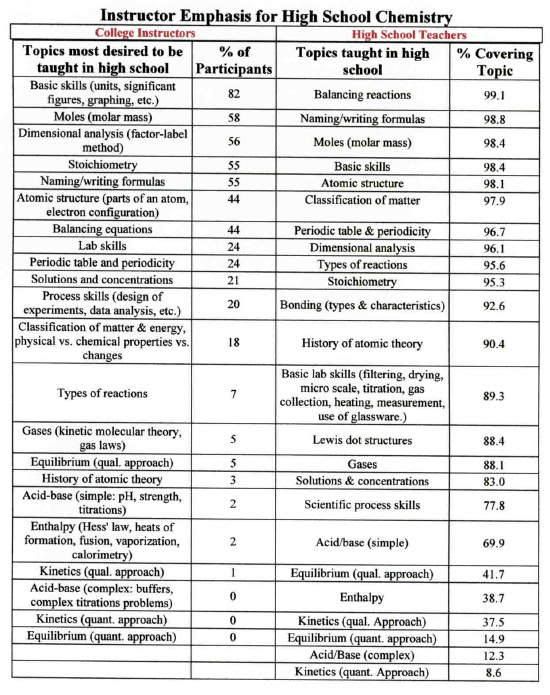

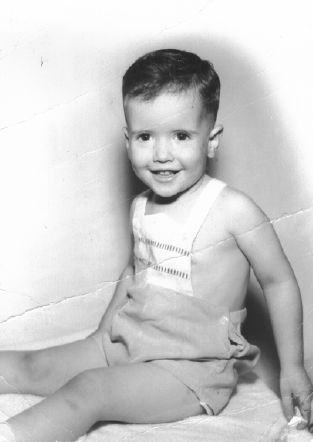
Speedo.jpg

CellPhones.gif

Thursday, July 14, 2005

The Social Security Lie

BushForkedTongue.jpg

Ok, yes, indeed, I appreciate how creepy a picture that is, but it does make the case about Bush in a very understandable way. For those not familiar with the term, "He speaks with a forked tongue", according to Wikpedia the term "forked tongue" means: to say one thing and mean another or, in more general terms, to act in a duplicitous manner. I suppose if I wanted to rail on I could get into all sorts of reasons for why I think Bush speaks with a forked tongue, but I'll just keep it on the subject of social security inasmuch as I just finished reading The Plot Against Social Security: How The Bush Administration Is Endangering Our Financial Future by Michael A. Hiltzik:

Overall it's a very readable book for anyone inclined to want to read about social security. Frankly I think nearly all of us should be up on social security, especially given what many people, in particular those in currently power, would like to do to the program. Hiltzik explains what the program is about, not all of which even at this point could I comfortably explain (this is genuinely a difficult topic to get your brain around), and why what you're seeing right now out of this administration on this subject is ideological and NOT good for you. The destruction of social security is the primary goal of libertarians and a large number of conservatives who feel people should have the freedom to save for their own future (in spite of the stark reality that unless forced to far too many people don't save for the future), and not be dependent on governmental "paternalism" --- how it's paternal in this situation escapes me exactly, but that's what they say.

Here are some of the lies dripping from the tongues of Bush and company:

- There is no trust fund, the government spent the money.

- The money won't be there for the next generation and may not be there for all of the baby boomers, and private accounts are the only way to fix this.

- The program itself is going to run out of money in either 2018 or 2042, you choose the year.

- You'll "own" your retirement (no, actually, your heirs will own it for as much as there may be anything left to bequeath.)

- Investing in the stock market will give you better returns than investing in social security [see below point regarding this.]

- African Americans are cheated out of their full returns from social security [it's true, male African Americans tend to die before their white counterparts, but in the way life has of evening things out, African Americans make up for this in benefits for widows and children, and in the social security disability provisions.]

I could go on and on. Bush has stacked the deck the committee that was to "look into what we should do with social security" --- first he gives the committee running orders that excludes any options besides privatization and the people he puts on the committee are ideologically inclined towards privatization. Can we guess what they're going to recommend? The fact is that this administration hasn't even given consideration to alternative social security solutions that they were not ideologically committed to --- facts and realities be damned. Well, heck, this IS a faith-based administration, after all.

Bush has spent a huge amount of money running around the country trying to scare people into believing that social security is going under and privatization is the only option we have to rescue something out of the sinking. He has people like Rick Santorum spewing the same lies. Fortunately, on the whole, they seem to have been unsuccessful. For whatever reason the American people aren't buying into this, and I just hope they stay the course, though at the same time I hope they're ready and willing to do what IS necessary to keep the program viable.

The fact is the only people that make out by privatizing social security are those who are well off to begin with (i.e. the rich) --- they're already invested in stocks and other vehicles to cover their retirement so privatization works out for them to be more of the same (though you'd think they'd want to have a sure thing on the side just in case.) In addition insurance companies (where, with the money in your privatized account, you'd buy your mandatory annuity when you finally retired), and investment companies who'd handle where you money went while you were accummulating that money in your privatized account, both do very good under privatization. Why, you may ask? Of course we'd have to include the costs associated with taking on that annuity (which can be up to as much as 20% of what you put in), and the cost of investment people handling your investments --- collectively this is no small thing and it can easily work out to be more expensive than any gain over what you'd have with social security that you might conceivably realize from privatizing (which has been the case in Chile, Britain, and Argentina, the three places thus far where this has been tried, so far not very successfully.)

Here's the take away message: Social security should be there for everyone, and certainly can be there if we were to make the adjustments to the program that would allow it to sustain itself as we now know it. But the options for this are not on the table as far as the Bush administration is concerned, which is fixed on privatization not because of fiscal reasons but solely due to ideology. Something needs to be done about social security, but privatization isn't it.

Wednesday, July 13, 2005

Chaplains in the Military

There was a very interesting article (well, for me anyway) in the yesterday's NY Times: Evangelicals Are a Growing Force in the Military Chaplain Corps. I don’t think the fact that evangelicals are a larger presence in the military comes as any great surprise to most of us. The fact is that they seem to be present everywhere else in larger and larger numbers, so it would seem to have been only a matter of time before they made a major move into the military.

During my 20 plus years with the Navy I rarely had much good to say about the chaplain program. That's not to say that there weren't some very good people who were in the corps, in fact people I admired, respected, and who I became friendly with. But on the whole I never quite saw the return on the investment in having the extra body, actually bodies as there’s normally at least one and often two Religious Personnelmen that come with a chaplain, on board that didn’t stand watch and contributed little to the primary mission of the ship.

What do chaplains do? My guess is that a chaplain would answer this question differently, but this represents my impression of chaplains from my time in the service. They tend to the faithful of their denomination, which usually entails holding services and anything else a clergy member of that faith would do; giving advice/counsel, spiritual or otherwise, when called upon; getting involved in different levels of counseling depending on the chaplain in question and his or her individual training; at sea more of the same, and when the ship pulls into port he or she is likely to be very involved in various projects in foreign ports where Sailors are recruited to volunteer for community projects, such as painting orphanages, helping build something in a poor area of a city or town, etc.; the chaplain is usually the one that's most directly involved in setting up tours in foreign ports; and lastly, though not at all least significantly, the chaplain is expected to attend to service members in the midst of battle, which I suppose on some level is the most compelling rationalization for having chaplains --- I want to state that many chaplains have been cited for bravery in battle, not for fighting but for attending to the men in the midst of war.

Ok, so what was/is my problem with chaplains? There are at least three:

1. The good ones avoid this, but too many of them don't, and that is their getting into the idea that somehow God supports death and destruction. Maybe in some faiths he does, I don't know, but there's nothing in the New Testament, which is where the Christian denominations get their marching orders from, that says, "Thou shalt smite thine enemies, bringing death and destruction to them in anyway you can." It doesn't fit for a chaplain to stand there and say "It's God’s will that you destroyed that village, and killed 20 enemy soldiers." Of course all sorts of philosophical tap dancing, going back to Thomas Aquinas, has gone into how indeed the Christian God does accept and support such things, but then a large part of the energy devoted to religion has always been about what you can creatively make of it. Like I said, the good chaplains avoid this, understanding to and in fact focusing their effort on the individual and his or her struggles, not getting up there and giving the modern day version of the St. Crispen's Day speech, going on about how the slaughter is all God's will --- I myself never understood a God like that, or why anyone would want to think that this is the way God works.

2. Frankly I think Sailors, and everyone else in the service, would be better served by someone who was a trained counselor, trained specifically to deal with the emotional problems and difficulties that service people go through, and who should be clearly secular and able to attend to the broad range of issues presented to them on something of an even keel.

3. The reason I used the above picture to depict the chaplains is because they are expected to be a representative of ALL faiths, or rather, he or she is expected to help people from any religious denomination by doing what they can do tend to whatever spiritual requirement that person may have. Unfortunately, and likely to be expected, some chaplains aren't able to separate their faith from their overall duties. A beautiful case in point is the following from the Times article:

Chaplain Gordon James Klingenschmitt, of the Evangelical Episcopal Church, says he was warned by commanders that his approach to the ministry was not inclusive enough. When a Catholic sailor on his ship died, Lieutenant Klingenschmitt said he preached at a memorial service and emphasized that for those who did not accept Jesus, "God's wrath remains upon him."

After that and several other incidents, Lieutenant Klingenschmitt's commanding
officer recommended that the Navy not renew his chaplain contract.

The lieutenant is fighting to remain in the military. "The Navy wants to impose
its religion on me," he said. "Religious pluralism is a religion. It's a theology all by itself."


What amazes me is that this person stood there and said to any non-Christian attending a non-denominational memorial service that their existence angers God so much that they're entitled to God's wrath, and he didn't see a problem with that. No, he considers the Navy's religious pluralism a faith unto itself and he doesn't buy it --- interesting argument, but I'm also quite sure he could have officiated at a service for a dead shipmate without relegating all non-Christians to God's penalty box. My assumption is that this is part of a consistent track record with LT. Klingenschmitt and his commanding officer was on target in wanting to see him go away.

The problem with types like Klingenschmitt is that they're merely a tip to the proverbial iceberg. More and more these days we're hearing about non-clergy in the military working to proselytize those working under them, or otherwise inappropriately invoking Jesus Christ (I wish for once one of them would invoke Buddha or the Great Spirit in the Sky --- just as inappropriate of course, but at least a change) in the course of their doing business in one way or another. Faith is an individual matter, and no one has the right to interfere in anyone's faith. That said, no one has the right to interject faith in inappropriate settings, which means any venue that is not comprised of likeminded individuals gathered together as an exercise of faith and fellowship --- that means not in the office, not in the locker room, not in the classroom, not on the drill field, and the list goes on and on.

It's often said that there are no atheists in foxholes, and I suppose there's likely a lot of truth to that --- when in extremis we do tend to look for comfort where we can find it. Who one shares a foxhole with is their business, but trying to foist that someone on anyone else is a violation of what our Constitution claims this country is about with regard to the freedom to worship, or not as the case may be. The clergy in the chaplain corps need to keep this in mind and a lot of people who take comfort in Jesus need to be less inclined to think everyone else should think as they do.

Tuesday, July 12, 2005


Words

Words.jpg

Where do words come from?
From what rubbing of sound are they born
on what flint do they light their wicks
what winds brought them into our mouths.

Their past is the ruffling of stifled silences
the trumpeting of molten elements
the grunting of stagnant waters.

Sometimes
they grip each other with a cry
expand into lamentations
become mist on the windows of dead houses
crystallize into chips of grief on dead lips
attach themselves to a fallen star
dig their hole in nothingness
breathe our strayed souls.

Words are rocky tears
the keys to the first doors
they grumble in caverns
lend their ruckus to storms
their silence to bread that’s ovened alive.

Venus Khoury-Gata
(Translated from the French, by Marilyn Hacker)


Monday, July 11, 2005

Testing My Way In --- II

In part I, we found our blogging hero having determined he was eligible for the enlisted nuclear power program, and facing having to get up at “oh dark thirty” the next day to take the Armed Services Vocational Aptitude Battery (ASVAB).

As I mentioned in my last post the ASVAB is normally given to students in grades 10 through 12, ostensibly as a tool that they can use to help them determine what they'd be good at and provide them some guidance with regard to what they may want to consider focusing their academic energies on. Here’s a general low down on what the ASVAB is all about [the
following is from ABCs of the ASVAB which is posted on About.com, and seems very informative on matters of ASVAB, etc., in addition to recruiting in general]:

The Armed Forces Vocational Aptitude Battery is a series of tests developed by the Department of Defense in the 1960s. Until recently, the battery consists of 10 individual tests of the following subjects: Word Knowledge, Paragraph Comprehension, Arithmetic Reasoning, Mathematics Knowledge, General science, Auto & Shop Information, Mechanical Comprehension, Electronics Information, Numerical Operations, and Coding Speed. In December 2002, DOD eliminated Numerical Operations and Coding Speed from the ASVAB, and added a new section titled "Assembling Objects."

I’ve come to find that there’s a school version of the test, the one I took, and a recruiting version that I was expected to take the next day. The general idea is to determine what a person will be good at. At the end of the test you’re able to give a general recommendation as to what the test taker should go into as a career option. The test isn’t binding in terms of the job choice you make. The fact is that if you score high enough on the Armed Forces Qualification Test (AFQT) part of the test you can pretty much go into anything you want regardless of whether the skills part of the ASVAB says you’re not safe with a screwdriver.

The AFQT is what’s most important about the ASVAB for this will determine whether you’re even let in the door. A bit about the AFQT:

The AFQT is important. It determines whether or not you can join the military.
The AFQT score is not derived from all portions of the ASVAB. Indeed, the AFQT
score is determined from only four areas of the ASVAB: Word Knowledge (WK),
Paragraph Comprehension (PC), Arithmetic Reasoning (AR), and Mathematics
Knowledge (MK).

For enlistment purposes, AFQT Scores are divided into the following categories:
Category I - 93-100; Category II - 65-92; Category IIIA - 50-64; Category IIIB -
31-49; Category IVA - 21-30: Category IVB - 16-20; Category IVC - 10-15; Category V - 0-9

In the early 90s, Congress passed a law stating that no Category V recruits could be accepted for enlistment in any of the military services, and no more than 20 percent of accessions could be in Category IV. Additionally, Congress required that any Category IV accessions had to be high school diploma graduates (no GEDs).

In my past experience my understanding has been that the restriction on cat IV recruits can at times be flexible or to some degree "bent" to accommodate potential recruits that are borderline. This may not be true and just recruiter legend, and there's reason to hope that it's not true. As a rule cat IV people tend to disproportionably comprise troublemakers and the most difficult to train, either due to behavioral problems or mental aptitude. By virtue of their categorization they find themselves essentially being used as cannon fodder when it comes to job assignments. These kids come in without any guarantee regarding what they'll do in the service, and the only sure bet is that whatever they do get for a job will be something that's inclined to need bodies without much brainpower but otherwise strong backs. The services tend to have a lot of jobs that fall into this category, though they're gradually going away either due to automation, new technology (new types of paints on ships, for example, that don't require seaman chipping away day in and day out), or it's "privatized", which in some magic of logistics support is found to be cheaper than using service manpower [how true this is remains to be seen, a lot of the magic has to with how budgets work out and that's a whole other story.] On the whole the system indirectly, by virtue of how the kid is treated for the first four years, and then directly if the kid is unable to pass advancement exams that would take them into a more professional direction, tends to discourage the kid from sticking it out past four years. That said, if the kid shows promise, is indeed well-disciplined and shows an aptitude to some degree for learning, then before their four years are up they'll very likely be given a choice, or afforded an opportunity to ask for a chance, to get advanced training and a shot at something that they'd find more palatable for their remaining time in or beyond.

So I was at the recruiting station at 6:30 the next morning, basically awake, though not altogether happy to be up at this hour. As I came in the station my recruiter greeted me and went through some quick paperwork to make sure I was ready for the coming challenge, and then asked me to hold on while he took care of some other recruits; we were all on our way to the ASVAB testing center to see if we had a place in the military.

I made myself comfortable and began reading whatever I brought with me to keep me occupied (I rarely can ever be found without reading material available). Before I got too comfortable my recruiter was introducing me to someone he called Chief so and so. I had no clue what a chief was (in the Navy the enlisted ranks go from E-1 through E-6, where on the whole these are considered the "junior" enlisted, and from E-7 through E-9 you have the chiefs, E-7 being a chief, E-8 being a senior chief, and E-9 being a master chief), but this guy looked like he was in charge, he certainly dressed differently from the recruiter, and he had some questions for me. He told me that I was lucky that I had a college degree because this made me eligible for accelerated promotion, etc., essentially the same spiel I had gotten from my recruiter. Then he asked me where I went to college, what I majored in, and what my GPA was. When I told him my GPA after my major I got a very queer look from him, but he cut off the conversation and bade me good luck on the ASVAB.

Off we went to the ASVAB testing center, of which I don't remember anything at all. In fact there was nothing noteworthy to recall about the ASVAB, where it was taken or anything else besides the fact that there were a lot of people there. I suppose given the economic circumstances of the time that was understandable. Carter was still President and fighting for his re-election against Ronald Reagan. The country was in a recession, with jobs hard to come by and the military, which was in the midst of a fiscal transfusion from Carter (Carter started the American military buildup of the 80's, Reagan, who is normally given all the credit for this exercise in military machismo, merely built on what Carter had started) and serving a country then at peace, was an attractive employment opportunity for a lot of people at that time.

The ASVAB done we made our way out to our waiting recruiters, all anxious about how we'd done and otherwise wanting to be sure that they had their charges in tow. We found our recruiter and we all headed out to the van we came to the center in, but as we moved as a group the recruiter pulls me to the side and tells me, "I was going to tell you this eventually, but I wanted you to get all the testing done first so if you decided this was an option for you that you'd be ready to go. But the fact is that you're likely eligible for the officer program and when we get back to the station there's going to be someone there to talk to you about applying for it."

Well I'll be ...

Sunday, July 10, 2005

Tidbits from The Economist of 2 July '05

From the magazine: Part-time work is continuing to increase in importance in most developed economies. But its salience varies a lot. In the Netherlands it comprises 35% of total employment. This contrasts with shares of 13% in the United States and 6% in Greece. Despite these national differences, part-time jobs in all countries are generally the preserve of women, who account for 72% of part-time employment across the OECD.

It would be interesting to see what the breakdown is for reasons why women make up the larger percentage of part time workers. While it would be easy to attribute it to child rearing concerns/issues, I wonder if there may not be more to this than might otherwise seem obvious.

I have no clue what this is telling is exactly. I was surprised at the amount of foreign investment coming out of Europe and Japan and had to wonder why that is. I expected there to be more coming out of the U.S. than there is, so that raised additional questions. Anyone with any insights on this one please feel free to share.

From the magazine: Demand for broadband connections is booming in the developing world, growing by 100% or more each year in many countries. In the developed world, meanwhile, growth has slowed to mere double-digit rates, according to Point Topic, a market-research firm. Separate figures from iSuppli, another market-research firm, suggest that global broadband growth peaked in 2004 at 52%, and will slow to 31% this year.

This isn't the first time I've seen something that shows South Korea as having the most broadband users in the world, followed by the other Asian "tigers", again inviting a "Why's that?" from me.

Friday, July 08, 2005

Dirty War


We just finished watching this. If you'd like to get an idea of what sort of terrorist attack we might see here in the not too distant future, I strongly recommend seeing Dirty War. This is not a comfortable movie, and it will surely make you think. It's also a bit prescient as the city this happens in is London.

The Musing of an Unhappy American

The bombing in London has served to re-focus my thinking about our government’s efforts in the “Global War on Terrorism”, henceforth the GWOT, and I suppose what follows is going to be something of a rant. Ok, fine, it’s my blog so why not, right? I’ll try to be reasonable here so it doesn’t come off too much as a rant.

London is now added to New York, Madrid, Istanbul, Jakarta, Casablanca, Riyadh, and Bali. Terror is alive and well throughout the world, and I suppose that in fact it’s only a matter of time before it makes its way back to these shores. I hope I’m wrong, but my guess is that whatever does come our way that the terrorists are going to try and outdo what was done heretofore, so we can likely expect to see something pretty horrific.

We ostensibly went into Iraq for two reasons. The first one, the one that’s most on the minds of the American people when they’re polled on the street, and the one that surely would have the most purchase in their consciousness when they were being convinced that this was a good thing to do, was to fight terrorism. Of course we now know that there’s nothing that conclusively ties Iraq to terrorist activities --- there’s a lot of speculation, there’s a lot of inference, but not a scintilla of hard evidence to suggest that Iraq presented a terrorist threat to this country. What evidence did exist we apparently made up on our own to fit our desires to go in there and teach Sadaam Hussein a lesson. Bottom line nothing has been found in Iraq, after over two years of our being there, to in any way support the idea that Iraq was a terrorist threat to this country at the time we invaded in the name of the GWOT.

The second reason was to bring democracy to the Middle East. This reason is sort of in the background, part of the small print in a manner of speaking, as most people aren’t aware that this was on the list of reasons to go in, and it sure and hell wasn’t made a selling point to the American people. I mean really, how many average Americans really want to give up their lives, the lives of their kids, and their tax dollars to export democracy? No, that wouldn’t float, which is why the speeches before this started all focused on the threat from Iraq, not on the idea that exporting democracy would help quell the natives and make them beg off terrorist activities.

At this point our exercise in exporting democracy has cost us over 1800 American lives, over $200 billion, God only knows how many innocent Iraqi lives, and you can throw in however many other people from different nations who happened to be there and were killed. Mind you, no one has EVER exported democracy in a situation that remotely matches the one we’re dealing with here. Now here in the U.S. our notion of democracy was distilled over years of oppression from the British government. The majority, though surely not all, of us wanted our own government and we felt that democracy best suited us. We then decided to declare our independence and rebel against the Brits, going to war against overwhelming odds to kick the Brits out of this country and to establish our own representative, constitutional government. In Iraq we figure, in our quintessential American way, that the Iraqis are just like us, they want what we have. We assume that when we get there that they'll welcome us in the streets with flowers, and in short order start paying on their own for our experiment in democratic exportation. What do we have? Well, the Iraqis up to now have spent far more effort in rebelling against us than they ever did against Sadaam Hussein. So we have invested our men and women, our money, and our security into an experiment that no one has tried before, the success for which is no where near certain, for a people who didn't really ask for it, and even if
what we’re trying to put in place does taken hold we have no reason to believe it’ll take hold in a fashion we’ll find palatable.

While exporting democracy to Iraq, and the region at large it would seem, we watched as Osama bin Laden and the Taliban hightailed it into the mountains of Afghanistan and Pakistan, where the hills became alive with the snickers of terrorists. Smart move, the territory is unfriendly and easy to hide within, but then we were also re-directing our resources somewhere else, i.e. Iraq, and in fact NEVER did a full court press in Afghanistan, instead using local surrogates to do much of the scut work. Since 9/11, some four years ago, Osama and company have been able to make video and audio tapes, which they send out to the world, essentially thumbing their noses at the U.S. and anyone else who was involved in trying to hunt them down, inciting more people to join their cause, which has resulted in what we’re seeing now in London.

As I’ve said, exporting democracy is an uncertainty --- killing terrorists is an absolute. Porter Goss, the head of our CIA, has the nerve to tell us that he has a pretty good idea where Osama bin Laden is right now, yet we don’t hear anything about getting him as apparently there are sensitivities regarding national sovereignty. I’m all for respecting the borders of a sovereign nation, but in this case said nation should be given 72 hours to make good on doing something or we take matters into our own hands. When Afghanistan was harboring al Qaeda that was our primary reason for invading THAT sovereign nation, so who's changing the rules?

Bush and company need to go --- I’ll not make the case that impeachment is a reasonable or even necessarily a desirable thing quite yet. That said, the company needs to change, and we need to start aligning our efforts towards where the actual threat is coming from. We’ve been victims of one bait and switch --- Bait: “We need to invade Iraq because it’s a terrorist threat to all freedom loving nations”, Switch: “Well, yes we didn’t find any WMD or anything at all to
suggest that Iraq was engaged in terrorism or presented any immediate terrorist threat, but by exporting democracy we make sure that Iraqis and those living near them don’t become terrorists.” Oh dear … how this rankles me, truly it does. But that said, we need to re-double our efforts against people, who are not parked in Iraq, that have no compunctions about placing bombs to kill perfectly innocent people, and the team we have in the government right now is nowhere near deserving of a fourth or fifth chance to finally get this right.

Thursday, July 07, 2005

The Terrorist Threat

First, my most heartfelt condolences to our friends in London and Great Britain as a whole.

Second, if you've not had the chance to see the January 2005 PBS program on al Qaeda's efforts of late (thanks to Stygius for pointing the program out, I myself had missed it) I'd strongly recommend checking out Frontline: al Qaeda's New Front --- you can see the program online, though it helps if you have a broadband connection (dialup connections will likely work, too, I can't be sure.)

Doonsbury, On Target, But Again

Wednesday, July 06, 2005

I Believe

I ran into an "I believe" post at Neptunus Lex, whose blog, in his own words, offers up: Tales of the Sea Service, San Diego, Politics and Culture. Lex is an active duty aviator (who unbeknownst to me made Captain --- equivalent to Colonel in the Army --- this past June. If you happen to read this Lex, BZ and congratulations) who's erudite, perceptive, polyglot, tells interesting tales, seems a bit right of center, and is otherwise the sort of reflective warrior I think we should be happy is in the service of our country. He engaged this exercise (well for me it was an exercise, he may have looked at it somewhat differently) on his blog, apparently when he first started blogging as the entry was a fairly long time ago and no one had commented on it --- that by itself was an attention catcher. I read his version of this (I'll let any curious reader go find that on their own --- it's worth the read) and it made me think, "What would I write were I to do this?" I'm sure he didn't intend this as a pass-on meme, he was just expressing what he believed, and it compelled me to think about what I believe in. Interesting question to self, and I found out that it wasn't really all that easy to answer either.

Ok, that said, this is my attempt to lay out what I believe. This, in no particular order, is what I believe:

- Reverence for self, others, and the reality we exist within and all it entails, is essential for harmonious and constructive living.

- Learning, specifically the process and facilitation of learning, is essential to a productive and worthwhile life and society.

- Fealty gives a life purpose, and makes it that much harder.

- Cruelty is sometimes easier than love and understanding; the better person overcomes this.

- You never truly know all there is to know about a person in your life, but often what you do know or love about them makes this unimportant.

- Sometimes saying a lot obscures what's meant to be said; economy in expression is an art that one should try to practice often [Blogger's note: maybe one day I'll practice this myself.]

- One should be generous with a benefit of the doubt, but absolute in the face of deception.

- Most problems are attributable to a lack of self-discipline, patience, and a plan, or otherwise thinking way too much of one's self.

- There are people and ideas worth dying for.

- The strong should protect the weak.

- Our children are the future and we are responsible to both; we very often don't take either responsibility very seriously.

- Few things are as important as conquering, or at a minimum not succumbing to, one's fears.

- Rumi had it right when he said, "Let the beauty of what you love be what you do." Finding that beauty and doing it is rarely easy, and often times impossible.

- Camus' Sisyphus had the right idea, and Sisyphus' line of thinking per Camus makes up for the preceding belief if you happen to be on the negative end of it.

- Something of worth and enrichment can be found in anything one does, even rolling a rock up a hill for eternity.

- I really don't care about finding myself; I'm more interested in being comfortable with who and what I believe I am.

- I personally don't have much use for religion, and I'm sure that "being spiritual" is not a religion; if we could come up with something less divisive or silly I might consider joining.

- A person without honor is rudderless and to be avoided as you would anything else, which are usually big and potentially painful, that's rudderless.

- Religion is great so long as it's not being rammed down your throat.

- Faith is also great, so long as someone else is not expected to share it.

- People are more often ignorant than not, and usually for no particularly good reason.

- Your quality of life is likely directly tied to your quality of entertainment [see previous item.]

- Evil exists and sometimes, to our shame, it wins because we let it.

- Coveting thy neighbor's anything is wasted energy, often irresponsible, and potentially destructive.

- Sin exists. Sometimes it's obvious to all, other times it exists only inside us.

- Abortion is a bad thing, but no one has the right to tell a woman what to do with her body.

- We're too afraid of death and embracing it when it is the appropriate thing to do.

- The state should not have the power to kill its citizens.

- That justice in this country tries to be blind, and is often unfair. On the whole I'd rather have justice meted out to me here than anywhere else in the world.

- This is the best country to live in for freedom and opportunity.

- Caring what others think of you is rarely worth the energy, unless you're delusional.

- It's important to have someone in your life who can give you an objective reality check [see previous item.]

- We don't do enough to try and help those that, due to no fault of their own and sometimes even due to themselves, are without what they need, especially the young.

- We are all responsible for our own lives and actions, though many of us don't take much responsibility for one or the other.

- Capitalistic democracy is the best possible system of living to live under, though it is too often divorced from helping to better society as a whole as opposed to a privileged few.

- Over time things get better, though it may not seem that way at the time.

- In all things but art truth and logic must trump passion.

- Art often has its own kind of truth and logic, but it should be unfailingly passionate.

- Truth isn't always what it seems.

- Working hard doesn't always pay off as we'd like, but the only worthwhile effort involves working hard.

- We should always act better than the worst of us.

- Prisons should rehabilitate not just incarcerate and dehumanize [see previous item.]

- Living up to one's ideals is a hell of a lot harder than trying to write about them.

- We are all imperfect, we all have bodily functions that on the whole we're embarrassed by or otherwise aren't interested in sharing, and no one by virtue of anything stands above anyone else in this country --- that's the ideal, though money often does seem to get in the way of it.

- Every person has a point that's worth at least a hearing.

- That God is in the interstices of the universe, and if he/she/it is paying attention to what goes down on this planet then there's an awful lot of cosmic head shaking going on.

- That perverters of the truth are a necessary evil in a free society, against which we all need to be vigilant [creationists and intelligent designers come to mind most readily, though they're hardly the only ones.]

- That this country was founded on the principle that ALL men were created equal, that in this day this means that ALL people are created equal, and from
this premise all else should give way. We have too many people who whine about
activist and Constitution-interpreting judges who themselves haven't bothered to read the Declaration of Independence.

- My wife is the best thing that ever happened to me.

Well, for what it's worth, so sayeth James.

Tuesday, July 05, 2005

At the Beginning --- Part I

BUTTON_findjob2_OFF.gif

At this point it's looking like I'll be starting a new career as a chemistry teacher for the coming school year (this won't be totally confirmed until 20 July when I'm voted on by the school district I've been invited into). I suppose it's not a surprise, but I find myself reflecting on how I ever got into teaching, which inevitably brings me back to my career in the Navy. It's interesting as I think about it, but I've never blogged much about my time on active duty or about the things that affected me while in the service. In 22 years there was a lot that truly made me think, though there was a lot that wasn't so much a part of conscious thinking --- it was more a feeling, a sense of belonging, being a part of something. The belonging part was more responsible for my 22 years than anything else, and I suppose it was a sense of not feeling a part of the organization any longer, either because of my own limitations or a certain weariness with what was expected for me to keep moving forward, that I retired.

I think it's fair and reasonable to say that the person I am today was shaped by those 22 years in the service and if for no other reason than to have my own chronicle of that time and my thoughts about it, I'll be focusing the blog on my Navy years. I'll touch on what got me in the service (the next few posts) and on some of the experiences that affected me. There are things that come to me as I think about this that mean a lot to me, and maybe this is as good a place as any to explore that.

I graduated cum laude with a BS degree in chemistry, with a focus in biochemistry in 1980; in those days the college didn't have a degree in biochemistry. I actually enjoyed chemistry a great deal, and with that in mind applied to graduate programs and was accepted into three which would have paid for my graduate education, but I belatedly concluded that I had had enough of school. I was burnt out and just couldn't see myself going on for more schooling as I knew I wouldn't enjoy nor engage it to the degree I'd need to. Having decided that follow-on schooling was not going to work for me, I had to find a job. Jobs in chemistry for guys with BS degrees weren't exactly for the taking unless I was interested in becoming a lab tech of some sort, and they weren't exactly handing those jobs out either. Without any real family and personal connections I made my way through the papers and tried to find something that would fit.

The job offers weren't exactly pouring in, though the resumes were going out and I was talking to anyone who might be able to help me. In keeping with investigating ALL my options, I decided to see what the military had to offer. I was at something of a disadvantage at this point as I was not aware that being a college graduate entitled to me to a shot at officer programs --- I had never read about such a thing, nor, that I was aware of, had officer recruiters ever come onto the campus of my college. I was under the impression that you only became an officer through the service academies or the individual service's Reserve Officer Training Corps program. So I made my way down to the enlisted recruiting stations that were found at the junction of Fordham road and the Grand Concourse in the Bronx. All four services had recruiting stations there so it was a convenient one-stop shop.

The first station I went to was for the Army. When I mentioned to the recruiter that I had a
college degree he surprisingly turned off on me; this made sense later, but at the time it caused me to wonder what was going on. I was given what I perceived to be a shuffle about how I might be eligible for something in the chemical corps, but he wasn't sure. The Air Force was out, so I didn't talk to anyone there, and the Marines I didn't bother with as I had no misconceptions about my ability to be sufficiently gung ho in the quintessential Marine Corps fashion --- don't get my wrong, Marines are great people, but to do the Corps and do it well you have to be a little bit special, in a way that many would define differently but otherwise does explain why once a Marine, always a Marine. That left me with the Navy. As it turned out the Navy recruiter was in, and he seemed a very lonely man.

As most successful recruiters are the guy behind the desk who stood up to greet me was very nice. In addition, when I mentioned to him that I was a college graduate with a degree in chemistry he didn't shut down on me, in fact he perked up. That said there was a slight element of doubt emanating from him, which I suppose could have been translated in a number of different ways but which I took to be "If you have a degree in chemistry why are you talking to me? But let's see what we have here." He explained to me that I'd be eligible for the Navy's nuclear power program and given my degree the training should be relatively easy for me and I'd be situated for accelerated promotion at the start. That said, we'd have to go to an office across the street where I'd have to take a test specific to the nuclear power program that would determine whether I had the requisite knowledge for the program or not. "Could I take the test now?", he asked. I said sure, and off we went across the Grand Concourse and then Fordham road and up a flight of stairs to an decent sized office. He went to a safe, pulled out some papers, and within short order I was working on the test. The test contained pretty basic high school level science and math questions, material that four years in a collegiate science program more than adequately prepared me for. I don't recall the total number of questions, but when done I got two wrong --- he was ecstatic.

My bonafides as a nuke prospect established, he became even more excited about me and the potential I represented for him. I didn't know this at the time but my being a potential nuke recruit meant more to him than the standard Navy recruit prospect to walk through the door --- nuclear accessions counted for more points to the recruiter who got the prospect into the Navy. The next step was for me to take the ASVAB, the Armed Forces Vocational Aptitude Battery. Normally high school students wind up taking this test somewhere between the 10th and 11th grades, and in fact I had, but that wasn't good enough, he wanted me to take the test again. I needed to come in at "Oh dark thirty", a new expression I was to encounter a lot in my time in the Navy, to go with a group taking the exam the next day. Off I went, I'd be back the next day at 6:30 in the morning.

Monday, July 04, 2005

Credit Monitoring Services & ID Theft Insurance

The following article is from Identity Theft Resource Center regarding credit monitoring services and credit insurance, something I alluded to in an earlier post on ID theft. I wasn't sure that the monitoring services were worth the money --- it seems they're not if you're going to take responsibility for your credit reports yourself. ID theft insurance MAY be worth the investment if you have the right coverage. Make your own determination:

Regarding "Credit Monitoring Services"

The Identity Theft Resource Center does not endorse any products. However, many consumers do ask about credit monitoring services. We have tried several but felt that none fulfilled all our needs. We still prefer to check our credit reports personally. Unfortunately, while most say that they monitor all 3 bureaus, they only do so for the purpose of the first tri-report. Afterwards, they only monitor the one bureau with whom they are associated. In essence, you would have to buy THREE monitoring systems.

The second problem is time lag and failure to place any notice with the bureaus. Companies are not required to notify the bureaus of credit accounts in your name. In fact, most utility companies only report to the bureaus once an account has gone to collection. There is also a time lag by the credit issues in some cases -- between the opening of an account and the notice to the bureau. It could be as long as 2 months according to one person who used these monitoring services.

Given these issues, ITRC does not think that credit monitoring services have met the level of service that we demand. For all practical purposes you can create your own monitoring service using free credit reports will start to be available to all U.S. citizens starting in December 2004. Each person will be entitled to one free annual credit report from each agency. It will be a roll-out program starting on the west coast. In other words, order one bureau this month, a different bureau's report in 4 months, and the third one four months later.

Your reports will always be free if you have been denied credit, suspect you are a victim of id theft or financial fraud or are unemployed and looking for employment.

Having said that, if you want to purchase a service, we think it's best to find a product that keeps you updated on all 3 credit reports on a daily basis. Who knows- maybe a company will eventually offer one at an affordable price (under $50).

ID THEFT INSURANCE: As to id theft insurance, this is a buyer-beware situation. Make sure that they cover most major costs including lost wages and time, travel, legal expenses, postage, photocopying, telephone costs and edical/psychological treatment that may be needed. It should have a low deductible.

This is a personal choice issue. The cost should not be more than $25-40 per year or it may be overpriced. The deductible should be not be high or it doesn't pay for itself. Your highest costs will be time spent, legal costs (if necessary) and travel.

Sunday, July 03, 2005

Personal Data Theft Redux

I figured that this article from the Times, Don't Let Data Theft Happen to You was worth sharing in toto just to make a point. I used the Opt-Out Prescreen Website mentioned in the article to permanently remove me from receiving such pre-screened documents, and did some preliminary checking on credit report freezes, only to find that right now they're offered only in seven states: California, Louisiana, Vermont, Texas, Maine, Colorado, and Washington, with the latter 3 joining this year due to the data losses that have played so prominently in the news of late. Frankly I think a freeze on credit reports is a great idea as it effectively blocks someone from becoming you. I'd also recommend paying attention to the advice below about where you HAVE to give your social security number. One of the reader's of this blog, Pablo, posted a comment saying that he routinely withholds his SSN and is still able to do his business; turns out he had the right idea. Here's a piece from a USA Today article, Is freezing your credit the way to safeguard your ID?:

Without a credit freeze, a consumer's only option for fighting identity theft is a fraud alert. Consumers can obtain a 90-day fraud alert if they believe they've been victimized.

Consumers who can provide evidence they've been victimized, such as a police report, can get an extended fraud alert that lasts up to seven years. A fraud alert directs lenders to verify an individual's identity before issuing loans or credit, typically by calling the individual first.

The only way otherwise for YOU to control YOUR credit report is if you've been victimized, and to get 9 year protection you need to have a police report. All a fraud alert requires is that a lender verify YOUR identity before issuing a loan or credit card --- imagine that?

Here's the Times article, worth your time and consideration, and at a minimum take a look at the Opt-our prescreen website and maybe give some thought to pushing your state to pass a law to allow you to freeze your credit report (read the USA Today article for the inconveniences that comes with that):

Don't Let Data Theft Happen to You

The recent spate of data breaches was worrisome, but I never expected to become a victim. Maybe I should have. Companies like Citigroup, Bank of America,
ChoicePoint
and LexisNexis have lost, misplaced or otherwise exposed the personal information of tens of millions of Americans. Even the government
concedes it lost records containing the Social Security numbers of more than a million employees.

UNFORTUNATELY, although there are steps you can take to protect yourself - and you should - there are no guarantees. "You cannot protect yourself completely," said Edmund Mierzwinski, consumer program director at the U.S.
Public Interest Research Group in Washington. "The best thing you can do is
react swiftly if it does happen."

That said, Mr. Mierzwinski endorsed the preventive measures offered by Privacy Rights Clearinghouse (www.privacyrights.org), a nonprofit consumer advocacy group, and by the Identity Theft Resource Center (www.idtheftcenter.org),
also a nonprofit. Besides the standard advice to shred personal documents,
following are some tips I found useful:

¶Avoid letting your cards out of your sight. Do not let store clerks take your card away on the pretext that there's a "problem."

¶Restrict the access to your personal data by signing up for the National Do Not Call Registry (www.donotcall.gov); remove your name and address from the phone book and reverse directories - and, most important, from the marketing lists of the credit bureaus to reduce credit card solicitations. The site
www.optoutprescreen.com can help.

¶Consider freezing your credit report, an option available in a growing number of states. Freezing prevents anyone from opening up a new credit file in your name (a password lets you gain access to it), and it doesn't otherwise affect your credit rating.

¶Protect your home computer with a firewall, especially if you have a high-speed connection.

¶Rein in your Social Security number. Remove it from your checks, insurance cards and driver's license. Ask your bank not to use it as your identification number. Refuse to give your Social Security number to merchants, and be careful even with medical providers. The only time you are required by law to give your number, Mr. Mierzwinski said, is when a company needs it for government purposes, like tax matters, Social Security and Medicare.

¶Curtail electronic access to your bank accounts. Pay bills through snail mail. Avoid linking your checking to savings. Use a credit card for purchases rather than a debit card. Although I was able to get all $1,772.26 reimbursed, I was lucky. While individual liability for fraudulent credit card purchases is only $50, it can be higher for debit cards: up to $500 or even all the money in your account in some cases.

These and other preventive steps may help, but people really can't safeguard their money and their data on their own. Robert Douglas, the chief executive of PrivacyToday.com, a privacy advocate, believes that this is not an issue of consumer responsibility but of corporate negligence. "These companies are trying to tell people it's their fault, but the largest breaches have been within the
financial services industry itself," Mr. Douglas said.

Mr. Douglas and Mr. Mierzwinski say that shredding documents is fine, but calling your state and local representatives is better. "Companies have refused to give consumers control over their financial DNA and they've refused to take responsibility for their actions," Mr. Mierzwinski said. "What will stop identity theft are stronger notification laws and stronger penalties, which we don't have now."

M. P. Dunleavey writes about personal finance for MSN Money.

Saturday, July 02, 2005


Dennys.jpg

Friday, July 01, 2005

Tidbits From The Economist

All content, except Tom the Dancing Bug, was taken from the June 25 - July 1 2005 edition of The Economist.

FavoriteCountry.gif

I have to admit this seems to me to be an odd mix of countries queried, or possibly the magazine was selective in what it included in it's final chart. It's sort of odd that we're more popular in China than we are in France and Germany.

LandofOpportunity.gif

I'm curious as to which of those countries seen as the "Land of Opportunity" actually take people in the way the U.S. does.

GovtBudgetBalances.gif

Well, clearly, we have a LOT of good company.

OilReserves.gif

Clearly, this stuff is going to run out eventually. How much more expensive will it get as we get closer to that point? What problems will come with it as we compete to have it?

And lastly, for your evolutionary pleasure:

creationistpatrol.jpg