Thursday, June 30, 2005

Courtesy of The Economist

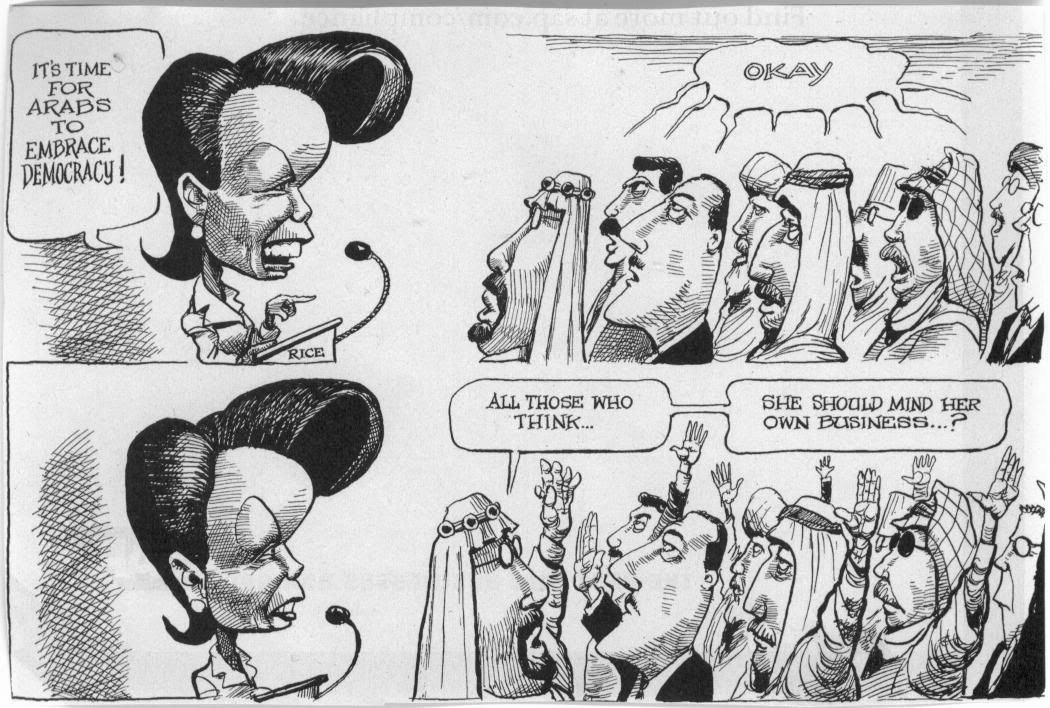
RiceArabs.jpg
Cartoon courtesy of The Economist, June 25 - July 1, 2005


This segues nicely with a recent article in the NY Times Magazine by Michael Ignatieff, a writer I respect a great deal and whose books have been no small source of neuronal stimulation. The article is Who Are Americans to Think That Freedom Is Theirs to Spread?. Ignatieff gets into a discussion regarding Jeffersonian democracy and how it's hard to argue that anyone wouldn't want to live in a country where such were the dominating philosophy of governance. I agree, I think everyone is entitled to democracy, and in keeping with that thought Ignatieff then goes onto argue that America is the only country that can in fact export democracy as we seem to be the only ones that believe so strongly in it that we on some level strive to help other countries establish their own democracies.

As always Ignatieff is interesting to read, though here he definitely gets things wrong in my view. He's focusing on the issue of this country exporting democracy as a casus belli for Iraq, and while I concede that this indeed was one of the reasons for our going into that country I feel it's obscured significantly by the way the war was sold to the American people. Many indeed would argue that we went into Iraq to export democracy, that we were going to establish the first democracy in the Middle East and the democracy meme/virus would spread far and wide, and all would be happy. In fact that's a very Jeffersonian perspective, as Ignatieff shares with us part of a piece written by Jefferson before his death:

Democracy's worldwide triumph was assured, he went on to say, because ''the unbounded exercise of reason and freedom of opinion'' would soon convince all men that they were born not to be ruled but to rule themselves in freedom.

And I agree, men and women are born to rule themselves --- I believe that, I honestly do. But it's not a meme that you can simply expect a culture to accept on its own, as we seem to expect now in Iraq. This meme grew here in the cauldron of an internal rebellion. We rebelled against what we perceived to be our oppressor at the time, Great Britain, and the rebellion was a well-thought out one, guided within the framework of striving towards an ideal of democracy. Fortunately for us that ideal took root and flourished, but it wasn't a sure thing at the time, nor was it so for a number of decades hence. Yet we're expecting that by simply saying that all men and women desire to be free, that this is a universal truth, that it will take wherever we plant it,
that it will be accepted, and we're the ones to make it so.

More to my main point, which is that Bush sold Iraq as a necessity for our national safety. There was a bad man with bad weapons and we didn't want to give him the chance to use those weapons on us. Moreover he was in cahoots with other bad men who had bad designs on this country. Sadaam must be stopped, was the cry. Of course Sadaam didn't have weapons (Thomas Powers does a wonderful breakdown of the intelligence failures tied to this in a NY Review of Books article, Secret Intelligence and the 'War on Terror', which, along with the questions surrounding the Downing Street memo, makes it hard to believe that Bush wasn't manipulating the facts to get us into Iraq), and there's not a shred of evidence to support that he was in cahoots with terrorists of any flavor, much less al Qaeda and Osama bin Laden.

So we went into Iraq because this country was threatened, so much so that the threat that we knew was gallivanting through the hills of Pakistan and Afghanistan was no longer the priority, Iraq now was because it was that much more of an important issue. Now, though, the administration is trying to sell us on the idea that we're actually traveling salesman of democracy, and it's costing us nearly 2,000 lives of our own, tens of thousands of Iraqi lives,
and over $200 billion in money for something that's so far removed from being a sure thing that it's not funny, in fact it's down right scary. But what's worse, we weren't sold on this idea from the start, it's plan B in Bush's list of reasons for doing what we're now doing and he hasn't admitted to any failure with regard to plan A, in fact everything's honky-dory on all fronts in Iraq if you're to believe him.

We've an administration that's essentially misguided, if not outright lied, to the American people, and we've damaged our credibility throughout the world. Is it any wonder that the countries we're most interested in trying to convince to change are more inclined to tell us to mind our own business than to listen to hypocritical lectures about changing how they do business?

Wednesday, June 29, 2005

Where Evil Lurks

The banality of evil, personified.

Visiting She Falters To Rise I encountered a recent post of hers regarding the BTK killer, Dennis Rader. This guy was the picture of normalcy, though he did have a few quirks, such as his obsessive behavior with regard to executing his job as a "code compliance officer." He was the one that came around to make sure your lawn was cut to spec, that your dog is tied up, anything to do with local "code" that tells you how you should or shouldn't do things. In many places a "code compliance officer" is otherwise referred to as a pain-in-the-buttocks, and it does indeed take a special personality to be really good at this sort of thing (that's not to say all that perform this function are serial killers, but I think most of us get the general idea.) The Times ran Kansas Suspect Pleads Guilty in 10 Murders yestday and here are some excerpts from that piece:

"The former Boy Scout troop leader, married father of two and regular churchgoer pleaded guilty to 10 counts of first degree murder. The killings took
place when Kansas was without a death penalty, so prosecutors cannot seek to
execute Mr. Rader on these cases, but he will almost certainly spend the rest of
his life in prison ..."

"One of Mr. Rader's public defenders said afterward that Mr. Rader's legal team had decided that the case "was not a viable insanity defense." ..."

"Mr. Rader, balding with gray sprinkled in his beard, wore a cream colored sports coat, and a white shirt and dark tie. During his court appearance, he did not appear to be nervous and expressed no remorse as he dispassionately explained how he stalked his victims, and bound and tortured them, before he shot, stabbed, strangled or choked them to death. He went into graphic detail during his testimony and often called his victims by name. Most, he said, were chosen at random."

This man knew right from wrong, but that didn't matter. He had strong sexual fantasies which some aspect of his character didn't allow or help him suppress or otherwise didn't compel him to find help to deal with horrible fantasies --- he likely felt therapy was for sissies or something along that line --- and consequently he went out and killed. But it was more than just the fantasies, he relished the limelight that came with the killing, he savored the news coverage, in fact ultimately it seems that this is what did Rader in as his taunts to local papers asking why they were no longer paying attention to BTK were what allowed law-enforcement to finally get a track on him. This guy compartmentalized his existence, cutting himself up at least three different ways, leading the life of a law-abiding, in fact on some minor level a law "enforcing" citizen on the one hand, a homicidal thrill freak with sexual overlays in another, and then on top of the killer he was some freaky voyeur who got off on what he did when he was being a bad boy. This was a man who saw himself as so pathetic that his existence had meaning only when he had control, and this came at the cost of the lives of ten people --- but yet looking at him no one would have guessed, in fact no one did.

The whole thing reminded me of a book I read some years ago, Adversary: A True Story of Monstrous Deception, By Emmanuel Carrere. It tells the true story of a man who went on to
convince family and friends that he had finished medical school, that he was employed by the World Health Organization in Geneva, that he was an investor making extraordinary returns on the money he managed and in turn convinced family and friends to put money in with him which he then used to support his lifestyle and family, and then finally, after 18 years of this, when it all began to unravel, he killed his family (wife and two kids) in an effort to hide what he had done. You'd think the whole thing was impossible, but sure enough it happened. Again, the banality of evil, a man who lived off of his ability to make people believe he was something he wasn't and this would have gone on forever had the house of cards not tumbled down --- but then he's exposed and what does he do? He kills his family and fakes his nearly being killed himself, and it turns out that he killed relatives initially taken in by him who were gradually figuring out what he was up to. Being a con man is one thing, even when you take it to the extreme of playing the con on your own family, but then to resort to murder of those the people you ostensibly love, the only ones who in the end that should have mattered to him, spotlights an extraordinary evil.

Well, one more reminder for me, something attributed to the anthropologist Catherine Baetson, which on some level certainly does apply here, but which is a good reminder for all of us in all aspects of our lives:

"We live with strangers. Those we love most, with whom we share a shelter, a table, a bed, remain mysterious. Wherever lives overlap and flow together, there are depths of unknowing. Parents and children, partners, siblings, and friends repeatedly surprise us, revealing the need to learn where we are most at home. We even surprise ourselves in our own becoming, moving through the cycles of our lives. There is strangeness hidden in the familiar.

"At the same time there is familiarity hidden in the strange. We can look with
curiosity and respect at the faces of men and women we have never met. Learning
to recognize these strangers with whom we share an increasingly crowded and
interdependent world, we can imagine ourselves joined in a single family, perhaps by a marriage between adventurous grandchildren.

"Strangers marry strangers, whether they have been playmates for years or never
meet before the wedding day. They continue to surprise each other through the
evolutions of love and the growth of affection. Lovers, gay and straight, begin in strangeness and often, for the zest of it, find ways to increase their differences.

"Children arrive like aliens from outer space, their needs and feelings inaccessible, sharing no common language, yet for all their strangeness we greet
them with love. Traditionally, the strangeness of infants has been understood as
temporary, the strangeness of incomplete beings who are expected to become
predictable and comprehensible. This expectation has eased the transition from
generation to generation, the passing on of knowledge and responsibility, on
which every human society depends. Yet the gap between parent and child, like
the gap between partners, is not left behind with the passage of time. Today, in
a world of rapid change, it is increasing, shifting into new rhythms still to be
explored."

Tuesday, June 28, 2005

Gravity and Center

Waterflowingintoabowl.jpg


I’m sorry I cannot say I love you when you say
you love me. The words, like moist fingers
appear before me full of promise but then run away
to a little black room that is always dark,
where they are silent, elegant, like antique gold,
devouring the thing I feel. I want the force
of attraction to crush the force of repulsion
and for my inner and outer worlds to pierce
one another, like a horse whipped by a man.
I don’t want words to sever me from reality.
I don’t want to need them. I want nothing
to reveal feeling but feeling --- as in freedom,
or the knowledge of peace in a realm beyond,
or the sound of water poured in a bowl.

--- Henri Cole

Sunday, June 26, 2005

Iran's New President: What Difference Does it Make?

Mahmoud Ahmadinejad

What does the new president of Iran mean to the rest of the world and what does this election mean? The new president, Mahmoud Ahmadinejad is an unknown quantity here in the U.S. Even though he was the mayor of Tehran since 2003, he hasn't made much of a mark outside of
Iran itself. So what can we divine from what there is out there about him? The following is some of what's known about the man:

1. He won as a populist candidate. He's considered a man of the people, someone who's down to earth and in touch with the common man. This, more than his hard-line views are more likely to have been the undoing of the "reformist" candidate Rafsanjani, a "cleric" who is widely disliked and closely associated with past and present corruption in the country. Rafsanjani is a rich man who flaunts his power and wealth, as does his family, and who over time has caused a wide range of people to develop strong feelings of dislike towards him. Rafsanjani's last election fiasco was four years ago when he resoundingly lost a bid for a senate seat, a performance he seems to have duplicated in this bid for the presidency. Bottom line, the man is not liked, and it may well have taken a run-down election with him as one of two candidates for president for the Iranian people to finally tune into how much they really don't like him.

2. He's considered to be very devout and very intolerant of corruption. What I've heard from family in Iran is that there's a rash of people trying to get out of the country who've had any association with corrupt goings on there --- the expectation is that Ahmadinejad is going to clean house.

3. He was on the frontline during the war against Iraq. This is a significant thing for a man, especially when one considers the savagery and waste associated with war.

4. He was very involved in the Islamic Revolution which brought Khomeini to power. His ties to the teachings of Khomeini and the Revolution are strong and hold considerable influence on his thinking and actions.

5. He didn't get along well with the reformists. He had problems with Khatami, the reformist president whose term is expiring.

6. His actions while mayor of Tehran, the largest city in Iran, were of a man who's very conservative and a strict interpreter of religious writing, who has no problem imposing that interpretation on the citizens of the country.

7. He's well-educated, with a PhD in civil-engineering, who taught for a time at the university level.

8. In many respects Ahmadinejad is Iran's version of George Bush, though better educated. It's rumored that he even has a problem with malapropisms, similar to Bush.

The fact is that there's little that the president of the country directly controls, so to a large degree the man who occupies the position is a figurehead. But when you consider that a large majority of Iranians did vote for him it causes one to wonder what's going on. My person belief is that this election wasn't so much of an endorsement for Ahmadinejad as it was a loud raspberry to Rafsanjani, a man who had gotten under the skin of a lot of people and who in the end was extremely presumptuous about what he expected to occur on the second election day. Moreover there's a strong sense that I get from the Iranians that I talk to, all of whom are more from the reformist school and as far as I'm aware didn't vote for Ahmadinejad, that of the two candidates Ahmadinejad seems to be the one who would do the most right by the country in terms of cleaning up the corruption and taking care of the people, platforms which played a large role in his getting elected. While the younger citizens in the country seem by and large reformist in perspective, it was pretty clear from the first electoral runoff that a reformist candidate was not going to hold sway, and of the choices available it was felt that maybe Ahmadinejad would get something constructive done during his time in office --- that said, it should be stated this is largely coming from people who are looking at this in some measure of bewilderment themselves, and to some degree trying to find the best message out of what happened.

While it's true that the president of the country has little to say about what goes on there or even internationally with regard to the country for that matter, with the last say in anything of significance coming from the "supreme leader" Ayatollah Khamenei, the president can still
have a significant influence on the people in ways associated with internal control of how they live their lives. Here is where those who voted Ahmadinejad in may regret their decision as it's clear that he favored a conservative interpretation for how Muslims in Iran should lead their lives, in particular the women. How far this will go now that he's president remains to be seen,
though weathervanes to what may come will be tied to those selected for various ministry posts.

The U.S. is still voicing criticism regarding a lack of democracy in Iran. To some degree this is true inasmuch as the unelected Guardian Council and the supreme leader vetted all possible candidates, with the end result being a group of candidates seen as acceptable to them, with one reformist thrown in to keep everyone else happy. This is clearly not a democratic process in any sense that we appreciate it here, but as for anywhere else in the Middle East it's still pretty much the best there is. Of the candidates that were available the electorate turnout in both cases, with the votes held the past two Fridays (it must also be kept in mind that Friday in Islamic countries is the equivalent of Sunday in Christian countries) came close to or exceeded 60%; last Friday's election was on the order of 59.6%. The reality is, regardless of however the
candidates were chosen, the U.S. hasn't had a national election turnout anywhere near that high in a long, long time, and if election day was held on a Sunday I'd hazard to guess that we'd see even less of a turnout.

On the whole, while there are many people who are concerned that there's a conservative who'll be sitting as president, it remains to be seen how this will play out and whether it's going to change much for the country. I'm inclined to believe that the next six months will tell. There's enough indication from Ahmadinejad's past actions to give some concern for how the lives of the people of Iran may regress. That said, there are a lot of things wrong in Iran right now that have nothing to do with religion, and corruption and the misuse of the country's oil wealth top the chart --- from an Iranian perspective Ahmadinejad may well be what the doctored ordered, though it is what the Iranian people clearly wanted, Bush and Rumsfeld's objections aside, and only time will tell what will come with this new twist in the history of a fascinating country.

Saturday, June 25, 2005

Yo! Jesus Has Arrived, and He Ain't Happy ...

PissedJesus.jpg

"For then there will be great distress, unequalled from the beginning of the
world until now ­ and never to be equaled again. If those days had not been cut
short, no one would survive, but for the sake of the elect, those days will be
shortened."
­Matthew 24:21-22

I bet that some of you are wondering what got into MY Rice Krispies this morning. I was perusing some old material I've accumulated and I came upon something I had saved from Nicholas Kristoff, one of the op-ed columnists for the NY Times. He wrote a piece titled
Jesus and Jihad
on July 17th, 2004. It talks about the "Left Behind" series of books by Tim LaHaye and Jerry Jenkins and given my train of thought from my last two posts it seemed appropriate to re-visit this.

I'm not sure how many of the LaHaye/Jenkins "Left Behind" books are out there, but there's quite a few and so far they've sold some 60 million of them in total. Here's a chunk of what Kristoff had to say, starting off with quoting a line from the book:

"Jesus merely raised one hand a few inches and a yawning chasm opened in the earth, stretching far and wide enough to swallow all of them. They tumbled in, howling and screeching, but their wailing was soon quashed and all was silent when the earth closed itself again."

"These are the best-selling novels for adults in the United States, and they have sold more than 60 million copies worldwide. The latest is "Glorious Appearing," which has Jesus returning to Earth to wipe all non-Christians from the planet. It's disconcerting to find ethnic cleansing celebrated as the height of piety.

"If a Muslim were to write an Islamic version of "Glorious Appearing" and publish it in Saudi Arabia, jubilantly describing a massacre of millions of non-Muslims by God, we would have a fit. We have quite properly linked the fundamentalist religious tracts of Islam with the intolerance they nurture, and it's time to remove the motes from our own eyes.

"In "Glorious Appearing," Jesus merely speaks and the bodies of the enemy are ripped open. Christians have to drive carefully to avoid "hitting splayed and filleted bodies of men and women and horses."

"The riders not thrown," the novel continues, "leaped from their horses and tried to control them with the reins, but even as they struggled, their own flesh dissolved, their eyes melted and their tongues disintegrated. . . . Seconds later the same plague afflicted the horses, their flesh and eyes and tongues melting away, leaving grotesque skeletons standing, before they, too, rattled to the pavement."

"One might have thought that Jesus would be more of an animal lover.

"These scenes also raise an eschatological problem: Could devout fundamentalists really enjoy paradise as their friends, relatives and neighbors were heaved into hell?"

Kristoff hit the nail on the head: if something like this had been written in an Islamic country and depicted Christians and Jews getting their comeuppance on Judgment Day, the howls over it in this country would be deafening. I can just see old congressman John Hostettler from Indiana (see Thursday's post if you don't recall him) licking his chops over taking our enemies to task for declaring war on good, God-fearing Christians in this country.

Here we live in a country that depicts itself as extraordinarily tolerant and inclusive, but we have a large contingent of the evangelical faithful who buy this tripe (apparently as much as 60 million of this garbage), who honest-to-God believe that this stuff depicts what God is going to do. They have no problem with the fact that this vision basically dumps all the non-believers into the garbage pail of existence or post-existence, which for many of them is more important. Well, I guess many faithful figure something like this is going to happen to the "other" guy, and oh well they deserve it by virtue of not embracing Jesus. They don't figure that this sort of thinking has any bearing on how they treat the non-believer, or "other" believer before Jesus does the slicing, dicing, frying and flailing --- wow, how cool are these specific Christians, who are so compassionate, understanding, and fundamentally big-hearted and minded enough to overlook the fact that most of us on the planet deserve to be boiled in oil when the big finale finally comes?

I need to clarify something: I don't for a second believe that all Christians think us non-believers or "other" believers are going to fry in oil, or whatever, at the end, any more than all or even many Muslims are proponents of Jihad and blowing up buildings and innocent people on the street. But I have to say I'm amazed how people can take the same book and come up with such totally different messages. In the case of the Bible, which I'm most familiar with, I always focused on "Do unto others as you would have done unto you", "Turn the other cheek", "Be compassionate to the poor and weak", and all these messages that speak to our better natures. I can't recall anywhere that Christ says "Thou must believeth in me as the Son of God or thou will fry in hell, or I'll make filet out of you on Judgment Day", in fact everything that's directly attributed to Christ seems to be pretty much peace loving, understanding, open-minded and generous in every way possible; those who interpret Christ, to include some of the writers in the New Testament, are the ones putting these weird spins on things that pretty much run totally contrary to the man and his message as he overwhelmingly otherwise seems to be depicted.

Well, anyway, my point is that don't think the loonies only exist in Islamic countries, no siree, we have our share here, too. What's even more amazing is that they haven't a clue that what they see as just a literal interpretation of the Bible is just as whacked out as anything Osama Bin Laden and his rationalists have ever come up with out of the Qur'an--- gotta love that ol' good time religion, yes indeed! And on top of this, as you may have gleaned from yesterday's post, these people are doing their damndest to have their skewed point of view represent you by funding institutions like Patrick Henry College, and I'm sure they're thinking of other interesting ways to make your life on Earth here hell before Christ has a chance to on the Judgment Day --- Praise Jesus!

Friday, June 24, 2005

That's it ... The Christian right has simply gone too darn far!!!

CatsII.jpg


"Whether you like it or not!"

So I read my morning blogs two days ago which all helped to ferment in my frontal lobe (or thereabouts, I'm never quite sure where my neural fermenting actually happens) this mess about the Air Force Academy and right wing Christians in politics, and all this was
happening right after finishing the following article, God And Country: A College That Trains Young Christians To Be Politicians in this week's The New Yorker the night before. Talking about nexus points in life, like wow, deja vu or something like that.

The New Yorker article got me to thinking, which I'm sure was its intention given that my guess is the average The New Yorker reader isn't homeschooling their children and wouldn't likely consider footing the tuition for a college like Patrick Henry [henceforth PH], an institution by and large set up to accommodate students who've been homeschooled. I'm going to take pieces out of the article, and to the greatest extent possible (which is to say not consciously, so I appreciate the danger attendant to this) not take anything out of context and sort of comment as I go along. Here I go:

Here we learn a bit about Elisa Muench, a student at PH, and a bit about the college itself:

Muench, like eighty-five per cent of the students at Patrick Henry, was homeschooled, in her case in rural Idaho. Homeschoolers are not the most obvious raw material for a college whose main mission, since its founding, five years ago, has been to train a new generation of Christian politicians. Politics,
after all, is the most social of professions, and many students arrive at Patrick Henry having never shared a classroom with anyone other than their siblings. In conservative circles, however, homeschoolers are considered something of an élite, rough around the edges but pure—in their focus, capacity for work, and ideological clarity—a view that helps explain why the Republican establishment has placed its support behind Patrick Henry, and why so many conservative politicians are hiring its graduates.

This raises an interesting point, at least it did for me. These "future politicians" are being cultivated from a social and academic background that has largely deliberately kept them out of the mainstream of society at large, and this often has started at a very early age --- well, I guess that's why they're "pure". They then go to college, very likely one of the strongest social formative agents of their newly adult lives, where again they're outside the mainstream. Now that's not to say that you have to attend Faber College with the wild and crazy boys of Animal House to know society, or appreciate, and appropriately navigate society as a whole, but how far outside of society are you when you're this far removed from reality as the vast majority of college students and citizens know it? Not sure ...

Indeed, homeschooling is a big deal in the U.S. today, as the article goes on to tell us:

Now about a million and a half children, as many as two-thirds of whom are thought to be evangelicals, are taught at home. Farris [blogger's note: the president at PH] bought the land for the Patrick Henry campus with four hundred thousand dollars from the Home School Legal Defense Association’s reserves; he raised the rest of the money for the college, nine million dollars, from parents and donors such as Tim LaHaye, the author [blogger's note: co-author, actually, along with Larry
Jenkins] of the best-selling “Left Behind” series. LaHaye’s portrait hangs in the main hall.

Just as a heads up, I'll be talking a bit about Tim LaHaye and his "Left Behind" series in tomorrow's post --- Tim has a special place in my heart, yes he does. Anyway, by and large those who are homeschooling their children are doing so with a religious agenda. That's not entirely the case, but it's true for somewhat better than 50% of those being homeschooled. Let me qualify my opinion regarding homeschooling: My personal experience with homeschooled students [not my own children] is that from an academic perspective they're actually very well-educated, on par with their peers as a rule, and often times better educated. More than anything else I attribute this to the active involvement of parents in the learning process of their children, something you don't see as often as you'd like to with students in public schools.

Three times a year, the White House chooses a hundred students for a three-month internship. Patrick Henry, with only three hundred students, has taken between one and five of the spots in each of the past five years—roughly the same as Georgetown. Other Patrick Henry students volunteer in the White House. Tim Goeglein, the Administration’s liaison to the evangelical community, said that the numbers reflect the abilities of the Patrick Henry students, who “have learned a way to integrate faith and action.” For the White House, it is also a way to reach out to its base while building a network of young political operatives.

Well, do you get a sense of favor being bestowed upon Patrick Henry students? I think you should, surely. Do you wonder, like I do, why it's so important to be able to integrate faith and action? I wonder what that means, exactly? Well, it seems pretty clear how the White
House feels about PH, where G.W. and friends are actively cultivating the future Republicans of American.

Now this gives us some clue as to the curriculum at PH, which on the whole doesn't seem bad, but then you can be sure they're not graduating any Nobel Prize in science winners from the place --- ha, they're lucky if they have science majors:

The curriculum for the first two years follows a “Christian Classical” model—basically, Western Civ from a Biblical perspective. Students read Plato, Aristotle, Virgil, Locke, Shakespeare, Milton, Tolstoy, Dostoyevsky, Beckett. They also study Euclidean geometry and biology; the school uses a standard science textbook, but the professor, Jennifer Gruenke, who also has a Ph.D. from the University of Virginia, tells students that the earth was created in a week [Blogger's note: For those interested in taking Professor Gruenke's course online, go to PHC Distance Learning: Biology (SCI230DL), where you're told you'll learn the following - Upon completion of this course, students should be able to: Understand the orderly operation of nature as it relates to biological organisms; understand the strengths and limitations of science; integrate knowledge of biology with faith based on biblical principles --- like wow, the two big selling points on the course deal with understanding the limitations vice the power and inspiration of science, and then you get to learn about how to integrate the Bible and faith into biology. Honestly, how'd I miss this stuff when I was getting that biochemistry degree way back when?!? Sign me up, or should it be beam me up?. ] . For the last two years, they switch to a “vocational” model, and receive credit for internships and research projects. Elisa Muench, for example, took a class on how to analyze polls, and is preparing a senior project on political realignments. Most of the students major in government; the few literature majors tend to be girls.

Plato, Aristotle, Virgil, et al., and Oh, by the way, we don't just teach intelligent design here, uh uh, we go for the HARD stuff, we're creationists! ID at least has some semblance of logic to it regardless of however much it may be out to lunch; creationism is from another planet all
together. So we're cultivating our future political leaders from a huge group of homeschoolers who believe in creationism, or at least they're taken through a curriculum where creationism is the explanation for biological development. I myself almost have this sense of visiting the Twilight Zone at this point --- there's definitely a future president in here somewhere, right? Well, according to the article the president of the college certainly thinks so.

Lastly, as I do appreciate that this has gone on overly long for a single blog entry, we have the PH view on women in general:

Elisa [blogger's note: Elisa Muench mentioned above] believes the Bible dictates that “there are different roles for men and women”; as a White House intern, she saw women with young children working “long, long hours,” and she doesn’t want that. Her mother, who had her first child at twenty-seven, tells her that she regrets having waited so long. [Italics is the blogger's emphasis] But the expectation of most of the guys she knows at Patrick Henry—that wives should just “fade out,” that she should instantly take on the identity of a wife and mother “and consider it a blessing”—is not something that she’s comfortable with. “I just think there’s more that God called me to do, and that’s a hard thing to say around here,” she told me.

At PH it seems that it's a really good thing that you ladies have ovaries (those future homeschooled kids gotta come from somewhere), and that you have such great housekeeping skills since you're going to be busy making yourself useful raising those chillin' and cleaning those corners --- Thank you Jesus!

I don't have any problem with someone's faith, Christian or otherwise. I do have a problem with a faith that is out of touch with the world around it and doesn't value women other than for their reproductive and housekeeping skills. But this is apparently where it's expected that the future generation of conservative leaders are going to come from, and it's scary as hell to think that people feel that this is what this country needs. Now to be fair I'm sure that PH is actually just a small response to what would be considered much larger secular training programs at better established schools. But people from those secular schools tend to be a bit more open to the varied nature of the world around them, and tolerant in a way that accommodates as many people as possible, to include evangelical Christians --- gosh, I guess that's why they have a problem as far as the conservative religious right in this country is concerned. Frankly what PH is putting out does indeed concern me, and given how people in positions of influence in this country, be it at the Air Force Academy or on the floor of congress, seem inclined to act with regard to their faith, I'm beginning to believe that we're growing our own version of the Taliban here in this country.

Thursday, June 23, 2005

Talk About Dog Chasing Tail --- My God!

Stolen from PostSecret , a totally cool site with some very strange postcards.


NASA.jpg

Update on Identity Theft

As would be expected, my post on this subject generated some additional information from people who've experienced this problem. That said, I want to share some of what's come my way:

As a victim of identity theft myself, I can attest to the importance of shredding everything even remotely personal.

I still don't know how someone got my SS#, but they did and opened several accounts in my name (with companies that don't run credit checks) before I found out about it.

One hint I was given (after the fact) was to use my initials as much as possible. "M" could be Mary, or Michael, or Marvin, or....

A common theme regarding this problem, as well as an interesting suggestion that I never considered. First, there are a lot of companies out there that will hand over accounts, be it for a credit card or loan accounts at the drop of a hat. Frankly I think there should be a law against this, but as I mentioned in yesterday's post trying to make this happen has been very difficult
due to resistance from the financial community. Here's the reality: There's someone out there willing to help that someone trying to pass themselves as you by making it easy for that person to take on your identity, so limiting the chances for this to happen are what you're striving for.

I hadn't considered using just my initials, but that's a good point and it's something I'm going to endeavor to do in the future, though often enough when your signature is asked for it comes after your card or something else with your full name is provided to you for your signature.

This one from Pablo at the Roundrock Journal:

Regarding Point #2 above: Whenever I am asked for my social security number, I say that I don't happen to have it memorized. (And since my driver's license uses a state-provided number, the SSN doesn't appear there either.) You'd be surprised how easily this profession of ignorance generally pushes aside the "need" for my SSN. Sometimes I'll then face a befuddled clerk who must call for a supervisor (who always "passes" me without the magic number), but usually, they just proceed with whatever needs doing and the SSN never enters the equation again.

This is an interesting methodology, though it entails your having to lie (well, some of us do indeed have a hard time remembering our SSNs, though I'd guess that this is not normally the case.) If you're willing to suffer a white lie and then deal with the potential consequences, which could be not getting the services you're looking for, then this is for you. In Pablo's experience it would seem that there's little to suffer, and it makes me wonder exactly how important is our SSN to those asking for it? Businesses seem to be able manage to work around not having a social security number, so why should they "require" it? Given that it's not that important to them or that they can otherwise come up with a way of getting around not having it, I have to wonder what would occur were one to simply say, "I prefer to not provide my social security number." My guess is that often enough the SSN is used simply because it's the simplest identifying number you have available to you, and the business in question doesn't have to go to the trouble of devising something independent that would cause them potential trouble or expense if instead they simply use your SSN.

And lastly, from my friend Hedwig, we're given a biodegradable way of attending to those pesky pieces of paper with personal information on them that you don't want to get out to identity thieves:

Regarding point 3: if you cannot afford a shredder, buy a few gerbils. They make the best (cheapest) paper shredders you'll ever have (without depending upon electricity), and they are fun pets too! I "fed" all the drafts of my dissertation to my office gerbils, and they happily shredded it within hours, and they peed and pooped on the tiny paper remains, too!

But she provides a caveat to this post in a follow-on comment after another reader expressed enthusiasm (Botanical Girl) about employing gerbils:

One thing to remember about gerbils .. unlike a paper shredder, which will stop shredding your couch when unplugged, gerbils are not similarly controllable.

There is ancient philosophy somewhere in that comment. "Confucius say ... "

In this case, I think it's time for Confucius to say it's time to move onto another subject, James.

Onward Christian Soldiers, Airmen, Politicians, etc.

The "Christianizing", specifically the right wing flavor of "Christianizing", of life in these United States has been getting a lot of attention lately. Yesterday Stygius and Murky Thoughts, who basically defers the writing on this subject to Arthur Schlesinger at The Huffington Post, touched on this subject, which was has also gotten attention at the Times with a few articles about what's been going on at the Air Force Academy, and then this editorial, Zealots at the Air Force Academy.

Stygius brings up an interesting tidbit in his post regarding how the issue of what's going on at the Air Force Academy seems to be playing out in Congress. Congressman David Obey (D-Wisconsin) recently introduced an amendment to the war appropriations bill that said the following:

The amendment makes clear that coercive and abusive religious proselytizing at the Air Force Academy is inconsistent with the professionalism and standards required by those who serve at the Academy.

Now the fact is that this was a bit overboard. There'd been no investigative results to show that anyone at the Air Force Academy has been coerced or abused with regard to their religious beliefs. In fact, if you happen to view the video another congressman says essentially the following: Let's see what the military investigation and the DoD inspector general have to say before we admonish the Academy. Good point. In fact yesterday's Times ran a story on the military investigation, Panel Finds No Overt Religious Intolerance at Air Force [Academy] which tells us that yes, there's been problems but it seems to be more with understanding boundaries than overt coercion or proselytizing; what the DoD inspector general has to say remains to be seen but my guess is that that report will say something very similar to this one. Keep in mind, though, that this is all coming up in the midst of deliberations regarding war appropriations, not a discussion of religious tolerance at the service academies or anywhere else for that matter. It bears mentioning that a third congressman gets up and says, "Hey, we're here to talk about the war and appropriations for THAT. This debate is a good one, but shouldn't we be talking about the business at hand and address this other issue some other time?" God, how logical --- he must have been deranged at the time.

So while Obey is very likely making more out of this than the evidence at the time warrants, and in that way is guilty of taking advantage of the issue for his own reasons, some (not I, I'm from the "Let's see what the investigators tell us before we jump to conclusions" school of doing business) would argue that his was a reasonable response to what the perceived problem is at the Air Force Academy. Ok, but really, he doesn't know the full problem yet so wag a finger or two at him, tell him shame on him for jumping the gun here, and let's get back to the program, and two colleagues of the House actually essentially say this to him in a reasonably delicate way.

Well, we weren't going to have the end of this there, no siree, not at all. Obey had a problem that most of us wouldn't have immediately identified with regard to this issue. Alas, Obey suffers from being a democrat. We have Congressman John Hostettler (R-Indiana) for bringing this to our attention as he went on to read the following in response to Obey:

The long war on Christianity in America continues today on the floor of the
United States House of Representatives. It continues unabated with aid and comfort to those who would eradicate any vestige of our Christian heritage being
supplied by the usual suspects, the Democrats. Don't get me wrong, Democrats
know they shouldn't be doing this ... But like a moth to a flame, Democrats can't help themselves when it comes to denigrating and demonizing Christians.

You actually have to see this to fully appreciate it, and indeed you can if you didn't take the chance to do so above: video. What's interesting about this is that Obey is speaking off the top of his head when he makes his suggestion for a proposed amendment, while Hostettler came with a fully prepared statement which he proceeds to read verbatim on the floor of Congress. Now I'm still baffled as to how Obey's amendment proposal in anyway amounts to a war on Christianity, or anything close to denigrating or demonizing Christians --- in fact note, Obey doesn't mention Christianity at all. I'm especially fascinated by Hostettler's claim that the Democrats are trying to eradicate any vestige of our Christian heritage --- a nice little get around to there being no national religion if you ask me. Hostettler infers that our heritage is in part derived from Christianity, so it's our de facto national religion. Ughhhhhhhhhh ...

Stygius calls this correctly, it's demagoguery in its ugliest guise with its untruths and deliberate attempts to hit buttons intended to incite illogical passions. This form of manipulation seems to be more and more a spectator sport in DC these days. Obey was definitely out of bounds in his trying to reign in the Academy before he fully appreciated the extent of what he was trying to help reign in, there's no question in my mind of that. But Hostettler was looking to stir hatred and otherwise serious bad vibes using baseless claims of Christian persecution. Moreover, he clearly had plenty of time and help to think this one through as his prepared statement made all too clear. Hostettler's shenanigans clearly represents the new face of politics in this country these days, and it doesn't serve anyone, much less the country, well. Exaggeration to the point of pretty near lying is fouling up our fully understanding our problems and what we can do to correct them, in fact it mostly works to keep people from thinking much at all, in fact this tactic depends on people responding without thinking at all. Maybe that's always a part of politics, but of late it seems especially prevalent and it's role in the American political landscape hasn't been like this since the days of good ol' Joe McCarthy, who I'm sure would have made a great right wing Christian republican, though he'd likely have had to give up or otherwise do a really good job of hiding Roy Cohn.

Wednesday, June 22, 2005

I'm Gonna be a Crispy Critter for Eternity

Taken from Betty Bowers' Guide to Interpreting the Bible : I'd like to thank Miss Betty for setting me straight about where I'm going in the afterlife --- that's one less thing for me to fret over.

The Vow

Painting by Shirin Madani

When the lover
goes, the vow though
broken remains, that
trace of love
brings down among us
stays, to give
dignity to the suffering
and to intensify it.

--- Galway Kennel

Tuesday, June 21, 2005

Identity Theft, Credit Cards, and You: Part II

or

12 Ways to Help Preserve Your Identity

Ok, enough frightening scenarios/considerations as addressed in yesterday's post and then again in another NY Times article last night, Black Market in Stolen Credit Card Data Thrives on internet, let's get down to the nitty-gritty: what can you do to protect yourself? There are actually quite a few things you can do, some of which are very simple and don't cost much at all, or you can spend up to $100 a year (or more, depending on what you get yourself talked into) to stay on top of your identity and financial information. Let's start with the big one, the thing you should do AS SOON AS YOU FINISH READING bullet #1 below:

1. At a minimum at least once a year have a FREE credit report done on you from the three credit bureaus (this is otherwise referred to as a 3-in1 report, which is a single report which aggregates the individual reports from the 3 main credit bureaus.) Yes, you read this correctly, FREE, and you'd be nuts not to get your FREE report. From Experian we learn:

The Fair and Accurate Credit Transactions Act (FACT Act) was signed into law in December 2003. The FACT Act, a revision of the Fair Credit Reporting Act, allows consumers to get one free comprehensive disclosure of all of the information in their credit file from each of the three national credit reporting companies once every 12 months through a Central Source.

When you're eligible for a FREE copy of your credit report is determined by what area of the country you live in. Everyone living anywhere but in the Eastern states are eligible NOW. People living in the Western states could get a free report as of December 1, 2004; those living
in the Midwest states were eligible as of March 1, 2005; those in the Southern states as of June 1, 2005; and those in the Eastern states and all U.S. territories are eligible as of September 1, 2005 (if you want a finer break down of the states go to Annual Credit Report.) By this September EVERYONE in the U.S. is entitled to a FREE credit report. Those of you not living in the Eastern states should get your request for a report in NOW. To get that report go once again to the Annual Credit Report site ( to get some additional information on this you can go to The FTC's website on Credit). Once you've done that make sure you then set your calendar so you can get your FREE report every year around the same time.

It's important to understand why this is something you should have. The 3-in-1 report allows you to see all of your extant financial accounts as the credit bureaus have them (which, of course, may not agree with what your records or memory have them) and, most importantly, it allows you to see if any financial activity is going on out there in your name that you're not aware of at all. The 3-in-1 culls financial information from all three of the main credit bureaus that collect financial information on you (they're identified below). So if a loan was obtained, credit card payments made (they'll show if you've been on time or not with your credit card payments), you've purchased a house or car, or you've engaged in any significant financial transaction, you'll see it in this report. The report is also used to determine if you get future loans by helping those making loans determine your credit worthiness. So if there's anything in this report that makes no sense to you, i.e. you don't think you took out that $300K loan, you need to contact the credit bureau concerned to correct the error and then follow up with a new report to be sure things are fixed. In addition, if you find an error you should contact the FTC and the police (see the FTC sites below for more information on this.)

The first time I pulled a 3-in-1 on myself I wound up canceling store cards and other miscellaneous credit cards that I forgot I had. I also learned about loans that were cleared that one bureau maintained were active but the others didn't. Indeed, that first credit bureau report took me two months of letters and phone calls to fix the errors that I found which were either inaccuracies or items I no longer wanted to have hanging over my head (best example of this being credit card accounts I no longer used); fortunately I didn't find anything that indicated that someone was out there trying to be me.

Some would argue that one report per year is not sufficient to adequately track your personal information. I'm inclined towards this thinking myself, so if you feel the same way you want to contact one of the three credit bureaus and have them do a credit report for you which includes all three bureaus at about the six month point from when you get your FREE report (this will cost you about $30, which is well-sepnt money.) The obvious question is why all three, aren't they all tracking the same thing? Of course it's not that simple, and no they're not and even when they track the same things they're not always tracking them the same way. From personal experience you may be clear on 1 or 2 of the reports but have a problem on the third. So the only way to be reasonably sure you have the most comprehensive picture of what's going on with your personal financial information is to get a 3-in-1 report, such as the FREE report you're entitled to every year. Here are the three credit bureau web sites and 800 numbers:

I. TransUnion, 1-800-680-7289
II. Equifax, 1-800-525-6285
III. Experian, 1-800-397-3742

ALL three will sell you a 3-in-1 report. They'll also sell you a lot more, not the least of which being something like TransUnion's ID-fraud watch. TransUnion's service seems to be cheaper than most, with the general idea being that for a fee (in this case $10.95/quarter) they'll keep an eye out for any suspicious financial activity occurring in your name. With this comes $25K insurance to cover any losses suffered in the event of your identity being stolen. I'm not in a position to qualify this service, frankly I think it's more of a money making opportunity for the credit bureaus than it is a legitimate protection for the consumer. But again, I'm not sure. The fact is that this sort of crime is increasing in frequency and if it hits you you can expect to be out a lot more than $44 in a year when it comes to fixing the problem.

My problem with these insurance packages is that it's asking us to pay for something that I believe the financial institutions themselves should be paying for. The main reason it's so easy for someone to use your personal information to co-opt your identity is because the financial institutions themselves MAKE it easy. For them easy credit translates into very lucrative fees, so they want to keep the rules loose for you, or someone acting like you, in order to increase the number of people getting credit. Yes, this increases the chances for fraud or bankruptcy (though your representatives in congress recently made it harder for you to file for bankruptcy with the result being that it's not as easy for you to declare bankruptcy as before, so you're not able to get out of crushing debt, often times due to legitimate emergencies, as easy as it once was, which made bankers very happy --- they now get to hook you on easy credit and then block any efforts for your recovery), but the possible losses from that are less than what they make on pushing credit onto a society that is ADDICTED to credit (ok, I'm being a bit moralistic here, but it's true, sorry.) While there have been proposals to enact legislation to tighten the rules for institutions being able to grant credit and loans, the financial interests have been very resistant to this. So the burden of protecting your name and financial identity falls disproportionably onto you. Now whether $44/year or whatever is paid is worth it or not I can't say, but I would at a minimum recommend you get at least TWO reports a year, your FREE one AND one you pay for separately.

2. Be very careful about giving out your social security number. Unfortunately it's asked for in far too many places where it's not necessary. Your SSN, full name, and address are all that's needed for someone to become you. Many places ask for your SSN and the following questions are perfectly valid for you to ask when you encounter this (you can be denied services if you don't provide your SSN, but whether you really want those services from this particular provider may well be determined by how they respond to the following questions):

• Why do you need my SSN?
• How will my SSN be used?
• How do you protect my SSN from being stolen?
• What will happen if I don’t give you my SSN?

3. Buy a shredder (preferably a crosscut shredder) and shred all documents that contain any information about you that will leave your home. Then DO NOT DUMP WHAT YOU SHRED BY ITSELF. In other words, ALWAYS mix what you're shredding with your house garbage. I shred straight into a waste basket lined with a plastic bag and about every two weeks I dump the contents of that bag into the house trash as I'm taking it out the door;I not only want to make it hard to reconstruct my documents, but nasty, too.

4. Do not have identifying information printed on your checks. Banks will print your name, address, and social security number on your checks if you ask them to ---- don't put anything on your checks besides your name.

5. Minimize the number of credit cards you use. I appreciate that this is possibly easier to say than do, but it limits the possible opportunity to take advantage of you. I have two cards, one I use all the time and is watched over by the same group who caught the Australians mentioned yesterday, and another card which stays at home in a box only to be used in the event I happen to lose the first card. The main card is a travel card with which I rack up points for airline tickets, so consolidating everything into one card makes sense in terms of maximizing points.

6. Reduce the amount of garbage sent to you via the mail, some of which happens to contain information about you that you likely would prefer not to have floating around out there. You can do this by getting in touch with the Direct Marketing Agency (DMA) - note: if you sign up with them online you have to pay a $5 fee. I recommend that you mail in your request to be taken off mailing lists. My personal experience with this is that I have seen significantly less information coming to the house. I haven't gotten a credit card offer in years, and what "junk" mail I do see tends to be from places that I've done business with in the past (that by itself becomes a problem, but at least I'm not getting the stuff which results from my name and address being sold via mailing lists.) However you cut it this reduces the amount of information out there about you and that's good. While you're at it, if you haven't done it already, sign up for the Federal Trade Commission's Do Not Call registry (I will attest that this does seem to work as since signing on for this we don't get nearly the number of unsolicited calls we once did.) Keep in mind that both of these services expire after a set period of time (usually about five years) so you need to be mindful of renewing the blocks you set in place.

7. Something I just found out at Comptroller of the Currency: If you prefer not to receive pre-approved offers of credit, you can opt out of such offers by calling (888) 5 OPT OUT.

8. Don't carry your SSN card with you, and do what you can to remove anything from your wallet/purse that has your SSN on it.

9. Put a password on your accounts. When I call my credit union I can do nothing with my account information until I provide them a verbal password, the same goes for when I go into the credit union and do business in person. Most banks and financial institutions will do this and it's worth having if for no other reason than that it's an extra block to someone trying to be you.

10. An excellent reminder from Hedwig the Owl regarding those who are seeking employment and have posted their resume on job sites. If you do this you might want to be sure to opt for your being contacted before someone is allowed access to your resume, a document which helps paint a very comprehensive picture of you and what you've done in your life and it also gives an ID thief that much more to go with to make them you. In addition it provides information to scammers who may try to take advantage of you --- "Hello, I'm Dr. Jones from the NIH and we're interested in funding the sort of research you do on blow flies, but we need to confirm some information we have for you in our database. Could you confirm you social security number for us ....".

11. Protect your computer. You can't be sure what your computer has in it that says something about you, but it's a fair bet that there's enough there that quite a lot about you could be reconstructed. It's important that you have a good firewall on your computer (and that includes if you're using just a dialup modem --- they're attacked, too) and anti-viral software to prevent your computer from infections such as a virus or a worm which could harvest information from your computer, such as what you're typing at any given time (called keylogger programs), which is then transmitted out of your computer to someone interested in your information (it's worth keeping in mind that the recent harvesting of credit card information reported in MasterCard Says 40 Million Files Put at Risk was accomplished using a virus or a worm). For those who want a basic firewall I strongly recommend a free one put out by Zone Alarm; it's effective and free for personal use only. A free and very good anti-viral software is from Avast, though you can go to the Freebyte's Guide to Free Anti-virus software to find something that may be more to your liking.

Another thing to do to keep personal information regarding what you're up to on the web hard to find is to clear the temporary files out of your browser (this assumes you're using IE). Anytime I leave a financial site, i.e. one where I provide a password or account information, I go to Tools in my browser tool bar, click on Internet Options, and then I hit "Delete Files". A box comes up asking me if I want to delete all offline content as well and I always select this. Then I hit ok and depending on how much online surfing I've done before hand it takes anywhere from ten or so seconds to 30 or more seconds to clear out the files contained here. Don't hit the button for clearing cookies unless you want to get rid of all of your GOOD cookies, like the ones that let you immediately access your morning paper.

There's much more you can do here, but I would say that this is the minimum you really need to be doing to protect your computer and any information that may be on it. As a rule I'd also recommend not storing any information on your hard drive which would give away your SSN or any other identifying information, but as I mentioned above it's not always possible to know exactly what you have stored on your computer.

12. Here are some online publications which can provide you additional information: Take Charge: Fighting Back Against Identity Theft; Identity Thieves Can Ruin Your Good Name; and
How to Avoid Becoming a Victim of Identity Theft.

Now here's my parting piece of wisdom: You can do ALL the right things and still find yourself running into a problem because your personal information was leaked or stolen from someone or some place that had it. That said the one thing you can do, and frankly these days must do, is be very watchful of your financial information and this is where the 3-in1 reports are crucial. If you aren't watchful, if you're not paying attention, the chances of your falling victim to someone trying to use your identity for their gain goes up considerably. Yes, it sucks and on some level it's not fair --- and, really, if ever there was a metaphor for life in general here it is. That said, be vigilant, be forewarned, and good luck.

P.S. Oh, sorry, but did I happen to mention the FREE credit report that you can get once a year? Oh, I guess I did ...

Addendum: Hedwig comes through with another suggestion. She's right, I didn't explicitly address this and it does bear focusing on. In her own words:

One thing that James did not mention (probably because it is so obvious); you should always check your credit card bills, line by line, against your receipts to be sure that you are always charged the correct amount for your purchases, and to ensure that no one else is making any purchases with your card. Discrepancies MUST be addressed immediately (okay, within a week of receiving your bill, at the latest). I also learned that you must be aware of the precise date that your credit card bill is delivered to your mail box each month (I am) and, if you must, write this date on your personal planner or calendar to remind you. Sometimes thieves will change your mailing address for your credit card bills and thereby steal your credit card account that way.

CONSTANT VIGILANCE

I would actually go one better and the reason for this is highlighted in Black Market in Stolen Credit Card Data Thrives on internet where we learn that those who steal credit cards assume that they have thirty days from the point at which your last statement goes out before you're going to notice that your card is being used. If your credit card company is legitimately tracking your card they SHOULD pick up on any unusual activity, but to be on the safe side you should look at your credit card statement online as often as possible. I'm anal, I look at it everyday and even then it'll take 48 to 96 hours, on average, for something to post that I used the card for, so you're not likely to catch someone using your card immediately but you won't have thirty days worth of damage done. Keep in mind that with a credit card you can only be socked for $50 if your card information is stolen and misused; in my case my credit card company didn't even hit me for that. If you lose a debit card or its digital information (such as my credit card's digital information being scanned into a portable scanner as discussed yesterday) you could be out your entire account.
Monday, June 20, 2005


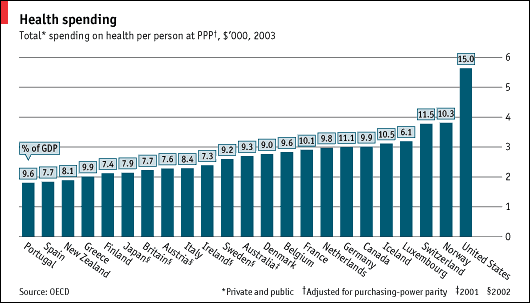
HealthSpending.gif

Courtesy of The Economist

I'm so puzzled at how it is we spend so much in this country, but yet we seem to get so little for what we spend. Many of these countries have universal healthcare, yet we're still outspending them per person. Something just ain't right.

Sunday, June 19, 2005

Identity Theft, Credit Cards, and You: Part I

  • Credit Card Fraud - Approximately 54% of consumers reported credit card fraud -- i.e., a credit card account opened in their name or a "takeover" of their existing credit card account;
  • Communications Services - Approximately 26% reported that the identity thief opened up telephone, cellular, or other utility service in their name;
  • Bank Fraud - Approximately 16% reported that a checking or savings account had been opened in their name, and/or that fraudulent checks had been written; and
  • Fraudulent Loans - Approximately 11% reported that the identity thief obtained a loan, such as a car loan, in their name.

Chart and information take from: Prepared Statement of the Federal Trade Commission on ID Theft

So as to not allow you the opportunity to obtain ANY comfort from the numbers you see above (i.e. you may be thinking they're low, except maybe those for credit card fraud), I must point out that this is from a presentation given in July 2000. Trust me, be assured, these numbers are LOW for now when the numbers are higher, and surely this past Saturday's article in the Times MasterCard Says 40 Million Files Are Put at Risk makes the case that this is a very real problem. If that doesn't bring you around, know that the problem is such that we now have Preventing Identity Theft for Dummies - if there's a dummies book about it, it's clearly something to be paying attention to.

So how concerned should we be? VERY. Here's a tidbit from an article, Personal Data for the Taking by Tom Zeller, that ran in the Times back on the 8th of May (it's not available for free online from the Times, but you can get it from The Hearld Tribune and you can also Google for the article and find it from other sources as well):

Senator Ted Stevens wanted to know just how much the Internet had turned private lives into open books. So the senator, a Republican from Alaska and the
chairman of the Senate Commerce Committee, instructed his staff to steal his identity.

"I regret to say they were successful," the senator reported at a hearing he held last week on data theft.

His staff, Mr. Stevens reported, had come back not just with digital breadcrumbs on the senator, but also with insights on his daughter's rental property and some of the comings and goings of his son, a student in California. "For $65 they were told they could get my Social Security number," he said.

That would not surprise 41 graduate students in a computer security course at Johns Hopkins University. With less money than that, they became mini-data-brokers themselves over the last semester.They proved what privacy advocates have been saying for years and what Senator Stevens recently learned: all it takes to obtain reams of personal data is Internet access, a few dollars and some spare time.

Working with a strict requirement to use only legal, public sources of information, groups of three to four students set out to vacuum up not just tidbits on citizens of Baltimore, but whole databases: death records, property tax information, campaign donations, occupational license registries. They then
cleaned and linked the databases they had collected, making it possible to enter
a single name and generate multiple layers of information on individuals. Each
group could spend no more than $50.

Although big data brokers can buy the databases they crave - from local governments as well as credit agencies, retail outlets and other sources that
students would not have access to - the exercise replicated, on a small scale, the methods of such companies.

Getting enough information about you such that a person can open up accounts in your name, which you would never know about, is not hard at all for someone committed to doing so and if someone's willing to put up some money, as little as $65 as Senator Stevens tells us, you can get everything needed to become you, to include your social security number. If that's not a little bit frightening to you it should be, honestly.

I myself haven't had a case of identity theft hit me (not that I'm aware of at least.) I have had a credit card compromised, and in my case in a very unusual way or at least in a way I hadn't thought about before. Feri and I were out getting her a pair of snow boots a little over a year ago --- if you live in RI during a bad winter you know why we were out buying snow boots. Anyway, I put the boots on my credit card and off we went to see a movie. Within 24 hours I'm getting a call from my credit card company asking me if someone who has my card is in Australia going on a shopping spree? No, indeed not. Apparently what happened was that when I used my card someone behind the counter double swiped it, once to allow me to make our purchase, and then again into a portable scanner:

that they likely had attached to their own laptop behind the counter (similar scams have been rigged at ATM machines, and gas stations.) They captured my credit card information and later that night the information was sold to someone on the other side of the world where the cyber-savvy thief or thieves went on a shopping binge. Fortunately my credit card company scans for suspicious activity (I'm sure that they have computers with special programs that look for odd activity on member cards, like how is it a guy who bought snow boots in Rhode Island is six hours later buying luggage and what not in Australia?) and quickly killed the card. I normally check my credit card account online just about every day, but it takes anywhere from 48 to 96 hours, sometimes longer, for a purchase to post to my online account and God only knows how much damage these people could have done to a card that's paid off every month and with a respectable limit on it before I would have seen what was going on.

So I am now a full-fledged member of Club Paranoid when it comes to information related to myself and my card use. I routinely use a shredder to destroy any documents with personal information (it really should be a cross cut shredder or one that makes confetti, but my old straight cut/ribbon cutter works well enough and you'd have to be a pretty darn industrious thief to put together my records, especially after I mix them up with the house trash), I'm more mindful of to whom I give my social security number (I'm still amazed at the number of places that expect you to give it up, or institutions, like colleges and universities, that think it's a great idea to use your SSN as a student identifying number --- aaarrrrrrrrrrgggggggggh!). I also try to be more mindful of where and with whom I use my credit card, but in all honesty that's a lost cause as I would never have suspected losing my card information where I did, how I did, but my credit card company security representative (a nice guy, we had many conversations on the phone) assures me that this type of scam is on the rise so we best all be mindful.

Tomorrow: What to do to minimize identify theft and erroneous financial information.

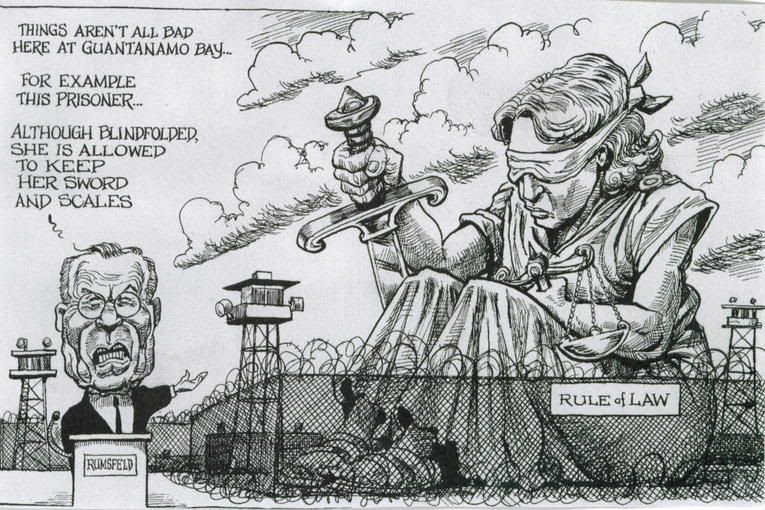
EconomistCartoonJune182005I.jpg

Courtesy of The Economist

Saturday, June 18, 2005


http://www.freekatie.net/

I stole the pic from The Corpus Callosum, and if ever there was a righteous call to action here's one. Don't sweat taxes, the vote in Iran, terrorist activity in Iraq, OR the Downing Street Memo, get involved in any local efforts to help extricate darling Katie Holmes from the clutches of the monkey-boy:

tom-oprah-jump.jpg

(well, on Oprah anyway) scientologist (yes, I think I was supposed to capitalize that ... darn):

(oops!!! Sorry, wrong Hollywood Monkey boy scientologist, though this one does look very simian --- now do you see why scientology is bad for you?)

Tom Cruise. If ever there was a cause worth your time and money, this is it.

Echo

mourn_with_those_who_mourn_by_libelle.jpg
Picture courtesy of Jai the Pirate at Deviant Art

Come to me in the silence of the night;
Come in the speaking silence of a dream;
Come with soft rounded cheeks and eyes as bright
As sunlight on a stream
Come back in tears,

O memory, hope, love of unfinished years.
O dream, how sweet, too sweet, too bitter sweet,
Whose wakening would have been Paradise,
Where souls brimfull of love abide and meet;
Where thirsting longing eyes
Watch the slow door
That opening, letting in, lets out no more.

Yet come to me in dreams, that I may live
My very life again though cold in death:
Come back to me in dreams, that I may give
Pulse for pulse, breath for breath:
Speak low, lean low,
As long ago, my love, how long ago.

--Christina Rossetti

Friday, June 17, 2005


I suppose it's no secret that I've been on something of a rant about Bush and taxes. Yesterday's blog entry highlighted a NY Times editorial about the Bush economy. I believe it was sufficiently trenchant a piece to make clear that many of us not anywhere near being rich are more and more susceptible to a tax bite, while our rich brothers and sisters are finding less and less of their income being taxed, especially unearned income which comes from investments or savings (I'm sorry, I am still past understanding why the money I earn with my sweat should be taxed MORE than the money earned from sitting in an account somewhere accruing interest, dividends, or share value increases which are gained in sales of those shares). I talked about Bush's Stealth Tax Increase a little over two weeks ago, where I got to get into the Alternate Minimum Tax which threatens to take a tax bite out of a larger percentage of the non-rich American people's income, which was decidedly NOT what it was intended for. With that entry two weeks ago I alluded to the fact that Bush had a committee looking into re-vamping the tax code and that we should be seeing the results of that sometime soon (it was supposed to be 31 July.) Which is what brings me to this subject, hardly one people tend to be overly excited about, but again.

Last night I'm reading the following article, White House Delays Timetable for Tax Overhaul. The article's short so let me quote it in its entirety:

President Bush's growing difficulties in pushing through an overhaul of Social Security imposed a new cost today: a delay in his plans for a top-to-bottom revamping of the tax code.

White House officials announced today that Mr. Bush would wait an extra two months for his special advisory panel to make recommendations on tax overhaul, saying that they needed to keep their focus on an unfinished agenda that includes Social Security, a trade pact with Central America and budget issues.

The decision means that Mr. Bush is unlikely to even propose a big tax measure until next year, mainly because administration officials have become far more bogged down on Social Security than they expected to be at this point. The announcement comes as Republican lawmakers are becoming openly pessimistic about their chances of passing a Social Security bill this year, because Democrats remain uniformly opposed and many Republicans are dubious as well.

Shortly after he won re-election last November, Mr. Bush announced plans to push for a historic overhaul of Social Security followed by an equally ambitious effort to purge the income tax of its complexity and perhaps replace it with an entirely different kind of system.

Mr. Bush made it clear that Social Security was the first priority, but his time frame for coming up with recommendations on the tax code made it clear that he hoped to begin work on that issue by the end of this year.

Under Mr.. Bush's marching orders, the bipartisan advisory panel was supposed to come up with recommendations for a comprehensive overhaul of the tax code by July 31. The Treasury Department was then to come up with its own recommendations, with a goal of proposing a measure to Congress before the end
of this year.

That timetable is now all but impossible. The panel will wait until September to issue its recommendations, and Mr. Bush would be unlikely to propose legislation until at least next year.

So here's the deal: Because he's bogged down in trying to change a program, social security, that faces a alleged crisis in about 30 odd years, he wants to put off making changes to a program that's going to be robbing more and more money out of American pockets in the coming years. Assuming he can come up with a tax plan that will make most people happy it'll take at least a year before changes can go through, and the AMT pushes itself more and more into the lives of all concerned. But it's more important to focus on social security rather than the immediate problem of taxes --- righto.

I just sent the following letter to my senators and congressman:

Dear

I just read this evening in the NY Times (White House Delays Timetable for Tax
Overhaul) that the president, because he’s bogged down in changing social security, a program facing a crisis (if one should be so generous as to agree that there is indeed a crisis as the president describes it, looming in the future), is pushing back dealing with reforming our tax system. Now the tax system, specifically with regard to the alternate minimum tax, is reaching down into more and more American pockets every year, yet that immediate problem should be put off for correction while we play with figuring out what to do about social security.

I have no clue what the president’s priorities are with respect to people like my wife and I who are threatened by the AMT and a tax system that values with tax breaks unearned income disproportionately to my hard-earned income. I want
to urge you to let the president know that tax reform is a problem today, not
at some point in the future, and the system needs to be fixed now. The president seems to be more concerned about fixing a program that’s not in extremis than he is with unfairly taxing middle-income Americans, and this is just not where I think his priorities should lie. I hope you agree with me and take this message to him.

Thank you.

Sincerely,

Feel free to copy and send one of your own (if you're unfamiliar with how to get through to your political representatives please do go U.S. Senate to find your senator, and United States House of Representatives to find your congressional representative; they all have email so you can go directly to their site and send them your thoughts on this issue.)

Thursday, June 16, 2005

Let's Gouge the "Not Rich at All"

This ran a week ago in the NY Times. If you didn't take note of it then I'd strongly recommend you do so now. This administration's tax cutting proclivities are going to dig into everyone's pocketbook with the exception of those who are well off. Maybe the reason most Americans seem to go along with this is that they think that somehow they, too, are going to be well off. Think again --- there is no reason for anyone reading this to think that they'll be living in the rarefied atmosphere of the truly well-off, and if you make to the $80 to $400K status, which used to be considered "well off", you'll be doing ok but you'll be paying more tax as a percentage of your income than someone making over $400K; this makes NO sense. I've bolded the parts that I think are most worthy of attention:

June 7, 2005

The Bush Economy

With all of the debate about taxes, the economy and domestic spending, it is hard to imagine anyone supporting the notion of taking money from programs like Medicaid and college-tuition assistance, increasing the tax burden of the vast majority of working Americans, sending the country into crushing debt - and giving the proceeds to people who are so fantastically rich that they don't know what to do with the money they already have. Yet that is just what is happening under the Bush administration. Forget the middle class and the upper-middle class. Even the merely wealthy are being left behind in the dust by the small slice of super-rich Americans.

In last Sunday's Times, David Cay Johnston reported that from 1980 to 2002, the latest year of available data, the share of total income earned by the top 0.1 percent of earners
more than doubled, while the share earned by everyone else in the top 10 percent rose far less. The share of the bottom 90 percent declined.
President Bush did not create the income gap. But the unheralded effect of his tax policy is its unequal impact on the modestly well to do. By 2015, those making between $80,000 and $400,000 will pay as much as 13.9 percentage points more of their income in federal taxes than those making more than $400,000, assuming the tax cuts are made permanent. Below $80,000, most taxpayers will see their share of taxes rise slightly or stay the same. Mr. Johnston's article quotes a prominent economist who argues that people care more about the chance to move from one income class to another (upward, of course) than about income distribution. But during the Bush years, the two main sources of class mobility - a good job and money for higher education - have increasingly failed to materialize for those who most need them. Last week's jobs report from the Labor Department confirmed that a strong labor market recovery has not taken hold. Wages for most working people failed even to outpace inflation in the past year. That might be more bearable if things were rough all over. But the share of economic growth that is going toward corporate profits, which flow to stockholders and bondholders who are concentrated at the top of the income scale, is at historic highs.

Which brings us back to the super wealthy and the merely rich. The divide between rich and poor is unfortunately an old story, but income-class warfare among the top 20 percent of the scale is a newer phenomenon. One cause is that the further up the scale one goes, the more of one's income comes from investments, which under the Bush tax cuts enjoy about the lowest rates in the tax code. But many families making between $100,000 and $200,000 are not
exactly on easy street. They don't face choices anywhere near as stark as those encountered further down the income ladder, but they face serious tradeoffs not experienced by the uppermost crust, particularly when hit with the triple whammy of college for the children, care for aging parents and preparing for their own retirement.

There is something deeply wrong about a system that calls into question a comfortable retirement or a top-notch education for people who have broken
into the top 20 percent of income earners. It starts to seem politically explosive when you consider that in a decade, those making between $100,000 and $200,000 will pay about five to nine percentage points more of their income in federal taxes than those making more than $1 million, assuming the Bush tax cuts are made permanent.

This is not about giving wealthy people more money to invest back into the economy. At this level, it's really about giving more money to those who have nothing to do with it except amass enormous estates for their heirs. Fixing the problem will require members of Congress to summon the courage to say no to a president who wants more for the richest of the rich at the expense of everyone else. We're not holding our breath.

Blogger's note: This affects you, gentle reader, and if you're not complaining about it and demanding that it be changed, it's you in your retirement, your kids, and your kid's kids who'll be suffering from it in the years to come.

More on this tomorrow --- I'm on a rant after reading something in the Times this evening.


Picture taken from Buy.com

"Wasn't anybody sorry? ... The after-the-fact rationalizations were strikingly similar to the mind-set that brought about the Enron scandal in the first place. All the arguments were narrow and rules based, legalistic in the hairsplitting sense of the word. Some were arguably true --- in the way that Enron itself defined truth. The larger message was that the wealth and power enjoyed by those at the top of the heap in corporate America --- accountants, bankers, executives, lawyers, and members of corporate boards --- demand no sense of broader responsibility. To accept these arguments is to embrace the notion that ethical behavior requires nothing more than avoiding the explicitly illegal, that refusing to see the bad things happening in front of you makes you innocent, and that telling the truth is the same thing as making sure that no one can prove that you lied." (pp. 406)

Feri and I were at the Navy Exchange. Normally Feri will go off and look at the clothes (which I'll concede do tend to be less expensive than anywhere else), and I'll wonder around the book section. There aren't many books, but I have to say that often there are interesting ones there and this one caught my eye, having come out in paperback. If I have book or magazine with me (on this day I didn't) I'll normally head out to the car and read (after gassing it, and on this day I got the a/c going so we could both better deal with an unexpectedly hot day) while I wait for Feri; this book became my impromptu reading fodder. I didn't think it would suck me in, I thought I had been "Enroned" out --- how wrong I was.

The piece of the book I quote above comes from the epilogue, and it seems to so totally sum up what you read throughout the book. It's hard to believe that the Enron debacle could ever have happened. Before this book I knew that there were many enablers to this disaster who should have been working to prevent it from happening, not the least being Arthur Andersen which at the time was the premier accounting firm in the U.S. and should have kept this from ever getting to the point where everything imploded as it did. On that note, the recent Supreme Court "vindication" of Andersen was hardly clearing the company of its responsibility for the Enron meltdown, it was merely a technicality related to the extraordinary amount of document shredding that went on at the firm before Enron totally self-destructed. Andersen, only second to Enron itself, was responsible for the Enron disaster, because it allowed itself to be sucked into Enron and completely lost its perspective as an overseer responsible for preventing shady business practices and accounting out of fear of losing its fees from the company.

This book gives you a sense of all the characters, the corporations and analysts that looked the other way and didn't do their due diligence, that only focused on making money off the premier cash cow of the decade, the media that went along with the hype and made heroes out of the worst of the Enron criminals, and the academics who you'd think would ask questions but were more interested in fascinating case studies (with Harvard leading the pack) than in whether what they were looking at was indeed representative of the sort of reality that MBA students should be heading into.

Then there was the ethos that ran throughout the business world at the time but which seemed to be crystallized at Enron. It was about thinking you're smarter than anyone else, that you can pretty much do anything so long as you had a plausible cover story and you were making money for the company and yourself, and more than anything else it was making as much money as you could without regard for how what you might be doing was wrong though could "technically" be considered legal or for which you could somehow muster plausible deniability. The book is about over-sized personalities, greed, self-deception, and extraordinary hubris, it's on par with a Greek morality tale and I fear that it highlights traits that are still very much apart of the American corporate landscape. I can't say I followed everything in the book, I just don't have enough of a background in finance or investing in general, but that wasn't important as it was pretty clear as you moved along in the story that you were reading an extraordinarily well-written and engaging stoary about how people build a house of cards on a foundation of marbles, and go on to tell the world that it was an Egyptian pyramid that would last for many a millennia.

An eye-opener, and a pointed reminder of what people are capable of. Not a pretty story at all, and it's hard to get through it without at multiple points finding yourself shaking your head in disbelief or disgust. I'm looking forward to seeing the documentary by the same title that is based on the book.

Tuesday, June 14, 2005


Winds of Change Blowing in Iran?

I lifted the above picture from Iranian.com a site most Iranians here in the U.S. who are concerned with Iran will visit fairly regularly as it tends to cover events in Iran more comprehensively than the U.S. news sources do. The photos from the recent demonstration by women in Iran are captivating for someone like myself who has followed the country with some interest. The NY Times has also reported on the demonstration depicted above with Sunday's Hundreds of Women Protest Sex Discrimination in Iran [you can also get an NPR report on the demonstrations and developments in Iran.]

The Iranian women that I personally know to a woman have college degrees, and otherwise are working on a masters, have a masters and are professionals or working on their PhDs, or otherwise have their PhDs (this includes my wife). I've come to appreciate, especially in light of some of the limited research I've done to support this blog entry, that my view of Iranian women is actually somewhat skewed. A chart breaking down the education levels found in various countries of the Middle East and some countries of Africa is found at the Population Reference Bureau. This chart complicates my personal perception of Iran as I was under the impression that Iranian women were the most well-educated females in the Middle East; clearly that's not the case. But something's brewing there to cause these women to protest like this, and protest is not something that's looked upon kindly by those in power in Iran. From the Times article one get an idea of some of what these women are protesting about:

Iranian law stipulates that the value of a woman's life or her testimony in court is half that of a man's. Iranian men can marry up to four wives and have the right to divorce any of them at will. A woman inherits half of the share of her brothers and needs her husband's permission to work outside the home or to leave the country. Women are rarely promoted to high positions, and despite their relatively high levels of education, they make up only 14 percent of government employees.

It should be pointed out that polygamy is not common in Iran, and for what there is the first wife is supposed to give her approval for any additional marriages. That said, the Times piece touches on only some of the problems women in Iran have to deal with, there are many more. Something not mentioned here, and which I've always had a hard time with, is temporary marriage [or mut'a], a religious "right" only found in Shia Islam. I quote the following from Nikki Kiddie's Modern Iran: Roots and Results of Revolution:

In this form of marriage, early outlawed by Sunnis, the duration of the marriage is stated in the contract --- anywhere from minutes to ninety-nine years. As in all marriages, the husband gives a sum of money. The temporary wife or wives could be in addition to the four maximum regular wives. Temporary marriage flourished in Shi'i pilgrimage centers where mollas [blogger's note: Shia clerics] might be intermediaries; both Sunnis and Westerners often characterized the custom as "legalized prostitution." It has, however, other uses, and even when of short duration it has the advantage that the children are legitimate and the temporary wives, even when professionals, are not breaking any law and are less stigmatized than prostitutes. (pages 32 - 33)

Essentially, on the whole, it lets men have lovers and through this device the lover is protected if she has a child with her being able to give the child the father's name (and possibly give the child up to the father as he has the right to custody of the child up to the age of 8), and she's not considered a loose woman in the context of her legal sexual liaison. So the men get the freedom and the women get the protections, which on the whole hardly seems like a right that treats both parties fairly. Moreover, if a married man engages in a mut'a that's acceptable and even legal (though technically the first wife would still have to approve, a restriction not always adhered to), but the same privilege is not extended to his wife, as of course isn't the right of polygamy. What I find interesting is that I've heard Iranian men (studying here, though very likely to stay in the U.S. or somewhere else in the west) defend the practice and not a single Iranian women has anything good to say about it.

You get a sense of Iranian women's rebelliousness from, of all things, their dress. Women's dress is also restricted, as is the case in Islamic societies throughout the world, but Iranian women seem to be in the forefront of subtly going against Islamic restrictions by virtue of how they wear their head scarf and the outer garment called the mantou (the women in this picture are wearing mantous over their jeans) or the hejab. The hejab is a traditional garment worn by many Muslim women, while the mantou is more specifically associated with Iranian women. Along with wearing a scarf to show as much hair as possible (the intention of the scarf is to hide a woman's hair, not to act as a focusing device on her hair, which is more how Iranian women have come to use the scarf), Iranian women, especially in the cities, make fashion statements with their mantous. All of these fashion statements come with some risk as there are religious police (the monkarat, often working in league with the basij) who roam the streets looking for offenders of the faith, and women can be picked up and taken to jail for improper dress (this includes too much makeup, showing too much hair, a mantous that's considered improper, etc.) --- how active they are seems to depend on the mood at the time of the conservatives actually running things in the country.

However you cut it Iranian women, and Islamic women as a whole be they Sunni or Shia, are not equal to men. I'm not surprised that it's Iranian women who are fighting for the equality as they have gone through things within their own society and how they're treated by it that other women in the region have not, with the Islamic Revolution topping the list, and they do have a strong sense of themselves. How they measure up against their other well-educated sisters in the region I don't know, but they're the ones making the noise. (For those not in the know, Iranian women are not Arab, they're ethnically separate and consider themselves Iranian or Persian, though Iran itself does have a fairly sizeable non-Persian population, to include Arabs, specifically in the south of the country ---the population ethnic make up, from Wikipedia - Demographics of Iran is as follows: Persians 51%, Azeri Turks 24%, Gilaki and Mazandarani 8%, Kurds 7%, Arabs 3%, Lur 2%, Baloch 2%, Turkmen Turks 2%, other 1% .) These demonstrations are likely tied to the soon to be held elections (in 3 days, on June 17th) and if the women can make any traction on their issues there's hope that others with legitimate complaints about freedom in Iran will be emboldened to push for change.

How much the country does change over the coming years is unclear, though that there's pressure to change is not in doubt. It's very likely that Rafsanjani, the president from 8 years ago, will be re-elected in 3 days (he is not especially popular in his own right, vice more being perceived as the best candidate out of an otherwise untenable group --- whether he'd be actually good for the country is an open question.) He, as are other candidates, is making strong appeals to the 75% of the population that's under the age of 35. It is the same younger generation that came out in record numbers to vote in the moderates and Khatami, the outgoing president, and then were let down in the ensuing years --- whether they'll see themselves having as much of a stake in this election is not entirely certain [Will Iranians vote? ], though the indications are not good at this point [there are many, to include the deposed Shah's son, Reza Pahlavi , exhorting voters not to come to the polls--- I would expect, and frankly hope, that Pahlavi involvement in this matter would increase voter turn out, for as much as he may be paid any attention in Iran.]

It's a combination of the relatively well-educated population, its extraordinary young age, and a yearning for something more that we're seeing expressed by the women of Iran, and that will help to move the country into change. The U.S. needs to be in a position to work to help change in Iran without interfering in the country. Iranians by and large like the U.S., and with making the right moves at the right time we can possibly bring our countries to a more reasonable relationship than has existed for the past 26 years. Having Iran as a friendly nation vice an enemy is better for both nations, but whether this administration and Iran are each flexible enough for the sort of changes that will need to happen for this to occur remains to be seen.

The women's demonstration in Tehran may well be a harbinger of things to come in the following months. I expect events in Iran to be very interesting in the next six months to a year, and I hope that the players that need to be prepared to facilitate the best outcomes, both here and in Iran, are ready for what may come --- if history plays out as it has in the past that's likely a bit much to expect.

Monday, June 13, 2005

Let's Save SS, But NOT Bush's Way!

As a starter I'd just like to clarify that most of the information for the first 5 points that follow comes from an opinion column in the NY Times entitled How to Save Social Security which ran October 2, 2004. The rest of the information is culled from various sources, to include my head (yes, granted, we're in murky terrain there, sorry.) I will state that the idea to hold a weekly bake sale at local supermarkets to generate funds for SS was definitely MY idea, if any copyright considerations should arise at any point in the future.

Let's hit the main problem here: Bush and his minions (henceforth Bushies), and a long list of
neo-conservatives and libertarians who feel that Santa blessed them for Christmas by giving them the country, are ideologically opposed to raising taxes in any form. Starting from that line of thinking the only way to save SS is to cut the program's benefits, to include payouts. SS could be propped up by diverting funds from other government programs, but that's not likely to happen as the only government agency that comes out ahead moneywise these days is the
Department of Defense, and the Bushies are loath to cut money there, it's not a manly thing to do, and if they did sending it on to old people, widows, and parentless children seems like such a wimpish thing to do, definitely not in the conservative spirit of things. Let us keep in mind the startlingly obvious, i.e. those who benefit most by a decrease in taxes are those who pay the most taxes. Let's be clear though, they pay more in terms of the overall amount, but as a rule they pay less on the basis of a percentage of their income and they also have less reason to care one way or the other whether SS will be there for them or not when they retire. Therefore
undoing tax cuts by reimposing them also isn't in the republican spirit of things.

Now here's an interesting tidbit: If Bush's current tax cuts were locked in over the next 75 years, the loss in revenue would cost about three times what it would take to "fix" SS. And who benefits most from from cutting taxes on unearned income, as opposed to the "earned" income you make by busting your butt getting up early in the morning and doing a job? Well, if you have a lot of investments which reap dividends, accrue value which you later take by selling the investment, or you make a lot of interest, you love G.W. Bush and his tax plan as your unearned income is taxed much less than it was before. The other good deal for the well-off from the Bushies is the repeal of the estate tax, which some clever PR person working for those who wanted to do away with the estate tax converted into the "death tax" --- made it seem like it applies to all of us since we all die, though few of us own estates. If the estate tax were retained mind you, this tax applies to only about 5% of the American people, though hope seems to spring eternal for many of us) and the revenues from it were directed into SS, 1/3 of the SS gap would disappear.

Ok, here's a message you've not been hearing much of, for no politicians seem to be addressing what could be done to save SS, and the news media seems to not have heard of anything that would: We can fix SS so it pretty much exists in 50 years as it does now. To get SS fixed will require small cuts in benefits and minimal tax increases. The idea is to generate the necessary revenue across an array of options such that the rich aren't being soaked to fix the system (you see, I don't hate the rich) and ultimately the elderly, widows, and parentless kids are not left with a disemboweled program. Here are some proposals to take under consideration:

1. Link benefits to increased life expectancy. The age at which you can collect full benefits is presently 66, going up to 67 in 2022. Continually raising the age for full benefits isn't practical or fair. To accurately reflect life expectancy the costs for SS should be routinely updated, say every ten years, and the responsibility for funding the extra costs shared
between the retirees and workers through small automatic reductions in future benefits and a minimal increase in the payroll tax.

For an average 35-year old today, the benefit cut in 2036 would be the equivalent of about $300/year. For workers, the tax increase would start 10 years from now and rise each decade. By 2036 the rate would be 12.7%, up from 12.4% today.

Doing this would close about one-third of the SS long-term financing gap.

2. Link life expectancy to income levels. Fact: the rich live longer than the poor, and the difference is growing. It may not be fair, but it is what it is. So this means that those with the highest incomes get the largest share benefits checks, and for longer periods of time.

High-earning workers get 15 cents in benefits for every dollar of earnings, reducing that to 10 cents per dollar would make the program more progressive.

Doing this would close the SS imbalance by 10%.

3. Slowly change the point at which SS taxes are no longer paid. In 1983 SS reform capped payments to SS at $87,900, i.e. if you made anything above this cap you didn't have to pay SS taxes on that money. In 1983 only 10% of wage earners made this much money, today it's 15%. If the wage base were increased over 40 years so that the inflation adjusted wage level were at the 1983 level, some 10% of the SS shortfall would disappear.

4. Wages above the wage cap should also be taxed. This would seemingly be in contradiction to #3, but not so. The idea is that wages above $90,000 (this is the level for wages as of this year) would continue to be taxed, but at a lower rate than for wages below $90K. The original argument for the cap was that benefits from SS would max out regardless of how much was contributed, therefore high-earning contributors should have their contributions capped. But contributions to SS not only pay into benefits but towards an overall debt incurred for past and present recipients and the burden of alleviating that debt should be shared by everyone. Taxing wages above the cap at 3 to 4%, matched by employers, would correct about 1/3 of the SS imbalance.

5. Bring state and local workers into the system. Some 4 million state and local government employees do not contribute to the SS system. This was true of federal employees as well until 1983. Bringing state and local workers into the system would decrease the SS debt by 10%, and a small increase in the SS payroll tax, about 0.2%, would cover costs for the new members into the future.

6. Selectively increase SS benefits for seniors per the consumer price index (CPI). Presently this is done by pegging SS benefits to increase in wages. Retain the present system for low to middle income recipients and shift to the CPI for high-income recipients.

Some additional potential revenue generators:

1. Raise gas taxes by 5 cents a gallon. Yeah, who needs to pay more at the pump? Well in this case you're paying more for yourself and your present and future family so in a way it's forced savings. Yes, it's a regressive tax, but it falls more on people who tend to drive (the poor don't drive as much as those better off), especially those with large vehicles who guzzle LOTs of fuel. It also works as a part of a comprehensive energy policy to help wean this country off of foreign oil.

2. Impose a 1% national "sin" tax. This which would generate revenues on cigarettes and all other tobacco products, alcohol, Starbucks coffee (ok, not just Starbucks), and pastries. Ok, the last one is a bit "out there", but we no more "need" to eat cake than we need to smoke or
drink. Again the money would go for a legitimately good cause and given our general low level of consumption of these things, be barely felt in our pocketbooks (well, for most of us anyway.)

3. Invest in the market! Gosh, isn't that what Bush wants to do? Well yes, but he wants tens of millions of busy Americans, many of whom are pretty ignorant about investing, to become reasonably adept at investing for their futures. Frankly that's an unreasonable expectation, ESPECIALLY from a president who was clearly a poor investor in anything other than politics, where it has been our misfortune that the man's apparently very adept and quite lucky.

Now there's no reason that the government shouldn't take on the risk of investing, with a few rule changes. The SS administration is currently restricted to buying government bonds for the trust fund. The problem with this is that the money then goes into the government tills and can be used for whatever congress decides to, with the understanding that down stream that money will have to be paid back with interest. If the government were allowed to invest in private investment instruments it would:

1. Take on the risk of the investments, which minimizes the potential impact for the average Jane and Joe.

2. Significantly reduce the fees paid to private investment managers as they would be dealing with just the government, not millions of Americans from whom they can charge fees that cut into the overall individual returns on the investments (this has been a huge problem in Chile and Britain, two countries with a privatized retirement system.)

3. The trust fund money is no longer touchable by congress. Putting the money in private accounts takes the funds from selling bonds out of the reach of politicians as the money invested for SS would have to stay in the accounts it was funneled into.

4. Renders some poetic justice of a sort: The big claim by many privatization proponents is that the market won't go down such that millions of people will lose their retirement money. Ok, great, have the government invest in a fund tied to the S&P 500 or the Dow Jones, i.e. when the market goes up so does the fund as the fund is invested in a represtenative sample (and a large one at that) of the stocks that make up the DJ or S&P. If the advice is good enough for the American people why shouldn't it be good enough for the government as a whole? I know this is more complicated with an entity the size of the U.S. govt, but it's doable and it brings the much vaunted (as per the republicans and libertarians) stock market into the mix but with some protections to keep people from losing their investments or getting screwed if they happen to look to retire at a down point in the market. The system can be set up such that a certain minimum amount is always avaiable for investors who retire and have to tap into this money in their retirement.

There you have it, Ruminating Dude's recommendations for saving SS, which should and can be available for everyone regardless of their age in another 50 to 100 years if we were only willing to make the sacrifices NOW needed to keep the program healthy, but G.W. and the republicans don't want you to feel any pain, your kids and theirs are supposed to feel it for you.

Sunday, June 12, 2005


01-libertarian.jpg


TomTomorrowSocialSecurity.gif

Saturday, June 11, 2005


Ok, we call it social security (SS), but how is it reflected on your pay stub? Usually you’ll find a deduction for OASDI, not SS. OASDI and SS are one and the same thing, though nearly all of us know it as SS. OASDI is an acronym for Old-Age, Survivors, and Disability Insurance. Coverage for “survivors” and “disability” didn’t come about until the sixties, but the word that’s most important here is “insurance”.

There are 2 definitions for insurance that bear on this:

1. Coverage by contract whereby one party undertakes to indemnify or guarantee another against loss by a specified contingency or peril. And:

2. A means of guaranteeing protection or safety.

OASDI was created as a means to protect against a loss of total income in the event another depression akin to the Great Depression ever happened again. Of course this was a very real concern in 1935 given the consequences of the Great Depression in the preceding five years and going into the next six, where families lost everything, unemployment peaked at 30%, most of the elderly were especially hard hit given the lack of jobs and pensions for retirees, and the prospects for the future were greatly clouded.

This was something of a risky bet back in the 30’s. During this time betting on the U.S. government wasn’t such a sure thing, and indeed betting on Uncle Sam was what the government was asking the people to do. There's no more visceral connection to something than that which you put your hard earned money into, and in this case the government was asking citizens to turn over their money to for safe keeping until they were of retirement age.

Communism
during this time in our, and the world’s history, was a very attractive alternative government and economic system to a capitalistically driven alternative, especially one that had recently failed miserably to sustain a user-friendly level of economic stability for the country. By getting the American people to buy into social security Roosevelt was being extraordinarily daring and clever, in fact I'd go so far as to say that it was one of the cleverest marketing campaigns of this past century as people were being asked to sustain the government by buying into it. Roosevelt was making the promise that the government was going to be there for us when we got old, regardless of what we saved on our own or the condition of the country at the time, and this provided a great deal of comfort to a nation of people who were profoundly scarred by what they saw from the Great Depression. Of course this isn't what Michael Barone or the Cato Institute would like for you to believe as I mentioned in yesterday's post.

Whatever the underlying implications there were to SS, the purpose was to create a progressively-based insurance system, not per se a retirement system. The idea was to make all wage-earning Americans pay into it, thereby spreading the cost of the system, which in the end would create what was essentially an annuity that would provide benefits to participants until they died, NOT until what they put into the SS fund was doled out. The prevailing promise, though, was that the American
elderly would never be left financially high and dry as they had been during the Great Depression. The reality is that today such a guarantee is every bit as important to Americans as it was some 70 years ago, but for slightly different reasons. Today companies are bailing out of their pensions and retirees will be fortunate to see a percentage of what they originally expected in retirement, and the old defined-benefit retirement plans which were once a sure thing if you kept a job are being replaced in large measure by retirement plans that are tied to the stock market or other investments with associated risk and their are no guarantees for what a retiree will find themselves left with to live on when they retire. Social security today is insuring against loss, the nature of the
loss is simply different from what it was 70 years ago.

Barry Schwartz, who wrote Choose and Lose in the NY Times on the 5th of January 2005, offers
this about the insurance aspect of SS:


This brings me to the final defense of privatization: the payroll taxes you pay are your money, and you ought to be able to do what you like with your money. This, I suspect, is the real justification behind the move to privatize, and it is the worst reason of all. The payroll tax is not "your" money; it's our money. Social Security was created as an insurance scheme, not a pension scheme. It was meant to provide a safety net, to protect the unlucky from immiseration [blogger’s note: not a common word at all, mostly used in economics circles, meaning to make miserable or impoverish] in old age. The benefits we get are not payouts from accounts in which we have accumulated our own private stash. What we get is largely determined by what we earned, but we keep getting it even after we've taken out every penny we put in. And if we happen to die early, someone else
reaps the benefits of our contributions.

Granted, Schwarz is a psychologist, not an economist, whose most recent work is The Paradox of Choice: Why More Is Less, but the point is valid enough. If you die before you reap what you invested in an insurance system, what remains of what you put in doesn’t go to your heirs, so in effect it’s NOT your money, the same as it’s not when you die under a standard insurance annuity
(though you can make provisions for spouses that will keep benefits flowing). Any money “in excess” goes to the system to be used by all the other participants. Of course the advantage to this is that you very often get to take out of the system more than you put in.

Ok, my next post will talk about some suggestions as to what we can do to help "fix" social security.

Friday, June 10, 2005

Cinderella Man, The Great Depression, and
Social Security

On Monday I took Feri to see Cinderella Man. She was more interested in seeing it than I, though I was curious enough about it. I've had an aversion to boxing movies as I've gotten older, mostly because of the up close, methodical, and animalistic brutality that comes with watching a fight. There's something very atavistic at work when we take pleasure and are willing to pay to watch two men attempt to destroy each other in such close proximity. I can make my way through a boxing movie mostly by telling myself that this is just a movie and I'm not really watching a fight, but even then I can't escape the thought that we're a savage bunch when we put men through this for money and our pleasure.

The movie wasn't a bad one at all, and Russell Crowe isn't a bad actor when he's not throwing telephones at concierges, and I very much enjoyed watching Paul Giamatti, of American Splendor (a superb movie about dysfunctional people and what they're capable of) and Sideways (not a bad movie, but I never got why there was so much "buzz" about it) do his thing as Joe Gould. The story, which is based on a true-to-life character by the name of James Braddock, portrays a man who in just about every sense would be considered a hero. He raised above the odds against him, and became an inspiration to many people for overcoming adversity, and in that his story is very inspiring. On the whole, though, with this movie we're talking about Rocky set during the Great Depression so the story isn't all that original, and I suspect Braddock never had a city construct a statue in his honor the way Philadelphia did for Stallone's Rocky character, so it does cause one to wonder about our love for myth over reality.

Ron Howard does a pretty good job of focusing on the Depression and what it did to people, and in a way this is a story that merits its own movie . Most people that are alive today have no connection to the Depression, whereas I grew up with grandparents who had lived through those years and had heard all the stories about not trusting banks, people putting their money in their mattresses, learning to eat parts of an animal we wouldn't touch today (kidney, brains, liver, tripe --- cow stomach, pigs' tails, ears, and feet --- gag!) because they were cheaper, and God forbid putting money into stocks given what the Great Depression did to so many people. To convey some general sense of what the Depression did to the country, at its height 30% of the population was out of work. The chart above averages out unemployment over the course of a year's time so you don't get to see the unemployment spikes --- imagine that, 30% of a country unemployed, just about 1 in 3 working Americans were unable to find jobs.

There were a multitude of factors which brought us into the Depression: Globalization and the resulting trade embargoes that arose in response to it; the introduction of liberal credit to everyone, and the unbridled enthusiasm with which people took advantage of this new tool to make purchases with which to keep up with the Jones and Smiths; an unregulated stock market which issued shaky stocks, and with the option to use credit to buy for people who were convinced that the stock market was a sure thing money machine; a banking system which was uninsured and unrestricted in where it could make investments, to wit: the stock market; and the eventual stock market crash of October '29 served as the nexus for bringing everything together into a depression of not just national, but global proportions. When you watch Cinderella Man you truly do get some sense of what it was like in those days, and you can appreciate why people flirted with communism and socialism, something which was forgotten, on purpose I'm sure, by people in the fifties like Eugene McCarthy and Roy Cohn who made a career out of witch hunts against good people who were at their wit's end during a period of economic devastation in this country. Franklin D. Roosevelt came to office as president in 1933, and from then up to the Second World War (which is when the Depression was finally beat back --- in a very real sense many dead bodies went into overcoming the Depression) did what he could to fix what put so many out of work, though he never quite made it to halving the annual maximum. One of the safeties that Roosevelt was responsible for was Social Security, the intention of which was to make sure our elderly were never without something to live on so long as this country remained in existence. Later on the program took on a greater range of coverage, but the original intention was to protect retirees who were otherwise without pensions or had small fixed incomes.

What got me thinking about all of this, but again, was an article in U.S. News & World Report by Michael Barone, Future Shock, with the catch line from the article displayed by the magazine's
presentation folks being "The lesson is that experts can err and big organizations can't always be relied on." He then goes on to inform us that the Supreme Court has decreed that social security benefits are NOT a right --- whoooooa, you say, receiving something I paid into is not a right? Well, as I expected, Barone's use of a Supreme Court case to support this point is somewhat misleading. Flemming v. Nestor , the case he cites, boils down to the following:

Ephram Nestor was a Bulgarian immigrant who came to the United States in 1918 and paid Social Security taxes from 1936, the year the system began operating, until he retired in 1955. A year after he retired, Nestor was deported for having been a member of the Communist Party in the 1930s. In 1954 Congress had passed a law saying that any person deported from the United States should lose his Social Security benefits. Accordingly, Nestor's $55.60 per month Social Security checks were stopped. Nestor sued, claiming that because he had paid Social Security taxes, he had a right to Social Security benefits. [Courtesy of the Cato Institute which would also like to remind you that Social Security benefits are not a right, and you shouldn't count on them.]

Ultimately how fair this was to Nestor is in my mind questionable, but Congress said if you're deported you're not entitled to social security, i.e. you may have a right to claiming it in another context but if we kick you out of the country collecting it isn't in fact a God or governmentally given right. You can be sure that if the American people had it in their heads that this wasn't a right, i.e. you put money into something and remain an upright citizen that you should get something in return, that the law would be changed to reflect that it is a right after the citizenry raked their representatives over glass somewhere.

Barone then points out how we've moved from defined benefits retirement accounts (such as the ones currently being defaulted on by United, US Air, and others), with retirement instruments like 401K's and IRAs taking their places, and in keeping with this we should also be moving social security to privatized accounts, mostly because it allows the poor to accumulate wealth. I love it when a rich or otherwise well-off guy makes this argument as he often, as in this case, is pulling your leg. The wealth you "accumulate" isn't yours to do anything with in privatized accounts, or at least anything besides determining where you invest it (which would include T-Bills under Bush's current plan, which is exactly what they're invested in now). You can bequeath what's left of your amassed social security wealth (which, remember, you accumulated while you were one of the working poor, and assuming your investments actually increased in value over the time of your investing, AND that when you take your money out of those investments and put them into something less volatile that what you earned indeed reflects an increase in your investment --- lots of caveats there, don't you think?) to your heirs --- Whooop-Tee-Do! For poor folks accumulated wealth only means something when they're dead --- something tells me that wealth with that type of restriction on it is not what Barone normally is thinking about when he uses the word, but it should be ok for poor people - righto!

Social security is indeed heading into fiscal problems, in about thirty years, but hey, they're coming. And we SHOULD do something about heading those problems off. The problem is that Republicans like Barone, who won't be counting on social security for much more than making a payment on their lawn maintenance contract when they're in retirement, are averse to all of us paying something now to take care of the problem that will arise later. There are many
relatively painless options we could avail ourselves of now to help pay off the pending problem --- a simple and easy one, raise gas prices $.01 per gallon so grandma, you, and your kids have something coming into the coffers in 2050, and maybe that extra penny will help people think more about conservation (ok, that's a stretch.) But Republicans don't want you to feel fiscal pain, and hell, really how many of us want to deal with it? But putting the burden of a guaranteed benefit (remember, per Barone and the Cato Institute, it's NOT guaranteed, particularly if you're a communist kicked out of the country) onto the shoulders of poor people, who are then expected to figure out what to invest in during their work lives and then when they retire (you don't just get handed that money when you retire under the private account plan, no, you have to invest it in an annuity, another wonderful blemish and complication to this plan to save social security --- but all this investing does sound like a good deal for people in the investing job arena, who, oh by the way, tend to be Republicans, doesn't it? God, I must get my cynicism in check), vice having all of us take up the load now to fortify the system so it serves the purpose that most working Americans, who don't consider themselves wealthy or particularly expect to make it into those rarified levels of fiscal categorization, expect for it to. And please, please let's stop the horse manure about empowering the poor by helping them to acquire wealth --- Barone and company should be ashamed of themselves.

Yes, experts and big organizations can't be relied upon, but the U.S. government is not just any big organization, it's answerable to the American people who understand the notion of fair especially when it comes to what they'll take from the government, and social security entitlement is not determined by a case specific to a deported communist. Making the average citizen the expert for their retirement payments isn't the answer, nor is subjecting their retirement fund to the inevitable risks of the ups and downs of the stock market, as I would have thought Barone would appreciate inasmuch as he makes the point that the organizations behind the market can't be relied upon. Collectively doing what we need to to make sure that social security maintains a fair semblance of what it's been for the past forty or so years into the foreseeable future is a worthwhile national endeavor, one that we should all be willing to pay a little to make happen - though I guess not if you're a republican or liberterian.

Thursday, June 09, 2005


BushSocSec.gif

Courtesy of The Economist

And indeed, the following remains to be seen:

BushSnakes.jpg

Wednesday, June 08, 2005


theapparition.jpg

The Apparitions
William Butler Yeats

Because there is safety in derision
I talked about an apparition,
I took no trouble to convince,
Or seem plausible to a man of sense.
Distrustful of thar popular eye
Whether it be bold or sly.
Fifteen apparitions have I seen;
The worst a coat upon a coat-hanger.

I have found nothing half so good
As my long-planned half solitude,
Where I can sit up half the night
With some friend that has the wit
Not to allow his looks to tell
When I am unintelligible.
Fifteen apparitions have I seen;
The worst a coat upon a coat-hanger.

When a man grows old his joy
Grows more deep day after day,
His empty heart is full at length,
But he has need of all that strength
Because of the increasing Night
That opens her mystery and fright.
Fifteen apparitions have I seen;
The worst a coat upon a coat-hanger.

Tuesday, June 07, 2005

Contemplation on Road Rage

I'm sitting here after getting my work done for the day, listening to the ding-dongs outside honk their horns at each other. It's 4:30 PM, EST, so people are heading home, and unfortunately we're at the intersection of two busy streets, and there is no left turn signal to the two-way street which crosses the intersecting one-way street, and invariably this causes backups and frayed nerves, resulting in some ridiculous horn mashers. That aside, I was reminded of what happened to Feri and I earlier this morning and now that I've gotten some distance on it I want to write about it.

There was a road rage incident and I was in the middle of it. Unfortunately Feri was with me and had to suffer through the whole thing. Now my wife is one of the kindest souls on the planet (what she's doing with me as her husband is a constant source of amazement to me and no end of contemplations along the lines of "How in the world did I get so lucky?!?", believe me) and
it's anathema for her to show anger publicly, it's just not cool, it's low-class, it's just not done. Fortunately it wasn't me acting like the total fool, but mind you I did help to set the stage.

Some background: We live in Rhode Island. I think it bears keeping in mind that this state ranked last in driver knowledge in a recent ranking of state drivers. Frankly, I'm not surprised as the drivers here are, often enough, crazy. I'd like to blame what I see on the road as being due to the Boston drivers coming through on their way to Connecticut or New York, but alas, the drivers I note tend to have RI tags on their cars. However you cut it, this can be a rough and tumble driving environment, and it's often reflected in the aggravation, expressed in actions (frequent incessant horn blowing, odd ball road tactics intended to --- what, I'm simply not sure, and looks of rage to make Jack Nicholson in The Shining merely appear as if he had a mild case of constipation vice a severe attack of psychopathic possession) that often defy any semblance of common sense or desire for neighborly good grace.

On Monday and Friday Feri and I normally treat ourselves to a simple morning breakfast of a couple rolls (two sour dough for Feri, one for me and a walnut raisin roll), latte, and Naked Juice (usually Blue Machine --- yummmmmmmmmm), at a place not too far from where we live called Seven Stars Bakery. If you live in RI I highly recommend you visit the place, if you happen to visit the city of Providence ditto. So this morning we made our way to Seven Stars,
indulged our usual routine, and we were on our way back to drop Feri off at work at the lab for her day, with my following onto attending to the oddities of my day. We were traveling up Hope Street, a two to four lane road depending where you at in it, and as I made my way a large gold SUV, probably on the order of an Escalade, moved itself about half way into the single lane I was traveling in. The driver, a woman I swear looks VERY much like the lady with the lug wrench in her hand above (a little older, dressed a bit more conservatively, walking with a cast on her right leg --- well, I'm pretty sure it was her right), responded to my short beep on the horn (honest, just enough to get her attention, making minimal noise for 9 AM) by giving me a look to melt cast iron steel with. Well, I'm from NY, grew up in the Bronx, and I can be as stupid as the rest of them --- I simply shrugged my shoulders and moved my way around her, causing her no apparent end of aggravation and evoking a crescendo of horn bleats from her monster vehicle, which she proceeded to move forward to cut me off, but by the time she reacted her only option was to broadside me --- fortunately she didn't do this as she would have been taking out my wife, not me, and I'm sure I would have gotten a tad bit homicidal had that occurred.

Ok, keep in mind, we're on a two lane street, one lane in each direction. To my left is a gas station (my guess is that she was situating herself to get into the gas station by blocking traffic in my lane, waiting until the traffic in the opposing lane had passed --- she didn't mind blocking
traffic to meet her needs), and at this point I've moved to the traffic light where I was obligated to stop. She now pulls up on the left side, effectively blocking any oncoming traffic in the opposite lane, and rolls down her window. Whooooooooa ... she wants to yell at me from her chariot of energy excess --- I'm stunned, but then not about to listen to her yelling at me from her SUV, so I move my car, therein committing a tactical mistake by backing away from her since I figured she can't yell at someone who isn't there, right? No, this was a woman with a mission, and I was way off the mark on thinking anything about this was going to be easy.

So I pull back, fortunately her moving in front of me as she did left me room for this, and she moves forward, but not just moving forward but taking her vehicle and parking it at a 90 degree angle to the street we are in, effectively entirely blocking off the lane I'm in. This I hadn't anticipated at all, though I'll certainly keep it in mind in any future situations like this. She has now blocked traffic, the only way to get around her is to move my car over into the oncoming lane, and the climax of the moment was yet to come. She steps out of her vehicle, at which point I see the cast on her right leg, and she proceeds to limp her way over to my car. I'm incredulous --- this woman is yelling at me as she moves towards my car, demanding I open my window. I had enough presence of mind to know that opening my window was not the thing to do, and then she went on and on about what I can't really recall, and my saying something to her through the window to the effect of "You're not supposed to be blocking the street" --- duh. I do remember her standing there and saying, "Well, see how much pulling in front of me got you anywhere!" I also recall, as I moved to make my way around her vehicle and seeing a bus coming at me, her saying, "Go ahead, go, there's a bus there!" Whooooooooa ... the bus passed, and I stupidly made my way around her. Stupid, you ask? Why? There was more traffic there, but it seemed they were in something of a shocked state themselves as they sat there watching what was happening, for as much as they could see, so there was no immediate danger, though, alas, I had no way of knowing this and I could very well have gotten into a collision, but at the same time I had no clue what this lady was going for in her vehicle and at this point I didn't put anything past her.

Part of the problem with this is that so much happened in such a short period of time that I wasn't sure how to put it all together. Pulling in front of someone as I did this woman, who shouldn't have been waiting in the street where she was to begin with, should not have induced lunacy on her part. Lesson here: I'm not sure --- don't pull out in front of someone who's waiting to get into a gas station who otherwise clearly feels she/he owns the road? Maybe that is the better thing to do, I still have to mull that one over. I am pleased with myself, to the extent that this is possible given how all this unfolded, that I didn't get into an expletive match with this woman, or otherwise get crazy about the whole thing --- frankly I was too stunned by what was happening and I was very conscious of Feri being in the car and what this must be doing to her to allow any rage of mine to kick in. Feri was upset, though she took it better than I would have hoped --- it was sort of hard not to be impressed by the extent of how far this SUV woman was "out there" and I think this gave me some measure of cover with Feri. After it was over and I had dropped off Feri I was seething --- I was bent with myself over anything stupid I had done, and there was this desire to put this stupid woman in her place, with her driving her faux-gold SUV and hogging the road. It was about at that point that I realized I had some anger management issues to work through --- not horrible ones, clearly, but running scenarios through my mind where I stuffed this woman up the tail pipe of her gas hog (and in all honesty this was one of the nicer thoughts running through my head) was definitely not healthy and totally counter productive.

A definite take-away lesson from all of this is that I need to be more consciously mindful of being respectful of people on the street or in their cars, even if they've managed to do something that for the life of me has me convinced they're morons or selfish buttheads. I need to instill a greater sense of reverence in myself. I am reading a book by Paul Woodruff, appropriately entitled Reverence, where he tells us "Reverence is the virtue keeps human beings from acting like gods." The woman in her SUV was not in the least bit reverent, for that moment in her anger nothing in the world existed but herself, nothing else mattered but getting back at someone whom she believed, in however petty a fashion it may have been, somehow had done her wrong. I was not reverent of drivers in the opposite lane when I zipped around this woman's tactically situated SUV. I can't say whose lack of reverence was the worst, though off the top mine seems like it would have resulted most easily in someone being hurt so I have to say I was the most lacking in a necessary sense of reverence. I need to make sure this isn't a habit, I need to make sure I have more presence of mind in situations such as this and that I don't contribute to bad situations spiraling into something worse, and I need to be more reverent of my fellow human beings, even those who give me no immediate reason whatsoever to like them.

Monday, June 06, 2005

Now There's Divine Design --- Gawd!

Evolution battle to flare up in Utah
Backers of 'divine design' theory want equal time in Utah schools.


Smart Bird

The things people send me via email sometimes amaze me, this link is on the list. The bird looks happy, so I'm assuming there's no bird abuse here (what say thee Hedwig?), so click on the link in the post title and see one of the coolest birds I've ever seen perform - well, not that I've seen a lot of performing birds, now that I think about it.

Queer Eye and Others for The Fruit Fly

I didn't get to the Times article, For Fruit Flies, Gene Shift Tilts Sex Orientation until yesterday. But you have to read it and think, "Whoooooooooa ... this is SERIOUSLY going to piss off Jerry Falwell and Phyllis Schlafly [some irony there for Phyllis, but I'm likely just reading too much into a last name]; my morning's made!"

The crux of the article: There's a master gene in fruit flies that determines whether a male fruit fly has sex with a female, or with a male, or a female with a male or with a female --- in other words, you can make a fruit fly a fruit by playing with a gene. There goes another "Whoooooooooooa ..." Yes, indeed, there are queer fruit flies --- it's times like this I'm totally convinced there is a God, and what a wicked sense of humor God doth have.

So, is homosexuality abnormal --- ? Well, yes, of course, anything that only happens in about 4% of a given population is NOT normal, ergo it's abnormal. Is homosexuality unnatural? Nope, or certainly more and more of the evidence would certainly point in that direction. Why isn't it unnatural? Because nature allows for it to happen (regarding people specifically, read on), for whatever reason nature may have, and therefore it's a "naturally" occurring phenomenon.

Let me elaborate a bit. I use the word "abnormal" not in the pejorative way most of us tend to associate the word, but rather in the sense that it connotes something that's not statistically normal. In this case heterosexuality is the normative condition inasmuch as better than 95% of humans anyway (I've not seen the number for non-humans, and let there by no doubt that
there are many non-human species which have same-sex coupling and sex) seem to be that way. Those with a problem with homosexuals, though, have tended to fall in line with homosexuality being abnormal in a sense that it's against nature, and otherwise indicative of moral depravity or degeneracy. It would seem that this isn't the case at all, though admittedly we still have to find this gene, or more likely whatever combination of genes in human beings are responsible for sexual orientation such as we've seen with fruit flies.

In its simplest sense a gene is a chunk of DNA that codes for a protein. In fact genes are often part of a very complex interaction of chemicals and biological processes and in that sense don't usually really stand alone. I don't now what the fruit fly gene in question here is coding for, but it's interesting to think that a single protein is determining the behavior of a creature, in this case its sexual orientation; that's no small thing. This isn't all, recently scientists have discovered that applying nasal spray containing a protein called oxytocin to subjects increases their level of trust for people they don't know --- so here we have a relatively simple protein changing how deal with people, specifically how we trust them, and again no small thing.

Getting back to the the fruit fly gene, we don't know if things work the same way in humans or not, but it leads to an interesting potential problem I can see society dealing with, which is being able to "cure" homosexuality. Homosexuality may well be "curable" by turning on or off a gene in a man or a woman. I suppose the same thing can eventually be said for "curing" a black person in America from being black, or any type of person with a distinctive characteristic that makes them stand apart as "abnormal" (me with my hazel eyes, for example). My personal belief, and my wife's inasmuch as this was a discussion we shared in the car yesterday, was that homosexuality is as natural a part of the human condition as any other and therefore there's nothing to cure.

I expect that this will be a topic of debate and research. Frankly I'd sooner see such efforts expended on pedophiles and other sexual deviants with destructive tendencies, assuming we eventually find a gene that causes them to be what they are, but my guess is this is not as easy to model in fruit flies as sexual orientation is and we'll likely wait a while for any answers here. But if there are genes for those behaviors, what does it say about how we look at these people? In the end we're still left with many questions of genetics vs. environment, and where the lines cross, and what aspects of behavior are, ultimately pre-programmed and to what extend we have no control over that programming. It's all so complicated, and fascinating, and offers up many hard questions that we'll have to wrestle with.

Sunday, June 05, 2005


wright.gif

Saturday, June 04, 2005

Tax Plan

Here's a follow-up on Bush's tax commission, for which part of the mandate is to come up with something to help stop the crush from the alternative minimum tax (AMT), taken from The Atlantic Online:

JULY 31 [Blogger's note: The following is to happen on this date]

Revamping the Tax Code

A group impaneled by President Bush must unveil its recommendations by today for reforming the federal tax code, which numbers more than 60,000 pages and by some estimates costs Americans 6.6 billion hours and $140 billion in prep time every year. Headed by the flat-tax advocate and former senator Connie Mack, the panel looked closely at consumption taxes (a federal value-added or sales tax) and a flat tax on income. Most advisers to the panel, including Alan Greenspan, favor a hybrid system, one that would continue the administration's quiet effort to exempt all savings and investment from taxation. (Scrapping the progressive income tax and popular exemptions all at once is considered politically unfeasible.) Congress will deliberate on the recommendations in the fall at the earliest, with action expected next year.

As I mentioned last time, this is an issue that will affect a lot more taxpayers than it has in the past, and you, dear gentle reader, maybe one of those affected so you want to be paying attention to this one.

Friday, June 03, 2005


June 3, 2005

Museum Quits as Film Sponsor

The Smithsonian Institution's National Museum of Natural History has withdrawn its co-sponsorship of a showing later this month of a film that supports the theory of "intelligent design."

The museum said it would not cancel the screening of the film, "The Privileged Planet," but would return the $16,000 that the Discovery Institute, an organization that promotes a skeptical view of the Darwinian theory of evolution, had paid it.

Proposals for events at the National Museum of Natural History are reviewed by members of the staff, and it shares sponsorship of all events. After the news of the showing caused controversy, however, officials of the museum screened "Privileged Planet" for themselves.

"The major problem with the film is the wrap-up," said Randall Kremer, a museum spokesman.

"It takes a philosophical bent rather than a clear statement of the science, and that's where we part ways with them."

Bush's Stealth Tax Increase

The "next year" in question, as pointed out in the graphic above, is 2006, and you may be one of those 18 million!

I have many reasons for not particularly liking our president's policies, in fact I could spend the better part of the day writing about my distaste for this administration. The tax refund that Bush gave all of us at the beginning of his reign of mendacity (God, the bile is rising --- gotta get it in check!) is looking more and more like a carny scam, to wit: I get you to buy into my plan by giving you some money now, for most of us it was $300 or so, but I get to take it out of you later without explicitly telling you I will. That's the crux of the alternative minimum tax. So while Bush has been busying excusing capital gains taxes, i.e. taxes on UNEARNED income, there's a good shot that you may have more tax taken out of your EARNED income.

What's incredible about the "Bite" chart above is the increase for the lowest income represented, the $50 to $75K, and then the $200K to $500K bracket. The $500K bracket has the largest hit with increased taxes, why that is I haven't a clue especially when you look at the taxes dumped on a millionaire. The group with the next largest hit is the $50 to $75K, which pretty much makes up the middle class in this country, and therefore they'd be the ones carrying the burden for this increase in taxes.

The AMT was never intended to hit middle-class taxpayers, but it was also never designed to be indexed to inflation, either. So this meant that as our incomes went up over the years, more and more of us found ourselves subject to the bite of the AMT. The AMT was specifically intended to catch very rich taxpayers who, believe it or not, were able to escape paying any tax at all. Lo and behold, an idea which was good at the time but implemented with a huge fault in it, is now threatening the average Jane and Joe taxpayer, helping G.W. make up for the tax revenues that the Treasury is not seeing from rich folk and all those corporations with tax loopholes that Republicans (ok, some Democrats, too) like so much.

I have no clue how many who read this may be eligible for the AMT, but if you're one of those you may want to be dropping your political reps in D.C. a line and asking what the heck they're doing about the AMT. Yes, Bush has a committee working on this and other tax issues, but the longer doing something about this is put off the harder it's going to be to get around when it comes to tax time, and we all get the opportunity to take it in the shorts the next time out when
the tax bills are calculated.

If you're looking for more information on the AMT and how it might bite you, check out:
MSNBC - AMT — the tax we love to hate, Alternative Minimum Tax 101, and The Alternative Minimum Tax: What Is It and Why Should You Care?

Thursday, June 02, 2005

The Smithsonian & The Discovery Institute
smithsonian.jpg

I made something of a stink last Sunday in my post Smithsonian Supporting Intelligent Design, as did many many others (to wit: Hedwig and The Panda's Thumb: Smithsonian Warming to ID?, to name but a few), about the Smithsonian showing the Discovery Institute's film The Privileged Planet. I sent an email to the Smithsonian expressing my concern, which I shared in my post. I just received the following email from the Smithsonian:

To:
Sent: Thursday, June 02, 2005 2:40 PM
Subject: Re: Discovery Institute Screening of The Privileged Planet

James

Your correspondence of May 29, 2005, regarding the screening of "Privileged Planet" has been received in the Smithsonian's Public Inquiry Mail Service for response.

The Smithsonian's National Museum of Natural History recently approved a request by the Discovery Institute to hold a private, invitation only screening and reception at the Museum on June 23 for the film "The Privileged Planet." Upon further review we have determined that the content of the film is not consistent with the mission of the Smithsonian Institution's scientific research. Neither the Smithsonian Institution nor the National Museum of Natural History supports or endorses the views of the Discovery Institute or the film "The Privileged Planet." Given that the Discovery Institute has already issued invitations, we will honor the commitment made to provide space for the event, but will not participate or accept a donation for it.

We appreciate your interest in the Smithsonian Institution.


Well, in my mind the question still begs as to how the Discovery Institute got in the door to start with, but my guess is that all things considered that this is as good of a solution as can be expected without creating too overly much of a stink about it. That a group that the Smithsonian neither supports or endorses managed to make its way into the house for a great PR moment is no small thing, and I should hope that the Institute is going to be far more vigilant in the future. I wonder if this qualifies them to take the $20K offered by the Randi Foundation for not showing the film? Something to look into.

Illegal Aliens

An interesting article in Sunday's NY Times, A Battle Against Illegal Workers, With an Unlikely Driving Force. We're introduced to Robert Vasquez, an Idaho Republican county commissioner, and Mexican American, who's against the huge influx of Mexicans streaming across our borders into the U.S. As you might expect this has not endeared him to many people, not the least being those businessmen and women in his own party. Here's his thinking on the subject and what he suggests be done about it:

Mr. Vasquez says the newcomers overwhelm public services, bring gang violence and drugs, spread diseases like tuberculosis and insist on rights that should not be granted to non-citizens.

His latest salvo, a plan to sue employers who hire illegal immigrants, has angered the solidly Republican business community and many of the senior political leaders in this heavily Republican state. The plan would make Canyon County the only local government in the country to use federal racketeering statutes against people who employ illegal immigrants, said Howard Foster, a Chicago lawyer advising the county.

Whoooooa ... actually going after people who employ illegal aliens, which of course is illegal after all. Imagine, taking to jail the business folk who employ illegals --- wouldn't that make headlines?

And what do those business people have to say? We're told the following:

Many farmers and construction contractors here say they could not survive
without the pool of workers from Mexico. They have lined up behind a proposal by the state's senior senator, Larry E. Craig, a Republican, to allow illegal
immigrants to stay in the country under certain conditions, a variation of a
similar plan offered by President Bush.

While promoting his bill this year, Mr. Craig said that 72 percent to 78 percent of the agricultural work force was here illegally and that without these workers "we could literally collapse American agriculture."

If he wasn't a Mexican-American himself, he would be labeled a racist and no one would listen to him," said Keith Esplin, executive director of the Potato Growers of Idaho. "He's attacking good people, good workers. You've got to have that population, because they're doing the jobs that no one else wants."

Actually Vasquez isn't attacking the character or work ethics of the illegals, in fact I'd hazard to guess that he's quite sympathetic to them as people. He makes the legitimate case, though, that allowing business people to hire illegals for dirt wages indirectly puts the burden of having these people in this country on the rest of us through the cost of education and medical care for them and their children, to mention but two things.

Why are there these dire predictions about construction and the state of American agriculture? These people are not paid reasonable wages, in fact they're often not even paid close to the minimum wage in this country, which is why no one else wants these jobs. If the jobs paid a reasonable wage, with benefits commensurate with what one should expect for working way harder than the average Starbucks barista (who have great benefits, and tips to boot!), then a lot more people would be interested in doing those jobs that now take advantage of illegal aliens. Of course to do this means employers relying on illegal aliens would have to pay more for them, which brings out predictions of economic disaster if forced to meet the same standard, pitiful as it may be, that we have for Americans. But what really kills me about this issue is that people ADMIT to their need for illegal aliens, as in the same article but again:

Latinos dominate the crews putting up drywall in big new houses; they mow, weed and water the half-acre lawns; they work the fields and dairy farms; and they staff many fast food outlets.

"We know we can't get workers any other way," said Ann Bates, executive director of the Idaho Nursery and Landscape Association.

So apparently here we have apparently law-abiding Republicans admitting that they have to rely on illegal labor to do business. Their solution to this isn't to enforce the current laws against hiring illegal aliens (no, too many members of the Rotary Club would be worrying about dropping their soap while showering in prison), and then offering salaries such that people are provided a livable wage if they're not a Mexican for whom being treated like an indentured servant isn't such a bad deal so long as they're paid something in the bargain. No, the solution to this is to give the illegal aliens doing the labor some sort of quasi-legal status so we can continue to take advantage of them.

The fact is that WalMart does pretty much the same thing, but since they couldn't get away with hiring illegals (they tried that with their cleaning crews, which were subcontracted out --- that put some distance between the company and the actual employers --- but they were snagged and fined for that), the company simply pays barely above minimum wage wages to its employees, making medical benefits too expensive for the employee to pay into, and so who gets to pay for the medical care of WalMart families when someone gets sick? Yep, you and me. Not to mention any welfare payments, such as food stamps, if the WalMart employee is the main, and often only, breadwinner making $17,000 a year for a family of four.

Vasquez has the right idea, and not because he's racist or anything close to what the business people in his state are trying to make this out to be (if you can't address the main issue, try to make it something else --- I hate this garbage, which we seem to get a lot of from the White House). I appreciate why people come to this country illegally, but we can't afford to keep this going. The cries from business people, and those who employ illegals to cut the grass, serve the morning coffee, clean the house, and watch the kids, is that we can't get anyone else to do the job. Horse manure, you can if you let the market do its job, which ostensibly Republicans are all in favor of until it works against their favor. In this case let the markets determine the wages for people who do the scut work that's left to illegals to do, and maybe people in this country will have some sense of being treated fairly and with respect.

Dream on James, dream on.

Wednesday, June 01, 2005

The Bush Follow-Up to Cheney

31cnd-bush.jpg

Like any good tag team operation, we were sure to hear from Bush on the Amnesty International brouhaha, and sure enough we did. Yesterday's Times ran Bush Defends Detainee Treatment and Cites 'Stalling' on Bolton, where we learn the following:

The Amnesty International accusations struck him as being based in part on "allegations by people who were held in detention, people who hate America," he said.

My post on this yesterday, Amnesty International & Dick Cheney provided the following quote from our vice president:

''Occasionally there are allegations of mistreatment,'' Cheney said. ''But if you trace those back, in nearly every case, it turns out to come from somebody who had been inside and released to their home country and now are peddling lies about how they were treated.''

Well, it's nice to see that they're both on message, though it would seem that they gave G.W. fewer words to have to use to express himself with (ok, cheap shot, but I couldn't help myself.) I like the way both of them quibble about the origins of the allegations in question. Bush tells us that they "...are based in part ...", and Cheney tells us "... in nearly every case ...", without qualifying that the exceptions to whatever the general rule may be happens to include FBI agents who reported on the abuse themselves (see yesterday's post if this comes as a surprise to you.) So on the whole they're not telling us a lie, they're just not telling us a fully qualified truth --- gee, does this sound familiar?

Movie Meme
ikiruII.jpg

Ikiru

This started with EagleSpeak, went to Stygius, who then passed it onto me and a few others. So, let's see:

Total number of films I own: I don't know, mostly because our collection here has increased and I have a ton of flicks in storage in Maryland. I'd guess at about 400.

The last film I bought: In the Name of the Father. I saw this movie some years ago and hadn't thought much about it. I encountered it on sale at the Navy Exchange recently, and figured why not buy it. Timely re-visit, surely, in the context of what's been going on with Guantanamo Bay and how the law has been stretched in this country to fight terrorists. The Brits went through the whole shebang with the IRA and the bombings back in the seventies, and there was so much more about that which was very in your face and real, and they botched how they went about handling that --- putting people away for crimes, guilty or not, was what mattered, not justice.

The last film I watched: Mean Creek. This was a terrific movie, and it totally made up for Taxi, which I won't even link to (the Jimmy Fallon/Queen Latifah disaster), which we watched right before watching this --- it was a lazy Memorial Day after running around earlier.

Five favorite films: These would be movies I like a lot and watch often, or otherwise, for whatever reason (to some degree explanations are rendered here) mean a lot to me.

1. Ikiru. I'm somewhat amazed that there's never been an American version of this movie. Maybe it's too dark, but then I don't see the movie that way. Well, whatever ... easily one of
Kurosawa's best movies, right up there with Ran and Rashomon, though not nearly as
well known.

2. The Twilight Samurai. Another simple story, one about honor that doesn't totally translate into how we'd see things in this culture, but at its heart it's a story most of us would
understand and appreciate.

3. Miller's Crossing. I think this is the best of the Coen brother's movies, and given what they've done that's saying a lot. The acting is excellent, and the story grabs you the whole way through.

4. Unforgiven. A great morality tale, as most really good westerns are.

5. Strictly Ballroom. It may seem like an odd addition, but it's so campy and fundamentally funny that I've watched it at least ten times with friends.

Ok, I'm sending the meme onto: Hedwig, Amy, Mr. Carlisle, Africanuck, Waxwing, and Josh.